





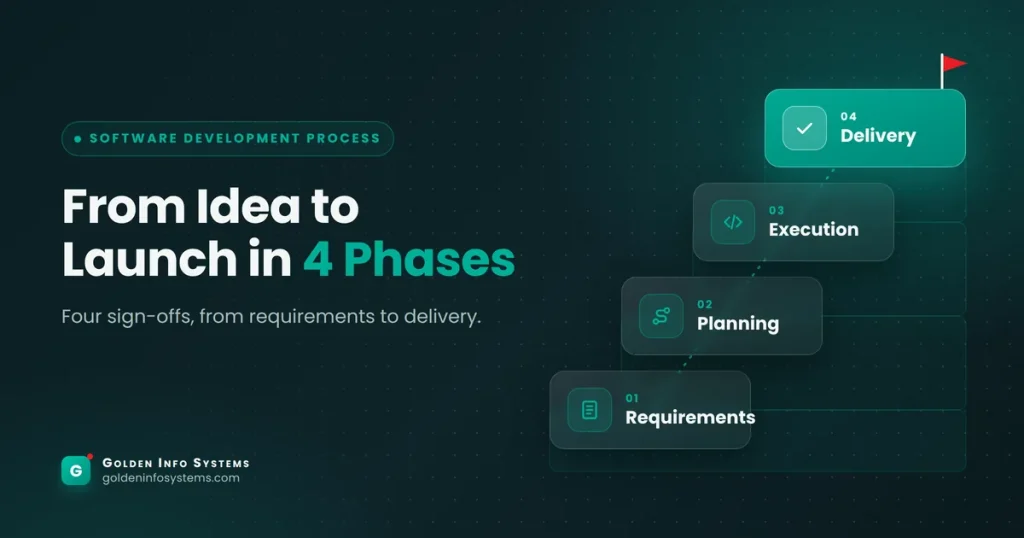
A software development process is the ordered set of steps a team follows to turn a business idea into working, tested software. At Golden Info Systems, our software development process has four phases: Requirements, Planning, Execution, and Delivery. Each phase ends with something you can review and approve before money moves to the next one.
That last point is why the process matters to you as a buyer. Most failed projects don’t fail because of bad code; they fail because nobody agreed on what “done” meant, or because a problem found in month four should have been caught in week two. A clear process gives you checkpoints where you can stop, adjust, or confirm.
This guide walks through each phase of the software development process in detail: what happens, what you receive, how long it usually takes, and what your team needs to prepare. It also covers how our four phases map to the standard software development life cycle, where agile sprints fit, and the mistakes we see most often on projects that arrive at our door already in trouble.
1. What a Software Development Process Is and Why It Affects Your Budget
Every piece of software goes through the same basic stages, whether a team writes them down or not. Someone decides what to build. Someone designs how it will work. Developers write the code, testers check it, and the result goes live and needs support. The software development life cycle (SDLC) is the formal name for this sequence, and most published versions split it into six or seven stages such as planning, analysis, design, coding, testing, deployment, and maintenance.
A documented software development process takes that generic cycle and makes it specific to one team: who does what, which documents get produced, when the client signs off, and how changes are handled. The difference is practical. “We test the software” is a stage. “Every build passes a written test plan, and the client gets a test report before user acceptance testing” is a process.
What a documented process looks like on paper
For a buyer, a documented process usually comes down to five things you can ask to see: a sample requirements document, a sample project plan, the sprint or milestone schedule, the test report format, and the handover checklist. If a vendor can show you anonymized versions of all five, the software development process exists in practice and not only in a sales deck. If they can only describe it verbally, expect each project manager to run things differently.
You should also ask who signs off at each stage. On our projects, the client approves the scope at the end of Requirements, the plan and budget at the end of Planning, each sprint demo during Execution, and the final build after user acceptance testing in Delivery. In agile vocabulary, these approvals line up with the agile software project phases of discovery, planning, iteration, and release; they’re the points where your feedback has the most effect on cost.
Why the process shows up on your invoice
Rework is the most expensive line item in software, and it rarely appears on a quote. When a requirement is misunderstood, the cost of fixing it grows with every phase it survives: a sentence changed in a requirements document takes minutes, while the same change after a feature is built and tested can take days of development and a new round of QA.
A good software development process can’t remove change. It moves the discovery of change earlier, when it’s cheap. That’s the main reason we put so much weight on the first two phases, even though clients are often eager to see code on day one.
Process and security
Security also depends on your software development process. The U.S. National Institute of Standards and Technology notes in its Secure Software Development Framework (NIST SP 800-218) that few SDLC models explicitly address software security in detail, which is why it recommends adding secure development practices to each phase. In plain terms: if security review isn’t written into your process, it tends to happen at the end, when fixing a design flaw is hardest.
2. The Four Phases of Our Software Development Process
Our four phases are the ones listed on our homepage, and they’re deliberately simple. Each one has a clear owner, clear outputs, and a sign-off, which keeps the software development process readable for people who don’t write code. Here’s what happens inside each phase.
Phase 1: Requirements (understanding the problem)
We start with detailed discussions and consultations to gather everything we need to know about your business, your users, and the problem the software must solve. This is the phase most teams rush. We don’t.
Typical activities in this phase:
- Stakeholder interviews with the people who will pay for, use, and support the software
- A walkthrough of your current workflow, including spreadsheets, paper forms, or legacy tools you want to replace
- A list of user roles (for example: admin, branch manager, customer) and what each role can do
- Functional requirements written as user stories, such as “As a branch manager, I can approve refunds under 5,000 BDT”
- Non-functional requirements: expected number of users, response time targets, data retention, hosting preferences, and compliance needs
- Integration points with payment gateways, SMS providers, ERP systems, or third-party APIs
The output is a requirements document (sometimes called a software requirements specification) plus a prioritized feature list. We tag each feature as must-have, should-have, or later. That tagging is what makes the next phase possible, because it tells us where the budget line should fall.
If you’re still deciding whether a custom build is the right move at all, our guide on custom software vs off-the-shelf is worth reading before this phase starts.
Phase 2: Planning (turning requirements into a roadmap)
Planning converts the approved requirements into a project roadmap, and it’s the stage of the software development process where cost becomes predictable. This is where we choose the technology, design the system architecture, and break the work into milestones with dates.
The main outputs of planning are:
- Technology stack recommendation, with reasons (for example, Flutter for a single codebase across Android and iOS, or React with a Python backend for a data-heavy web portal)
- System architecture diagram showing the database, services, APIs, and hosting setup
- Wireframes or clickable prototypes of the key screens, so you can react to layout and flow before any code exists
- A milestone plan that groups features into releases, usually with a first usable version as early as possible
- A written estimate of effort, cost, and timeline, tied to the feature list from Phase 1
- A risk register listing what could delay the project (third-party API access, content from your side, approvals) and how we’ll handle each risk
Planning is also where the engagement model gets settled. A fixed-scope project needs a tightly defined feature list here. A time-and-material or dedicated-team project can keep more flexibility, but it still needs a prioritized backlog. We explain how budgets are built from this plan in how much custom software development costs.
Phase 3: Execution (design, development, and engineering)
Execution is the phase people picture when they think of software development. Designers produce final UI screens, developers build the features, and the team integrates everything into a working system. We work in short iterations and share regular updates, so you see progress as it happens rather than at the end.
This is where agile methods fit inside our software development process. Most execution work runs in sprints. The 2020 Scrum Guide defines a sprint as one month or less, with a 15-minute daily scrum, and it caps sprint planning at eight hours for a one-month sprint. In practice, we find two-week sprints give clients a good balance between frequent demos and enough time to finish meaningful features.
A typical sprint inside Execution looks like this:
- Sprint planning: the team picks the highest-priority items from the backlog
- Daily stand-ups: short check-ins on progress and blockers
- Development with code review: no code merges without a second developer reading it
- Continuous testing: QA engineers test features as they’re finished, not in one batch at the end
- Sprint review: a demo of working software to you, followed by feedback
- Retrospective: the team looks at what slowed it down and fixes that for the next sprint
This structure is how agile software project phases work in real life, as opposed to the textbook version. The big phases (Requirements, Planning, Execution, Delivery) stay in order, while the work inside Execution loops in short cycles. You get the predictability of a phased plan and the flexibility to reorder features after each demo.
Phase 4: Delivery (testing, launch, and handover)
Delivery is the last phase of the software development process. It covers final testing, quality assurance against the agreed standards, deployment to the live environment, and handover. Our homepage describes this phase as testing and quality assurance to make sure the software meets the required standards, and that’s where most of the effort goes.
Delivery usually includes:
- Full regression testing of all features, not only the ones built in the last sprint
- Performance and load checks against the targets set in Phase 1
- Security checks such as input validation, authentication, and access control reviews
- User acceptance testing (UAT), where your team tests with real scenarios and signs off
- Deployment to production, including domain, SSL, database migration, and backups
- For mobile apps, store submission to Google Play and the Apple App Store
- Handover of source code, credentials, admin guides, and training for your staff
- A support period for bug fixes after launch
Testing deserves its own attention, since skipping it is one of the fastest ways to lose users. We’ve written about why dedicated QA testers change the outcome of a project.
How the four phases map to the software development life cycle
Our four phases are a client-friendly grouping of the standard software development life cycle. Requirements covers SDLC analysis. Planning covers SDLC planning and design. Execution covers design completion, coding, and in-sprint testing. Delivery covers final testing, deployment, and the start of maintenance.
We use four phases instead of seven because each one ends with a decision you make. Seven stages are useful for engineers; four sign-off points are easier for a business owner to manage.
3. Comparison Table: What Each Phase Delivers and Who Does What
The table below summarizes the requirements to delivery process. Time shares are our estimates for a mid-sized custom web or mobile project; your project may differ depending on scope, integrations, and how quickly approvals come back.
| Phase | Main activities | What you receive | Your role | Estimated share of timeline |
|---|---|---|---|---|
| Requirements | Interviews, workflow review, user stories, non-functional requirements | Requirements document, prioritized feature list | Provide access to stakeholders, answer questions, approve scope | 10 to 15% |
| Planning | Tech stack choice, architecture, wireframes, estimates, risk register | Architecture diagram, prototype, milestone plan, written estimate | Review prototype, approve plan and budget | 10 to 15% |
| Execution | UI design, sprint-based development, code review, continuous QA | Working builds and sprint demos every one to two weeks | Attend demos, give feedback, supply content and API access | 50 to 60% |
| Delivery | Regression testing, UAT, deployment, store submission, training | Live software, source code, documentation, test reports | Run UAT, sign off, prepare your team for launch | 15 to 20% |
Choosing a delivery model: waterfall, agile, or phased hybrid
Your software development process also depends on the model behind it. Here’s how the common options compare for a typical business project.
| Model | How it works | Best for | Main risk |
|---|---|---|---|
| Waterfall | Each stage finishes fully before the next begins | Small, well-defined projects with fixed rules (for example, a regulatory report) | Late discovery of problems; changes are expensive |
| Pure agile (Scrum) | Work runs in repeated sprints with a living backlog | Products with uncertain requirements and an engaged product owner | Budget and end date can drift without firm priorities |
| Phased hybrid (our approach) | Fixed phases with sign-offs; sprints inside Execution | Most custom business software, apps, and portals | Needs discipline at each sign-off to stay on track |
The Agile Manifesto, published in 2001, values “responding to change over following a plan.” A phased hybrid respects that value inside Execution while still giving finance teams the milestones and budget control they need.
4. A Step-by-Step Checklist for Your Next Software Project
You can use this checklist to test any vendor’s software development process, not only ours. Work through it before signing a contract and at each phase gate.
Before the project starts
- Write one paragraph describing the business problem, not the solution
- List the people who will use the software and what each group needs to do
- Collect the documents, spreadsheets, and screenshots of your current process
- Decide who on your side can approve scope and budget (one person is ideal)
- Set a realistic budget range and a hard launch date if one exists (a trade fair, a regulatory deadline, a season)
At the end of Requirements
- Does every must-have feature have a written description a new team member could understand?
- Are non-functional needs covered: number of users, speed, hosting, backups, data privacy?
- Are integrations listed with the name of each external system and who owns access?
At the end of Planning
- Have you clicked through a prototype of the most-used screens?
- Do you understand why the recommended technology was chosen?
- Is the estimate tied to specific features, so you can see what changes if you cut one?
- Is there a written change-request process with cost and time impact shown before approval?
During Execution
- Are you seeing a working demo at least every two weeks?
- Do you have access to a staging environment where you can try features yourself?
- Is feedback logged and answered in writing, rather than only discussed in calls?
Before Delivery sign-off
- Has your team run UAT with real data and real scenarios?
- Do you have the source code, admin credentials, and hosting access in your own name?
- Is there a written support period, and do you know how to report a bug?
A vendor that answers these questions easily probably has a mature software development process. One that avoids them is telling you something too.
5. Common Mistakes That Derail the Requirements to Delivery Process
We’ve taken over projects from other teams, and the same problems appear again and again. None of them are about programming skill; they’re gaps in the software development process itself.
Skipping or shortening Requirements
Starting development after a single meeting feels fast. It usually costs more time later, because the team builds from assumptions. If your vendor quotes a fixed price after one call, ask what happens when their assumptions turn out to be wrong.
Treating the prototype as optional
A clickable prototype costs a small fraction of development and catches layout and flow problems before code exists. Clients who skip it often request screen changes during Execution, which is where changes are slowest.
Too many decision-makers
When five people on the client side can each approve or reject features, sprints stall. Pick one product owner with authority, and let others feed their input through that person.
Leaving testing to the final week
Testing only at the end means bugs pile up and interact with each other. Continuous QA during each sprint keeps the defect count low and makes the Delivery phase predictable.
No plan for content, data, and access
Projects often wait on the client, not the developers: product photos, translated text, data migration files, or API keys from a payment provider. List these in Planning with owners and due dates.
Ignoring life after launch
Software needs updates for operating system changes, security patches, and new features. Budget for support and maintenance from the start, and make sure the handover includes documentation your future team can use.
Scope changes without a change process
Changes are normal in any software development process. Unrecorded changes are the problem. Every change should be written down with its effect on cost and timeline, then approved before work begins.
6. How Golden Info Systems Runs the Software Development Process
At Golden Info Systems, we’ve followed this four-phase software development process across 850+ completed projects over more than 12 years. We’re a BASIS member company based in Dhaka, Bangladesh, and we’re also members of the Bangladesh Computer Samity, DevEx, and e-CAB. Our work is done by a 100% in-house team, with no freelancers, which keeps communication direct and accountability clear.
Here’s how we apply each phase in practice:
- Requirements: we hold consultation sessions with your stakeholders and gather everything needed before proposing a solution. You receive a written scope you can review line by line.
- Planning: we create a project roadmap, pick the technology, and show you screens before development. Our stack includes Java, Python, React, Angular, Vue.js, CodeIgniter, Flutter, Dart, Swift, and Ionic, so the recommendation fits the project instead of the other way around.
- Execution: our designers, developers, and engineers build in iterations and send you regular updates. You see working software throughout the project.
- Delivery: we test and run quality assurance against the agreed standards, deploy, and hand over with training and support.
We use the same process across our software development services, which cover consulting, custom software, enterprise software, software product development, custom CRM development, and software integration and APIs. It also carries over to our web development, mobile app development, UI/UX design, and AI solutions work, and to our own products such as G-CRM Study Abroad and G-Association.
We don’t promise that a project will have zero surprises. We promise that surprises get written down, priced, and approved by you before they change the plan.
7. Frequently Asked Questions
What are the main phases of the software development process?
At Golden Info Systems, the software development process has four phases: Requirements, Planning, Execution, and Delivery. Requirements defines what the software must do and for whom. Planning turns that into an architecture, prototype, timeline, and estimate. Execution covers design and development in short sprints with regular demos. Delivery covers final testing, user acceptance testing, deployment, and handover. Each phase ends with a sign-off, so you approve the outputs before the next phase begins and before more budget is committed.
How is the software development life cycle different from a software development process?
The software development life cycle is the general model most teams share: planning, analysis, design, coding, testing, deployment, and maintenance. A software development process is one team’s specific way of running that cycle, including who does each task, which documents are produced, how clients approve work, and how changes are handled. Think of the SDLC as the map and the process as the route a particular team drives. Two vendors can follow the same SDLC and still deliver very different experiences.
How long does each phase take?
It depends on scope, but for a mid-sized web or mobile project our estimate is roughly 10 to 15% of the timeline for Requirements, 10 to 15% for Planning, 50 to 60% for Execution, and 15 to 20% for Delivery. A small internal tool might finish all four phases in a couple of months, while a platform with many integrations can take much longer. Slow approvals and missing content from the client side are the most common causes of delay, so plan your own team’s availability too.
Is your process agile or waterfall?
It’s a phased hybrid. Our software development process runs four phases in order with sign-offs. This gives you budget control and clear milestones. Inside Execution, the work runs in agile sprints, usually two weeks long, with a demo at the end of each one. The 2020 Scrum Guide caps sprints at one month, so two weeks sits comfortably inside that rule. This setup lets you reorder features after each demo without losing sight of the overall plan and launch date.
What do I need to prepare before the Requirements phase?
Prepare a short description of the business problem, a list of the people who will use the software, and examples of your current process, such as spreadsheets, forms, or screenshots. Decide who on your side has authority to approve scope and budget. Note any hard deadlines and any systems the software must connect to, like a payment gateway or an ERP. With these ready, the first phase of the software development process moves faster, and the scope document we produce will be far more accurate.
What happens if requirements change during development?
Changes are expected in every software development process. We handle them through a written change-request procedure. When you ask for something new or different, we describe the change, estimate its effect on cost and timeline, and wait for your approval before starting. Small changes often fit into the next sprint by swapping out a lower-priority item. Larger ones may move to a later release. This keeps the budget honest and stops scope from growing quietly in the background.
Do I own the source code at the end?
Ownership terms are set in the contract, so confirm them before signing with any vendor, whatever their software development process looks like. In our Delivery phase, handover includes the source code, admin credentials, hosting access, and documentation, so your team or another vendor can maintain the software later. We recommend keeping domains, hosting accounts, and app store accounts registered in your company’s name from the start, which avoids access problems if you ever change partners.
8. Practical Next Step
Before you talk to any vendor, write down your problem in one paragraph and list your five must-have features. Then send that list to our team through the Golden Info Systems contact page and ask for a Requirements consultation. We’ll reply with the questions we’d need answered to scope your project, which gives you a clear view of how our software development process would apply to your idea before you commit a single taka to development.