





Custom software development cost for most business projects lands between about $10,000 for a small internal tool and $300,000 or more for a multi-module platform, and the number you get is almost always hours multiplied by a blended hourly rate. A focused tool usually needs 400 to 900 hours of work. A mid-size system with several user roles and integrations needs 900 to 2,500 hours, and the rate you pay for those hours can differ by a factor of four depending on where the team sits.
That’s the short answer. The useful answer is the math behind it, because once you can see the hours by phase, you can compare quotes properly and cut scope in the right places instead of the wrong ones.
This guide gives you that math: the seven factors that move the price, a cost table by project size, a fully worked (hypothetical) example with line items, an eight-step method for your own estimate, and the hidden costs most quotes leave out. We wrote it from the vendor side of the table, so we’ll also tell you where agencies tend to pad a number.
1. What Custom Software Development Cost Really Covers
A quote for custom software is a forecast of effort. It isn’t a product price, because nothing exists yet; the vendor is estimating how many hours a team will spend turning your requirements into working, tested, deployed code.
The formula behind every quote
Strip away the formatting and every quote reduces to this:
- Total cost = estimated hours × blended hourly rate + third-party costs + contingency
Estimated hours cover discovery, design, development, testing, project management and deployment. The blended rate averages the seniority mix on the team (a senior architect, two mid-level developers, a QA engineer). Third-party costs are things like cloud hosting, paid APIs, SMS gateways and app store fees. Contingency is a buffer, usually 10% to 20%, for the unknowns that surface once real users touch the product.
When a vendor won’t show you hours, ask for them. A fixed price with no hour breakdown tells you nothing about what you’re paying for.
Why the same idea gets quotes from $20,000 to $200,000
Two things create the spread. First, vendors read the same brief differently: one assumes a simple admin panel, another assumes role-based permissions, audit logs and an API for a future mobile app. Second, rates vary hugely by region and seniority.
So a wide spread doesn’t mean someone is lying. It usually means the brief is vague. The fix is a tighter scope document, which we cover in section 4.
What a trustworthy quote includes
Before you compare prices, check that each proposal gives you the same building blocks. A quote you can actually judge contains:
- Hours per phase (discovery, design, development, QA, project management, deployment)
- The team: roles, seniority and whether each person is full-time on your project
- A list of assumptions, such as “client supplies API credentials” or “no data migration”
- What’s excluded (hosting, third-party licenses, content entry, post-launch support)
- A payment schedule tied to milestones you can verify
- A warranty period for fixing defects after launch, commonly 30 to 90 days
If two quotes differ on custom software development cost by 50% and one of them skips the assumptions list, the cheaper number probably isn’t describing the same product.
2. The Seven Factors That Drive Software Development Pricing
Every serious approach to software development pricing comes back to the same drivers. Here they are in rough order of impact, with the kind of hour ranges we see on real projects so you can judge how much each one moves your custom software development cost.
Scope: screens, user roles and features
Scope is the biggest lever. A useful proxy is the number of distinct screens plus the number of user roles. An internal tool with 10 screens and one role is a very different job from a portal with 40 screens, a customer role, a staff role and a manager role, each seeing different data.
Count features as verbs. “Users can export invoices to PDF” is one feature; “users can manage invoices” hides at least six.
Business logic and integrations
Logic is where hours quietly pile up. Pricing rules, approval chains, tax calculations and inventory reservations all need edge cases handled and tested.
Integrations add their own weight. Connecting to a well-documented REST API with a sandbox might take 20 to 40 hours. Connecting to an old on-premise ERP with no documentation can take 150 hours, and most of that time goes into reverse-engineering the data format.
Design depth
Design ranges from using a component library (Material UI, Ant Design) with light branding to a fully custom interface with user research, wireframes, clickable Figma prototypes and usability testing. The first might be 5% to 8% of the budget. The second is closer to 12% to 15%, and for customer-facing products it’s usually worth it.
Platforms
Each platform multiplies part of the work. A responsive web app is one codebase. Adding iOS and Android apps with a cross-platform framework such as Flutter or React Native adds roughly 30% to 60% more front-end effort, while two separate native apps (Swift and Kotlin) can nearly double it. The back end is shared, which is why the increase isn’t a clean 2x or 3x.
Data migration
If you’re replacing spreadsheets or an old system, someone has to clean, map and import that data. Teams underestimate this constantly. Ten years of customer records with duplicates, inconsistent date formats and free-text fields can easily take 60 to 120 hours to migrate safely.
Security and compliance
A basic login with hashed passwords is standard. Two-factor authentication, role-based access control, encryption at rest, audit trails and penetration testing are not free. If you handle payments or health records, budget for compliance work (PCI DSS for card data, for example) early, because retrofitting it later costs more than building it in.
Team location and seniority
Rates follow local salaries. The U.S. Bureau of Labor Statistics puts the median pay for software developers, QA analysts and testers at $134,040 per year, or $64.44 per hour, as of May 2025. That’s wage, not billing rate. Agencies add benefits, office costs, idle time between projects and margin, so U.S. agency rates commonly sit well above $100 per hour.
Offshore teams in South Asia, including Bangladesh, typically bill a fraction of that (in our experience, roughly $20 to $40 per hour for a blended team). Lower rates only save money when the team’s process is solid; a cheap team that needs twice the hours isn’t cheap. If you’re weighing this option, our guide on outsourcing software development to Bangladesh covers time zones, contracts and vetting.
3. Custom Software Development Cost by Project Size
The table below turns hours into money at three illustrative blended rates. The hour ranges are our estimates from typical projects; the rates are rough market bands, not quotes. Use it to sanity-check any number you receive.
| Project size | Typical examples | Estimated hours | At $25/hr (offshore, South Asia) | At $50/hr (mid-market nearshore) | At $120/hr (U.S. or Western Europe agency) |
|---|---|---|---|---|---|
| MVP or prototype | Single workflow, one user role, web only | 250 to 500 | $6,250 to $12,500 | $12,500 to $25,000 | $30,000 to $60,000 |
| Small business tool | Booking system, internal dashboard, simple CRM | 400 to 900 | $10,000 to $22,500 | $20,000 to $45,000 | $48,000 to $108,000 |
| Mid-size system | Order management, customer portal with 2 or 3 roles, 2 integrations | 900 to 2,500 | $22,500 to $62,500 | $45,000 to $125,000 | $108,000 to $300,000 |
| Large platform | Multi-module ERP, marketplace, web plus mobile apps | 2,500 to 6,000+ | $62,500 to $150,000+ | $125,000 to $300,000+ | $300,000 to $720,000+ |
Notice how the rate column changes the answer more than the size column in some rows; custom software development cost is as much a question of who builds as what gets built. A mid-size system built offshore can cost less than a small tool built by a U.S. agency.
Where the money goes by phase
Hours don’t all go to coding. On a typical project, the split looks like this:
| Phase | Share of total hours | What you get |
|---|---|---|
| Discovery and requirements | 5% to 10% | Scope document, user stories, acceptance criteria |
| UI/UX design | 8% to 15% | Wireframes, prototype, final screens |
| Development (front end and back end) | 45% to 60% | Working features, APIs, database |
| Quality assurance | 15% to 20% | Test cases, bug fixes, regression testing |
| Project management | 8% to 12% | Sprint planning, reporting, coordination |
| Deployment and DevOps | 3% to 5% | Servers, CI/CD pipeline, go-live support |
If a quote shows QA below 10%, ask why. Testing is the first line that gets squeezed to win a bid, and it’s the one you pay for later.
A worked example: a hypothetical order management system
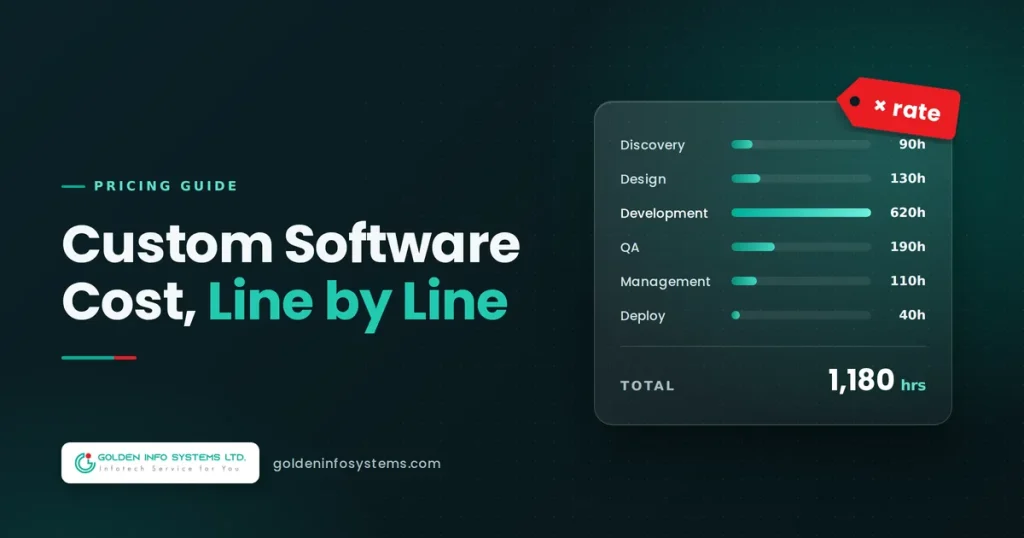
Here’s a clearly hypothetical project so you can see the arithmetic. Picture a mid-size distributor that wants a web-based order management system with three user roles (sales rep, warehouse staff, admin), about 28 screens, an accounting export and SMS order alerts. Web only, responsive on phones.
| Line item | Hours |
|---|---|
| Discovery and requirements workshops | 90 |
| UI/UX design (wireframes, prototype, final screens) | 130 |
| Development (front end, back end, two integrations) | 620 |
| Quality assurance and bug fixing | 190 |
| Project management | 110 |
| Deployment, CI/CD and launch support | 40 |
| Total | 1,180 |
At $25 per hour that’s $29,500. At $50 it’s $59,000, and at $120 it’s $141,600. Add a 15% contingency and the offshore figure becomes about $33,900.
Then add running costs. Cloud hosting for a system this size is often in the range of $50 to $300 per month, and the SMS gateway charges per message. Plan on 15% to 20% of the build cost each year for maintenance, which here means roughly $4,400 to $5,900 a year at the offshore rate.
What custom software development cost looks like after launch
The build is only the first bill. Over a three-year horizon, the ongoing costs for a system like the example above usually fall into four buckets:
- Hosting and infrastructure: servers, database, backups, domain and SSL certificates
- Third-party services: SMS, email delivery, maps or payment gateway fees, billed by usage
- Maintenance: security patches, dependency and framework upgrades, bug fixes, monitoring
- Enhancements: new reports, extra user roles, small workflow changes requested by staff
Maintenance is predictable and belongs in the budget from day one. Enhancements are optional, so many companies fund them from a separate quarterly allowance rather than folding them into the maintenance contract.
4. How to Build a Software Project Budget Estimate in 8 Steps
You don’t need to be technical to produce a credible software project budget estimate. You need a structured brief and a bit of discipline. Work through these steps before you ask anyone for a quote.
- Write the business goal in one sentence. “Cut order entry time from 15 minutes to 3” is a goal. “Build a modern system” isn’t.
- List user roles. Name every type of person who logs in and what each one must be able to see and do.
- Write features as user stories. Use the format “As a [role], I want to [action] so that [result].” Aim for 30 to 80 stories for a mid-size system.
- Sort stories into must-have, should-have and later. This is the MoSCoW method, and it’s the single best tool for controlling cost. Your first release should contain only the must-haves.
- List every integration. Include the system name, whether it has an API, and who owns access. Unknown integrations are the most common source of budget overruns.
- Describe your data. How many records, in what format, and how messy? Attach a sample file if you can.
- Set a budget range and a deadline. Telling vendors “$30,000 to $45,000, live by March” gets you more honest proposals than hiding the number. Good vendors will tell you what fits inside it.
- Ask every vendor for hours by phase. Compare the phase splits side by side using the table in section 3. Outliers deserve a question, not an automatic rejection.
Once you have three or four quotes in the same format, the comparison takes an afternoon rather than weeks.
Fixed price or time and material?
The pricing model changes who carries the risk. A fixed-price contract works when scope is clear and stable; the vendor carries the overrun risk and prices it in, often with a 15% to 25% buffer. Time and material suits evolving products, because you pay for actual hours and can change priorities every sprint.
Many teams combine them: a fixed-price discovery phase of two to four weeks, then time and material for the build once the scope is solid. A third option, the dedicated team, bills a monthly fee per person and suits long-running products where you want the same developers for a year or more.
5. Common Mistakes That Inflate the Cost to Build Business Software
Most overruns aren’t caused by bad developers. They come from decisions made before the first line of code. Here are the ones we see most often when a client asks us to review the cost to build business software they’ve already been quoted.
Starting without a scope document
Vague requirements produce vague estimates, and vague estimates grow. If the brief says “user management,” one team builds a login page while another builds invitations, roles, password policies and single sign-on. Agree on a written scope before signing.
Building every feature in version one
Founders often want the full vision at launch. That usually doubles the first budget and delays feedback by months. Ship the must-haves, watch how people use them, then fund the next release with real data.
Picking the lowest bid without checking hours
A quote that’s 40% below the others either assumes less scope, less testing or a very junior team. Ask for the hour breakdown. If QA is missing or development hours look impossibly low, you’ve found the reason.
Paying most of the budget upfront
A payment schedule protects both sides only when it follows delivered work. Paying 50% or more before any design is approved leaves you with little say if the project slips. A healthier pattern is a modest deposit (often 20% to 30%), then payments tied to milestones you can check yourself: approved designs, a working staging build, completed user acceptance testing and go-live.
Ignoring maintenance and hosting
Software keeps costing money after launch: security patches, operating system updates, framework upgrades, server bills and small feature requests. The common planning rule is 15% to 20% of the original build cost per year. Leave it out and the system slowly decays.
Treating quality as optional
Poor quality is expensive at national scale, not only project scale. The Consortium for Information and Software Quality estimated the cost of poor software quality in the US at no less than $2.41 trillion in its 2022 report, with accumulated technical debt of around $1.52 trillion. On a single project, that shows up as bugs found by customers, rushed hotfixes and a rewrite two years early.
Choosing custom when a subscription would do
Sometimes the right answer is to not build at all. If an existing product covers most of your workflow, a subscription can be cheaper and faster. We compare both paths, with a five-year cost example, in custom software vs off-the-shelf.
6. How Golden Info Systems Prices and Delivers Custom Software
At Golden Info Systems, we price projects the way this guide describes: hours by phase, a named team, and a clear list of what’s included and what isn’t. We’ve been building software for 12+ years, have completed 850+ projects, and work with a 100% in-house team rather than freelancers. We’re members of BASIS, the Bangladesh Computer Samity and e-CAB.
We also put every assumption in writing. If your custom software development cost estimate depends on an API you haven’t confirmed, the proposal says so, along with the hours it would add if that API turns out to be missing or undocumented.
Our custom software development services cover consulting, enterprise systems, software product development, custom CRM development, and software integration and APIs. Our stack includes Java, Python, React, Angular, Vue.js, Flutter and Swift, so we can match the technology to your budget instead of forcing one framework onto every project.
Every engagement follows the same four phases:
- Requirements. We run discovery sessions with your team to turn goals into user stories, roles and integrations, then agree on scope in writing.
- Planning. We produce the estimate with hours per phase, choose the architecture and tech stack, and build a release plan that puts must-haves first.
- Execution. Our designers, developers and engineers build in short sprints, with a working demo you can click at the end of each one.
- Delivery. We finish with structured testing and quality assurance, deploy to production, and hand over documentation and access.
If your project includes mobile apps, our breakdown of app development cost in Bangladesh goes deeper on iOS, Android and cross-platform pricing.
7. Frequently Asked Questions
How much does custom software development cost?
For most business projects, custom software development cost ranges from about $10,000 for a small internal tool to $300,000 or more for a large platform. The deciding factors are the number of hours (driven by screens, user roles, integrations and data migration) and the blended hourly rate, which varies by region and seniority. A mid-size system of 900 to 2,500 hours costs roughly $22,500 to $62,500 with an offshore team at $25 per hour, or several times that with a U.S. agency.
How do you estimate software development cost?
Break the project into user stories, estimate hours for each, then add design, testing, project management and deployment as separate phases. Multiply the total hours by the blended hourly rate and add third-party costs such as hosting and paid APIs. Finish with a 10% to 20% contingency for unknowns. Teams often estimate a few similar past projects first (analogy estimating), then refine with a bottom-up estimate once the scope is written down.
How much does it cost to outsource software development?
Outsourcing cost depends mainly on the destination’s rates and the team’s efficiency. Offshore teams in South Asia commonly bill around $20 to $40 per hour for a blended team, while U.S. agencies often charge above $100. For a 1,180-hour project like our hypothetical example, that’s the difference between about $29,500 and $141,600. Factor in time spent on communication and reviews, and choose a vendor with a documented process, not only the lowest rate.
How can you reduce the cost of a custom software project?
Cut scope, not quality. Launch with must-have features only, use proven component libraries for the interface, and pick a cross-platform framework if you need mobile apps. Settle integrations and data formats before development starts, since unknowns there cause most overruns. Choose time and material billing for evolving products so you only pay for work that happens. Avoid removing QA hours, because bugs found after launch cost more to fix than bugs found in testing.
Are software development costs capitalized?
Often, yes, but it depends on your accounting framework and the project stage. Under U.S. GAAP (ASC 350-40 for internal-use software) and IFRS (IAS 38), costs from the development stage can usually be capitalized as an intangible asset, while early research and post-launch maintenance are generally expensed. The rules differ in detail, so ask your accountant how they apply to your company before you finalize the software project budget estimate. This isn’t tax or accounting advice.
How long does custom software take to build?
Timelines follow hours and team size. A 400-hour MVP with a team of three can ship in six to ten weeks. A 1,200-hour mid-size system usually takes four to six months including discovery and testing, while large platforms run nine months or longer, often released in stages. Adding more developers shortens the timeline only up to a point, because coordination overhead grows with every person added to the team.
Why do software development quotes vary so much between vendors?
Quotes vary because vendors assume different scope and charge different rates. One team may price a basic admin panel while another includes permissions, audit logs and an API, and rates can range from about $25 to over $120 per hour. Ask each vendor for hours by phase plus a written list of assumptions and exclusions. Once every proposal uses the same format, the real differences in software development pricing become easy to spot and question.
8. Practical Next Step
Before you request any quote, spend one hour writing down your user roles, your must-have features as user stories, and every system the software needs to connect to. That single page will make your custom software development cost estimate far more accurate, whoever builds it. When it’s ready, send it to our team for a free, itemized estimate with hours by phase, and we’ll reply with a breakdown you can compare line by line against any other proposal.