





Have you ever wondered what powers the incredibly smart AI systems you use every day, from the chatbots that answer your questions to the algorithms that recommend your next favorite movie? The secret isn’t just clever code; it’s the raw, unimaginable computing power hidden away in massive data centers. And right now, one company is making a massive play to dominate that hidden world.
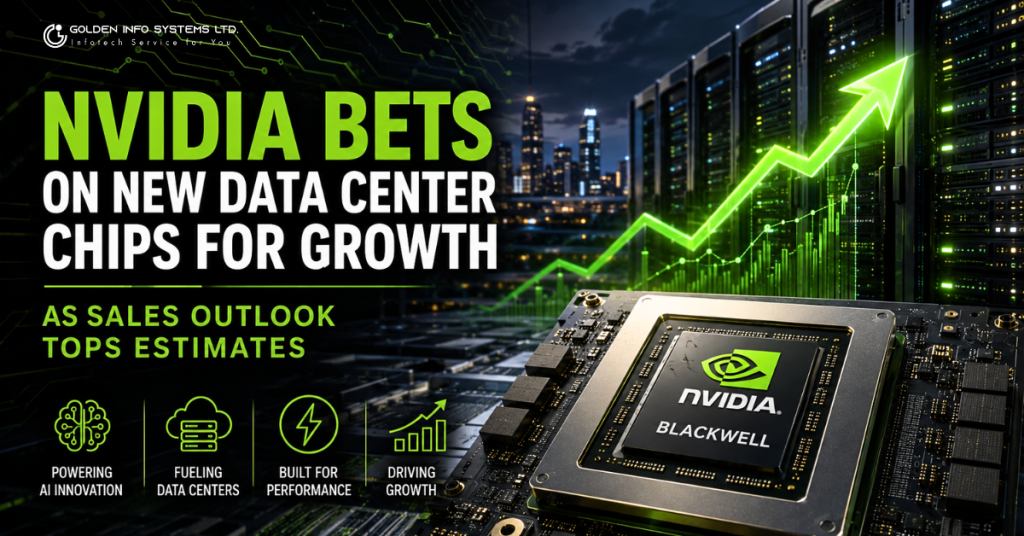
Welcome to the exciting, high-stakes world of AI hardware, where Nvidia bets on new data center chips for growth as sales outlook tops estimates. If you’ve been following the tech world, you know Nvidia isn’t just a gaming company anymore. They are the engine room of the artificial intelligence revolution. Let’s dive deep into why this move is so crucial, what these new chips mean for you, and why the tech world is watching so closely.
What Are Nvidia’s New Data Center Chips?
When we talk about Nvidia’s new data center chips, what exactly are we looking at? If you are picturing the standard processor sitting inside your home laptop, think again. These new chips are massive, incredibly sophisticated engines built for one specific purpose: accelerating artificial intelligence.
At the heart of this lineup is the GPU (Graphics Processing Unit). While traditional CPUs are great at handling complex instructions one by one, Nvidia’s data center GPUs are designed to handle thousands of smaller tasks all at once. This “parallel processing” is exactly what AI models need to learn and generate text, images, or code.
Currently, the crown jewel you hear about most often is the H100 (based on the “Hopper” architecture). It is the powerhouse behind the current generative AI boom. However, Nvidia recently revealed their next generation: the Blackwell architecture (including the B200 and GB200 “superchips”). These new Blackwell chips pack literally hundreds of billions of transistors and are designed to train massive AI models significantly faster and more energy-efficiently than the H100.
So, when you see that Nvidia is betting big on these new chips, they are essentially betting on their Blackwell generation to become the new, undisputed brain of the global internet.
Is the Future of AI Resting on a Single Chip?
Right now, it might seem like the entire AI revolution is balancing on a very small, incredibly complex piece of silicon. When you look at the major tech giants—from the creators of ChatGPT to the biggest cloud service providers—they all share one massive bottleneck: an insatiable appetite for Nvidia’s GPUs. But is the entire future of artificial intelligence really resting on a single chip?
In the short term, it certainly looks that way. The current generative AI boom was largely made possible by the staggering capabilities of Nvidia’s hardware, specifically the H100 GPU. Entire industries are queuing up, sometimes waiting months, just to get their hands on this specific processor.
However, resting the future on a single point of failure presents massive challenges. If a single chip design is the only path forward, it severely limits how fast and how affordably AI can scale across the globe. This intense reliance is exactly why Nvidia is constantly innovating—they know they cannot rely on yesterday’s silicon. It is also why the tech world is desperately seeking alternatives. While the future of AI might currently revolve around Nvidia’s flagship chips, the ultimate goal for the industry is a diverse ecosystem of specialized hardware.
The Power Shift: Why Nvidia Bets on New Data Center Chips for Growth as Sales Outlook Tops Estimates
You might remember Nvidia primarily for making your PC games look stunning. But today, their focus has expanded far beyond your desktop monitor. The real action—the massive, world-changing action—is happening in data centers.
These data centers are the brains behind cloud computing, enterprise-level AI, and deep learning models. And they are hungry for power. They don’t just need fast processors; they need processors specifically designed to handle the complex, parallel calculations that AI requires.
This is exactly where Nvidia saw an opportunity. They realized that traditional CPUs (Central Processing Units), while great for general tasks, couldn’t keep up with the demands of training massive AI models. They needed something different. They needed GPUs (Graphics Processing Units) that were reimagined for a new purpose.
By developing specialized data center chips, Nvidia isn’t just updating its product line; it’s redefining the entire landscape of computing. They are betting that the future of technology relies on these specialized chips, and their recent sales figures suggest they are right on the money. The market’s response has been overwhelmingly positive, proving that Nvidia bets on new data center chips for growth as sales outlook tops estimates is more than just a headline; it’s a solid business strategy.
The Technology Behind the Bet: What Makes These Chips So Special?
So, what exactly is under the hood of these new data center chips? Let’s break down the complex technology into something easier to understand.
The Architecture of the Future
Imagine you are trying to solve a massive puzzle. A traditional CPU is like one incredibly fast person trying to put the pieces together one by one. It’s quick, but it takes time.
An Nvidia data center GPU, on the other hand, is like thousands of people working on different parts of the puzzle simultaneously. This parallel processing architecture is what makes these chips so devastatingly effective for AI workloads.
They are designed from the ground up to handle massive amounts of data at once. This involves specialized cores, high-bandwidth memory, and sophisticated interconnect technologies that allow multiple chips to communicate at lightning speeds.
From Hopper to Blackwell: The Evolution Continues
Nvidia’s strategy isn’t a one-and-done deal. It’s a continuous cycle of innovation. You might have heard of their “Hopper” architecture, which powered the incredibly successful H100 chip—the gold standard for AI training.
But Nvidia isn’t resting on its laurels. They are constantly pushing the boundaries. Their newest architectures, like the recently announced “Blackwell,” promise even greater leaps in performance, energy efficiency, and scalability. These aren’t just incremental updates; they are massive generational leaps designed to tackle problems that were previously thought unsolvable.
Energy Efficiency: The Hidden Challenge
When you think about supercomputers, you probably picture massive racks of servers generating tons of heat. Energy consumption is a critical issue in data centers. It’s not just about raw power; it’s about efficient power.
Nvidia knows this. Their new chips are designed to deliver more performance per watt than ever before. This is crucial for businesses that want to scale their AI operations without breaking the bank on electricity bills or causing a localized meltdown. It’s a key reason why data center operators are so eager to get their hands on these new processors.
Why Does This Matter to You?
You might be thinking, “This is all fascinating, but I don’t run a data center. Why should I care about Nvidia’s new chips?”
The truth is, these chips are the foundation of the technology you interact with every single day. Here’s how Nvidia’s bet impacts your life:
1. Smarter, Faster AI Tools
Whether you use AI for writing assistance, generating images, or analyzing data for work, the speed and capability of those tools rely entirely on the hardware they run on. Nvidia’s new chips mean developers can create more complex, more intelligent, and more responsive AI models. That means better tools for you.
2. Better Recommendations and Personalization
When a streaming service suggests a show you end up binge-watching, or an online store recommends a product you actually want, that’s AI at work. The algorithms behind these systems require immense computing power to analyze your preferences and behavior. Faster data center chips lead to more accurate and personalized experiences.
3. Advancements in Healthcare and Science
This is perhaps the most exciting impact. AI is revolutionizing drug discovery, medical imaging analysis, and genomics research. The immense computational power provided by Nvidia’s new chips allows scientists to simulate complex biological processes and analyze vast datasets much faster than before. This could lead to breakthroughs in treating diseases and understanding the human body.
4. The Future of Autonomous Vehicles
Self-driving cars rely on sophisticated AI to interpret their surroundings in real-time. This requires processing enormous amounts of data from sensors and cameras instantly. Nvidia’s technology is playing a crucial role in making these systems safer and more reliable.
The Ripple Effect: How Nvidia’s Strategy Impacts the Tech Industry
Nvidia isn’t operating in a vacuum. Their success or failure sends shockwaves through the entire technology ecosystem. Let’s look at how their bet on data center chips is changing the game for everyone else.
The Cloud Computing Arms Race
Major cloud providers like Amazon Web Services (AWS), Microsoft Azure, and Google Cloud are locked in a fierce competition to offer the best AI services to their customers. To do that, they need the best hardware.
This has created a massive demand for Nvidia’s chips. These cloud giants are essentially fighting over allocation, driving up sales and solidifying Nvidia’s position as the arms dealer of the AI revolution. If you are building an AI application today, chances are you are running it on a cloud server powered by an Nvidia GPU.
The Challenge to Competitors
Nvidia’s dominance hasn’t gone unnoticed. Competitors like AMD and Intel are scrambling to catch up. They are developing their own specialized AI chips, hoping to offer alternatives to data centers looking for better pricing or different features.
However, Nvidia has a significant advantage: their software ecosystem. The CUDA (Compute Unified Device Architecture) platform has become the industry standard for AI development. Millions of developers are trained on it, and countless software libraries are optimized for it. This “moat” makes it incredibly difficult for competitors to simply introduce a faster chip and expect everyone to switch. They have to overcome the immense inertia of Nvidia’s software dominance.
The Rise of Custom Silicon
Interestingly, the massive cost and high demand for Nvidia’s chips have prompted some large tech companies, like Google and Amazon, to develop their own custom AI processors (like Google’s TPUs).
While this represents a potential threat to Nvidia, the overall market for AI computing is growing so fast that there is currently room for multiple players. And Nvidia continues to stay ahead of the curve with relentless innovation in its generalized GPU architectures.
The Investment Perspective: Riding the AI Wave
The financial world has certainly taken notice of Nvidia’s strategic pivot. The fact that Nvidia bets on new data center chips for growth as sales outlook tops estimates has made it one of the most closely watched stocks on the market.
Explosive Revenue Growth
Nvidia’s data center revenue has skyrocketed in recent quarters, often surpassing even the most optimistic analyst predictions. This growth isn’t a blip; it’s a reflection of a fundamental shift in how computing is done at the enterprise level. The transition from traditional servers to AI-accelerated infrastructure is a massive, multi-year trend, and Nvidia is currently capturing the lion’s share of the value.
The Market Capitalization Milestone
This unprecedented growth has propelled Nvidia into the elite club of the world’s most valuable companies. Their market capitalization has soared, reflecting investor confidence in their long-term vision and their ability to execute it.
Risks and Considerations
Of course, no investment is without risk. While Nvidia’s current position seems unassailable, there are factors to consider:
- Supply Chain Constraints: Manufacturing these incredibly complex chips is difficult. Nvidia relies heavily on partners like TSMC (Taiwan Semiconductor Manufacturing Company). Any disruption in the supply chain could impact their ability to meet demand.
- Geopolitical Tensions: The semiconductor industry is deeply intertwined with global politics. Export restrictions, particularly regarding sales to certain countries, could impact Nvidia’s total addressable market.
- Intensifying Competition: As mentioned earlier, competitors are investing heavily. If a rival manages to create a significantly better or more cost-effective solution, Nvidia’s market share could erode.
However, for now, Nvidia is firmly in the driver’s seat. Their strategic foresight and execution have positioned them perfectly for the AI era.
Looking Ahead: What’s Next for Nvidia and Data Centers?
The pace of innovation in the AI hardware space is breathtaking. What is cutting-edge today might be obsolete in a few years. So, where does Nvidia go from here?
AI at the Edge
While the massive data centers are the focus now, Nvidia is also looking at “edge computing”—processing data closer to where it’s generated, like in a factory, a hospital, or a retail store. This requires smaller, more efficient chips that can still perform complex AI tasks. Expect to see Nvidia pushing aggressively into this space.
The Software Defined Future
Nvidia knows that hardware is only half the battle. They are investing heavily in software solutions, creating entire platforms for specific industries like healthcare (Clara), robotics (Isaac), and automotive (Drive). By offering a complete hardware and software stack, they make themselves even more indispensable to their customers.
The Metaverse and Omniverse
You’ve probably heard of the Metaverse, but Nvidia is building something practical for the enterprise: the Omniverse. It’s a platform for creating and simulating accurate 3D worlds. This has massive implications for manufacturing, architecture, and design. And, you guessed it, it requires immense computing power, driving further demand for their data center chips.
The Bet That Changed the World
When we look back at the history of technology, certain moments stand out as pivotal shifts. The transition to cloud computing was one. The rise of smartphones was another.
We are living through one of those moments right now with the explosion of generative AI. And at the center of this revolution is the hardware that makes it all possible. The fact that Nvidia bets on new data center chips for growth as sales outlook tops estimates is more than just a smart business move; it’s a defining characteristic of our current technological era.
They saw the future before many others did, and they built the tools necessary to bring that future into reality. Whether you are a developer, an investor, or simply someone who uses technology every day, Nvidia’s bet on the data center is a gamble that has already reshaped the world we live in.
Frequently Asked Questions (FAQs)
What exactly is a data center chip, and how is it different from the processor in my laptop?
Your laptop processor (CPU) is a generalist, great at doing many different things quickly in sequence. A data center chip, specifically a GPU designed for AI (like those from Nvidia), is a specialist. It contains thousands of smaller, more efficient cores designed to perform many calculations simultaneously (parallel processing). This makes them exponentially faster at training complex AI models and handling massive datasets, which is what modern data centers require.
Why is Nvidia so dominant in the AI chip market?
Nvidia’s dominance comes from a two-pronged approach. First, they design incredibly powerful hardware (the GPUs themselves). Second, and arguably more importantly, they spent years developing a software platform called CUDA. CUDA allows developers to easily program these GPUs for AI tasks. Because so many developers learned on CUDA and so many tools are built for it, it created a massive “moat” that makes it hard for competitors to catch up, even if they build a comparable chip.
Is Nvidia’s growth sustainable, or is this just a short-term AI bubble?
While the current pace of growth is astonishing, most analysts believe the shift toward AI-accelerated computing is a fundamental, long-term trend, not a short-term bubble. The demand for AI capabilities is permeating every industry, from healthcare to finance to entertainment. As long as the demand for smarter software continues, the demand for the hardware that powers it (Nvidia’s data center chips) is likely to remain strong, though growth rates may eventually normalize.
How do geopolitical issues affect Nvidia’s data center business?
Geopolitics, particularly tensions between the US and China, significantly impact Nvidia. The US government has imposed restrictions on exporting the most advanced AI chips to certain countries to prevent them from being used for military applications. This forces Nvidia to redesign chips specifically for those markets (often with reduced capabilities) and can affect their overall revenue potential in key global regions.
What is the “Blackwell” architecture I keep hearing about?
“Blackwell” is the code name for Nvidia’s newest, upcoming generation of GPU architecture, succeeding the highly successful “Hopper” architecture. It represents their next major leap in performance and efficiency. It is designed to handle even larger, multi-trillion parameter AI models and promises significant improvements in the speed and cost of running massive AI workloads in data centers.