





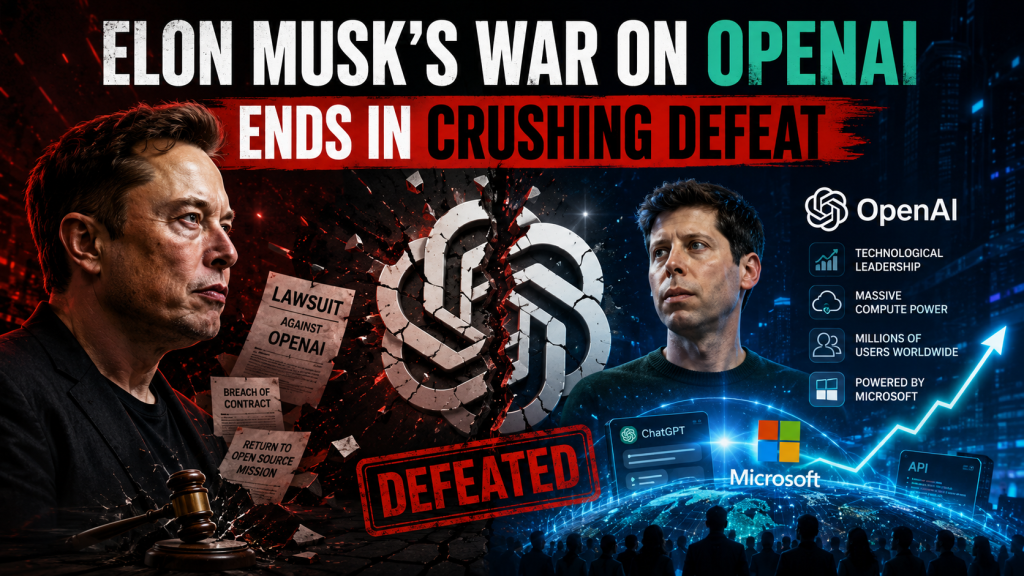
Have you ever wondered what happens when two tech titans clash over the very future of artificial intelligence? The drama between Elon Musk and OpenAI has been a rollercoaster for years, but recent events suggest a definitive turning point. If you’ve been following the saga, you know the stakes couldn’t be higher. In this article, we’re going to dive deep into why Elon Musk’s war on OpenAI ends in crushing defeat, what led to this moment, and what it means for you and the future of AI technology.
The Origins of a Feud
To understand the current situation, you need to look back at the beginning. You might remember that Elon Musk was actually a co-founder of OpenAI back in 2015. The original mission was noble: to develop artificial general intelligence (AGI) in a way that is safe and beneficial for all of humanity. It was meant to be a non-profit, open-source counterbalance to massive tech corporations.
However, things quickly grew complicated. You see, the cost of developing cutting-edge AI is astronomical. Computing power and top-tier talent don’t come cheap. Disagreements arose about the direction and funding of the organization. Musk eventually departed OpenAI in 2018, citing potential conflicts of interest with Tesla’s own AI ambitions, though reports suggest he also disagreed with the leadership and the pace of development under Sam Altman.
Since his departure, OpenAI transitioned to a “capped-profit” model and secured massive investments, most notably from Microsoft. This shift fundamentally changed the nature of the organization, moving it away from its original open-source roots. This pivot has been the core of Musk’s ongoing criticism.
The Legal Battles and Public Sparring
The conflict hasn’t just been a difference of opinion; it escalated into a full-blown public and legal spectacle. You likely saw the headlines when Musk launched a lawsuit against OpenAI and its CEO, Sam Altman.
The Breach of Contract Lawsuit
Musk’s lawsuit was rooted in the claim that OpenAI had breached its founding agreement. He argued that by partnering closely with Microsoft and keeping the source code for advanced models like GPT-4 closed, OpenAI had abandoned its original non-profit mission to benefit humanity. He essentially accused them of transforming into a closed-source de facto subsidiary of Microsoft.
This was a bold move. You have to understand that this wasn’t just a business dispute; it was a philosophical battle over who controls AGI and how it should be developed. Musk demanded that OpenAI return to its open-source roots and make its technology freely available.
The Retaliation and Dropped Charges
OpenAI didn’t take this lying down. They fired back with internal emails from Musk’s time at the company, suggesting he had actually pushed for OpenAI to attach itself to Tesla to secure funding and had acknowledged the necessity of moving away from a purely open-source model as development became more expensive.
Then, in a surprising twist, Musk abruptly dropped his lawsuit without prejudice just before a scheduled court hearing. While he hasn’t provided a detailed public explanation for dropping the suit, legal experts suggested that proving a breach of a vague founding mission in court would be incredibly difficult.
Elon Musk’s war on OpenAI ends in crushing defeat: The Turning Point
So, why are we saying that Elon Musk’s war on OpenAI ends in crushing defeat? It’s not just about the dropped lawsuit; it’s about the broader trajectory of both entities and the landscape of the AI industry.
OpenAI’s Unstoppable Momentum
Despite the legal challenges and the public criticism from one of the world’s most prominent billionaires, OpenAI has continued to thrive. You’ve seen the impact yourself if you use ChatGPT or their API services.
- Technological Dominance: OpenAI remains at the forefront of AI development. Their generative models continue to set the industry standard. They have maintained a significant lead in terms of capabilities, user adoption, and integration into enterprise software.
- Financial Backing: The partnership with Microsoft has provided OpenAI with the immense computing resources (Azure cloud) and financial backing necessary to push the boundaries of AI research. This is a massive advantage that is hard to overcome.
- Market Penetration: OpenAI’s technology is becoming deeply embedded in our daily lives. From customer service bots to creative writing assistants and coding co-pilots, their API is the backbone of countless applications.
Musk’s Alternative: xAI and Grok
Musk hasn’t given up on AI, of course. You might be familiar with his new venture, xAI, and its flagship product, the Grok chatbot, which is integrated into the X (formerly Twitter) platform.
Grok is designed to be a “rebellious” and “anti-woke” alternative to ChatGPT. While it has gained traction among certain user demographics, it currently lacks the broad utility, developer ecosystem, and enterprise adoption that OpenAI enjoys. Launching a competitor is one thing; overtaking an entrenched market leader is another entirely.
The reality is that while Musk is building his own AI empire, his attempt to legally or publicly dismantle or force a change in direction at OpenAI has, for now, failed. The “war” he waged to revert them to a non-profit, open-source entity did not succeed.
What This Defeat Means for the Future of AI
The outcome of this conflict isn’t just about bruised egos; it has significant implications for how AI will develop and who will control it. Here is what you need to consider.
The Triumph of the Commercial Model
The biggest takeaway is that the commercial, closed-source model of AI development has seemingly won out over the purely non-profit, open-source ideal that Musk championed (at least for a time). The sheer cost of training massive AI models necessitates significant capital, and that capital expects a return.
You can expect to see AI development continue to be dominated by heavily funded, profit-driven organizations. While open-source models exist and are improving, the very cutting edge of AGI research will likely remain closely guarded by the companies investing billions in it.
The Microsoft-OpenAI Alliance Solidified
Musk’s attacks highlighted the deep ties between Microsoft and OpenAI. Rather than fracturing that relationship, the scrutiny seems to have solidified it. Microsoft’s integration of OpenAI technology into its suite of products (like Copilot) is moving forward aggressively.
This alliance creates a formidable force in the tech industry. It means that the tools you use every day, whether for work or personal projects, will increasingly be powered by OpenAI’s underlying technology, channeled through Microsoft’s platforms.
The Fragmentation of AI Ideologies
While OpenAI leads, the conflict has highlighted the different philosophies regarding AI safety and development. You now have distinct camps:
- The Pragmatists (OpenAI/Microsoft): Focus on rapid deployment, commercialization, and iterating on safety as models scale.
- The Rebels (xAI): Focus on less restricted, potentially more controversial outputs, challenging established norms.
- The Open Source Advocates (Meta’s LLaMA, Mistral): Pushing for decentralized access and community-driven development.
This fragmentation means you, as a consumer and professional, will have choices, but you’ll also need to navigate different ecosystems with varying rules and capabilities.
How to Navigate the AI Landscape
With OpenAI firmly established as a dominant force, how should you adapt? Whether you are a business owner, a freelancer, or just someone curious about tech, ignoring AI is no longer an option.
Embrace the Tools
The reality is that tools like ChatGPT and the OpenAI API are powerful productivity multipliers. If you aren’t learning how to use them effectively, you risk falling behind those who are.
- For Professionals: Learn how to write effective prompts. Use AI for drafting emails, summarizing reports, or brainstorming ideas.
- For Developers: Explore the OpenAI API. Building applications that leverage natural language processing is becoming a standard skill.
- For Businesses: Look for ways to integrate AI into your workflows. This could mean using AI for customer support, content generation, or data analysis.
Stay Informed on Safety and Ethics
Just because OpenAI is winning the market share battle doesn’t mean the concerns Musk raised are irrelevant. The safety of advanced AI remains a critical issue.
You should stay informed about the ethical implications of the tools you use. Understand the potential for bias, misinformation, and job displacement. Supporting organizations that prioritize responsible AI development is important, even if they aren’t the loudest voices in the room.
Diversify Your AI Usage
While OpenAI is powerful, don’t rely on it exclusively. Explore other models like Google’s Gemini, Anthropic’s Claude, or open-source alternatives. Diversifying your toolkit ensures you aren’t locked into one ecosystem and can choose the best tool for specific tasks.
Conclusion
The saga between Elon Musk and OpenAI is a defining story of our time. While Musk remains a powerful force in technology, his specific campaign to alter the course of OpenAI has not achieved its goals. Elon Musk’s war on OpenAI ends in crushing defeat—not because he has disappeared from the AI scene, but because OpenAI has successfully weathered his legal and public attacks, solidifying its position as a commercial juggernaut.
For you, the user, this means the tools powered by OpenAI are here to stay and will only become more integrated into your daily life. The best approach is to understand the landscape, embrace the technology responsibly, and ensure you have the skills and the hardware to thrive in this new era.
Frequently Asked Questions (FAQs)
Did Elon Musk found OpenAI?
Yes, Elon Musk was one of the co-founders of OpenAI in 2015, alongside Sam Altman, Ilya Sutskever, and others. He provided significant initial funding.
Why did Elon Musk leave OpenAI?
Musk left the OpenAI board in 2018. The stated reason was to avoid potential future conflicts of interest as Tesla became increasingly focused on AI. However, reports also indicate he disagreed with the leadership direction and the speed of development.
Why did Musk sue OpenAI?
Musk sued OpenAI and Sam Altman, alleging they breached their founding contract by prioritizing commercial interests (specifically their partnership with Microsoft) over their original non-profit mission to develop open-source AGI for the benefit of humanity.
Did Elon Musk win his lawsuit against OpenAI?
No. Musk abruptly withdrew his lawsuit without prejudice in June 2024, just before a judge was scheduled to hear OpenAI’s request to dismiss the case.
What is xAI and Grok?
xAI is a new artificial intelligence company founded by Elon Musk in 2023. Grok is their first AI chatbot product, designed to be a competitor to ChatGPT, with a focus on real-time knowledge (via the X platform) and a less restrictive, “rebellious” persona.
Is OpenAI still a non-profit?
OpenAI currently operates under a complex “capped-profit” structure. The non-profit OpenAI, Inc. governs the for-profit subsidiary OpenAI Global, LLC. This allows them to raise massive capital while theoretically remaining bound to the non-profit’s mission, though this structure is a major point of contention.