




Could you build a $1 million software product with zero traditional coding skills? In 2026, the answer is increasingly yes — and that terrifies a lot of software engineers. But before you write off four-year CS degrees and a decade of debugging experience, here’s the honest question you should be asking: what exactly separates a vibe coder from a software engineer, and when does that difference actually matter? The answer is more nuanced than any LinkedIn hot take suggests — and it’ll change how you think about building software entirely.
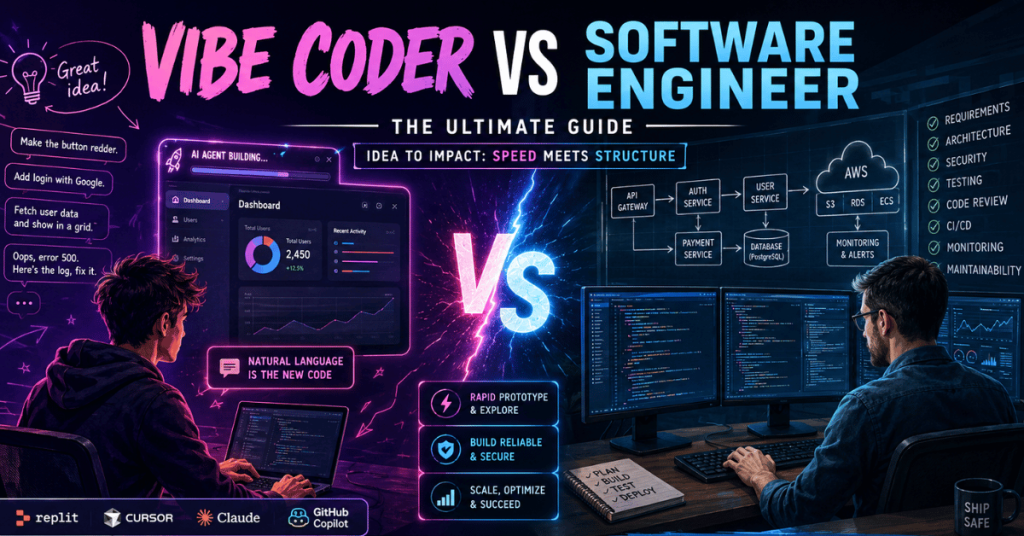
A vibe coder uses AI tools (Cursor, Copilot, Claude, Bolt.new) to generate working software from natural language descriptions — prioritising speed to prototype, often without deep knowledge of what’s happening under the hood. A software engineer owns the entire software development lifecycle — architecture, security, testing, scalability, maintainability and long-term accountability for production systems. The key difference: vibe coders measure time to first working version. Software engineers measure time to safe merge. Both approaches are valid — and increasingly, the best engineers use both.
In early 2025, AI researcher Andrej Karpathy coined the term “vibe coding” to describe something he was already doing: building software by describing what he wanted in natural language and letting AI tools handle the actual code. The idea wasn’t new — AI coding assistants had been around for years. But Karpathy’s framing gave the concept a name that stuck so hard it became Collins Dictionary’s Word of the Year for 2025.
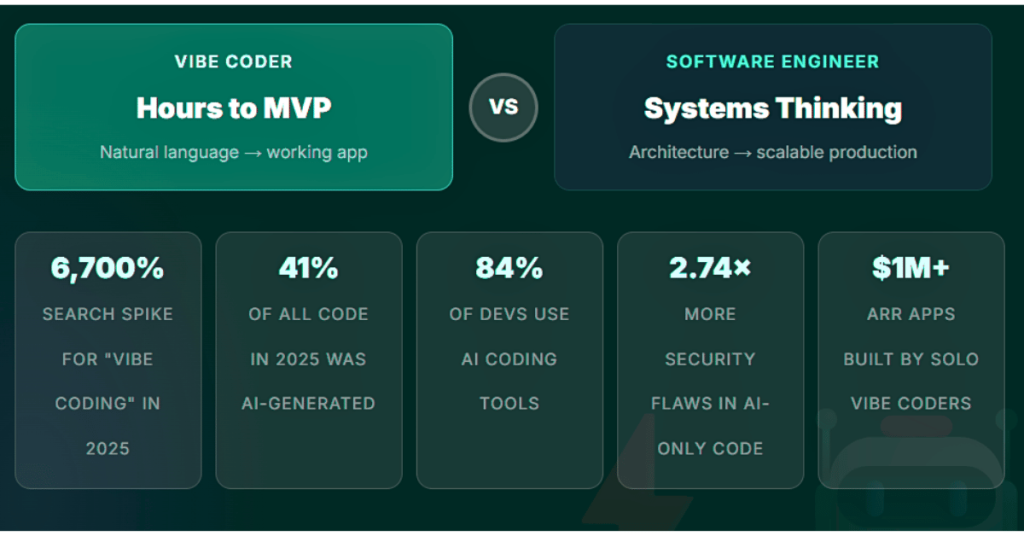
What followed was a genuine cultural moment in software development. Searches for “vibe coding” reportedly jumped 6,700% in spring 2025. Solo founders started shipping $1 million ARR apps without engineering backgrounds. Y Combinator’s Winter 2025 batch included startups running on codebases that were 95% AI-generated. And 25–30% of new code written at Microsoft and Google is now AI-generated.
Meanwhile, entry-level engineering hiring quietly tightened. Companies that used to hire 10 junior developers now hire 3. A December 2025 analysis of 470 GitHub pull requests found AI-generated code was 1.7× more likely to have logic errors and 2.74× more prone to security vulnerabilities than human-written code. And a senior engineer named Tim Lorent publicly documented major architectural flaws in AI-generated production code — problems a junior human developer would have been unlikely to introduce.
What if the next billion-dollar app wasn’t written by a coding genius, but by someone who simply knew how to talk to a machine? Imagine you are sitting at your desk with a brilliant idea for a new piece of software. In the past, you had two choices: spend months learning complex programming languages, or hire a costly development team to build it for you. Fast forward to today, in 2026, and the landscape has fundamentally shifted. Now, you can just sit down, open an AI tool, and start chatting your application into existence.
This rapid shift in how we build technology has sparked the biggest debate in the tech industry today: the Vibe Coder vs Software Engineer.
Are you a “vibe coder” who relies on intuition, natural language prompts, and AI to rapidly prototype ideas? Or are you a traditional “software engineer” who meticulously plans the architecture, focuses on the entire software development lifecycle, and ensures every line of code is scalable and secure?
In this comprehensive guide, we are going to dive deep into the Vibe Coder vs Software Engineer debate. We will explore what each role means, how they differ, where their responsibilities begin and end, and how you can leverage the best of both worlds to build incredible digital products. Whether you are a startup founder, an aspiring developer, or a seasoned tech veteran navigating the AI revolution, this article will give you the exact roadmap you need.
So which is it? Is vibe coding the future — or an expensive shortcut that creates problems downstream? The real answer requires understanding not just what each approach is, but what each one is actually good for. Let’s break it down.
Table of Contents
What Exactly is a Vibe Coder?
To understand the core of the Vibe Coder vs Software Engineer dynamic, we first need to look at how the term “vibe coder” was born.
In early 2025, renowned AI researcher and former OpenAI and Tesla leader Andrej Karpathy popularized the term “vibe coding.” He described a new reality where developers could “fully give in to the vibes,” forget that actual code even exists, and let large language models (LLMs) like ChatGPT, Claude, and specialized AI coding agents do the heavy lifting. By March 2025, Merriam-Webster had listed it as a trending expression, and it quickly became the defining tech buzzword of the year.
But what does it actually mean for you?
The Vibe Coder
- Uses AI tools to generate code through natural language prompts
- Moves fast from idea to working prototype
- Measures success: time to first working version
- May not fully understand the generated code
- Strong on product intuition, prompt engineering
- Excellent for MVPs, internal tools, prototypes
- Accountability: “the model generated it”
- Risk: technical debt, security gaps, unscalable architecture
The Mindset: English is the New Programming Language
A vibe coder does not sit down and write loops, define variables, or manually configure databases line by line. Instead, a vibe coder uses natural language—plain English—to describe what they want.
- “Make the button redder.”
- “Add a login page using Google authentication.”
- “Fetch user data from this API and display it in a grid.”
- “Oops, that threw an error. Here is the error code, fix it.”
The vibe coder acts more like a movie director than a construction worker. You provide the vision, the goals, and the constraints, and the AI agent executes the technical syntax.
The Toolkit of the Vibe Coder
If you want to step into the shoes of a vibe coder today, your toolkit looks very different from a traditional developer’s setup:
- AI IDEs: Tools like Cursor or Windsurf that have AI deeply integrated into the text editor.
- Agentic Platforms: Platforms like Replit Agent that can build, host, and deploy entire applications from a single text prompt.
- Large Language Models (LLMs): Constant interaction with the latest AI models to troubleshoot, brainstorm, and generate boilerplate code.
The Goal: Time to First Working Version
For a vibe coder, the primary metric of success is speed. The goal is to go from a raw idea to a functional prototype as quickly as possible. You are testing hypotheses. You are seeing if an idea “sticks.” You do not care if the underlying code is slightly messy or if the database isn’t optimized for a million users yet. You care about the outcome and the user experience. You are exploring.
What is a Traditional Software Engineer?
Now, let’s look at the other side of the Vibe Coder vs Software Engineer equation.
A software engineer is a professional who applies engineering principles to the design, development, maintenance, testing, and evaluation of computer software. If the vibe coder is the visionary architect sketching a beautiful house on a napkin, the software engineer is the structural engineer ensuring the house won’t collapse when a hurricane hits.
The Software Engineer
- Thinks across the full software development lifecycle
- Prioritises security, scalability, maintainability
- Measures success: time to safe merge
- Deeply understands every decision in the codebase
- Strong on architecture, systems design, debugging
- Excellent for production systems serving real users at scale
- Accountability: “I own it — even if AI generated it”
- Risk: slower initial speed vs vibe-coded prototype
The Mindset: The Entire Software Development Lifecycle (SDLC)
While a vibe coder focuses on getting an app to work, a software engineer focuses on what happens after it works. They think about the entire lifecycle of the software.
When a software engineer looks at a feature, they ask questions like:
- How does this integrate with our existing systems?
- What happens if 10,000 people click this button at the exact same time?
- How do we test this to ensure it doesn’t break other features?
- How will another developer understand this code six months from now?
- What is our rollback plan if this deployment fails?
The Goal: Time to Safe Merge
As tech writer Yusuf Aytas brilliantly pointed out, while a vibe coder measures “time to first working version,” a software engineer measures “time to safe merge.”
Safe merge means the code is reviewable, testable, and maintainable. It means the developer takes complete ownership of the changes. If an AI generates 500 lines of messy boilerplate code, a vibe coder might celebrate the speed. A software engineer, however, will see 500 lines of “review debt” that someone has to maintain, secure, and pay for in cloud computing costs.
The Reality of Modern Cloud Infrastructure
Remember the top cloud infrastructure trends we saw taking shape in 2025? The focus was entirely on resilience, massive scalability, and digital growth. As businesses shifted to highly complex, multi-cloud environments, the demand for rigorous software engineering skyrocketed.
You cannot simply “vibe code” a highly resilient, globally distributed cloud architecture that handles sensitive financial data. That requires disciplined engineering, an understanding of physical limits, strict security protocols, and meticulous system design.
Vibe Coder vs Software Engineer: The Core Differences
To truly grasp the Vibe Coder vs Software Engineer debate, we need to compare them head-to-head across several critical categories. Here is how their approaches differ when sitting down to build software.
A. Ownership and Responsibility
- Vibe Coder: Delegates responsibility to the AI. If a bug occurs, the vibe coder copies the error message, pastes it back into the AI, and asks the AI to fix it. They don’t necessarily need to understand why the bug happened, as long as the AI can resolve it.
- Software Engineer: Retains total ownership of the code. Even if they use AI to assist in writing a function, the engineer takes responsibility for that code. They must be able to explain exactly how it works to stakeholders, product managers, and other developers.
B. The Unit of Work
- Vibe Coder: Treats generated output as progress. The more the AI builds, the closer they feel to the finish line.
- Software Engineer: Treats any code change as a unit of liability. Every new line of code is something that must be tested, maintained, and eventually updated. Therefore, engineers prefer narrow, bounded changes over massive, AI-generated data dumps.
C. Problem-Solving Approach
- Vibe Coder: Relies on intuition, iteration, and trial-and-error. They use a “stochastic” approach—throwing prompts at the wall and seeing what sticks until the UI looks right and the app functions.
- Software Engineer: Applies the scientific method. They isolate variables, write unit tests, verify hypotheses, and ensure that a solution fixes the root cause of a problem, rather than just patching the symptom.
D. Skill Set Required
- Vibe Coder: High creativity, strong communication skills, excellent prompt engineering, deep domain knowledge (knowing what the product should do), and a basic understanding of logic.
- Software Engineer: Deep knowledge of algorithms, data structures, system architecture, database management, cloud deployment, security best practices, and version control.
A vibe coder is someone who wants to test an idea by generating software as a prototype. A software engineer is someone who thinks about the entire software development lifecycle. The difference is not the tool. The difference is where responsibility starts and where it ends.
— Yusuf Aytas, Software Engineer
That distinction sounds clean, but the reality in 2026 is messier — and more interesting. The best software engineers now use vibe coding tools as force multipliers. Senior developers at Booking.com who participated in a 2025 pilot with AI tools reported a 30% increase in merge requests and improved job satisfaction. Senior developers across the industry report an 81% productivity boost from AI tools — while mid-level developers see 51%. The gap isn’t vibe coder vs software engineer as two separate species. It’s a spectrum of how much engineering discipline accompanies AI-assisted development.
The Danger of Misunderstanding the Roles
The tension in the Vibe Coder vs Software Engineer conversation usually arises when people try to apply the wrong approach to the wrong phase of a business.
The Trap for Vibe Coders: Many non-technical founders use vibe coding to build a brilliant MVP (Minimum Viable Product). It gains traction, users flood in, and suddenly, the app crashes. Because the app was “vibed” together without an understanding of database indexing or cloud scalability, it cannot handle the traffic. The vibe coder hits a wall because AI cannot magically fix fundamental architectural flaws in a live, highly-trafficked production environment without breaking everything else.
The Trap for Software Engineers: On the flip side, traditional engineers can fall into the trap of over-engineering early on. If you are building a weekend toy project to test a market idea, setting up a massive Kubernetes cluster, writing a 100% test coverage suite, and agonizing over perfect system design is a waste of time. While the engineer is busy setting up the infrastructure, the vibe coder has already launched, validated the idea, and gained 100 paying users.
The 3 Real Differences Between a Vibe Coder and a Software Engineer
Difference 1 — What They Measure as “Done”
A vibe coder measures time to first working version. The demo works. The prototype ships. The MVP is live. That’s a meaningful achievement, especially for testing ideas and validating market demand before committing engineering resources.
A software engineer measures time to safe merge. This is a completely different finish line. Getting code to “safe merge” includes review cost, test coverage, rollout planning, rollback strategy, coordination with other teams, security review, and the cost of future maintenance. The demo is not the finish line — the production-ready, peer-reviewed, reliably deployable change is.
Why this matters: Code that demos well and code that runs safely at scale can look identical. The difference lives in what happens next: under load, after security testing, during the incident at 2am six months later.
Difference 2 — Unit of Responsibility
A vibe coder treats generated output as progress. More code, faster generation, working prototype in hours. The unit of success is output volume and speed.
A software engineer treats each change as a unit of responsibility. The change must be narrow enough to review, explainable enough to trust, and bounded enough to merge without dragging half the system with it. A change that can’t be explained by the person who introduced it creates what developers call “review debt” — cost that gets paid later by someone else.
The AI-generated code problem: When a human writes code, there’s usually a decision trail. You can ask why they chose that pattern, why they used that package, why they made the test look that way. With AI-generated code, some of those “decisions” aren’t decisions at all — they’re statistical predictions. A software engineer has to convert generated output into an engineering decision before it can be owned by the team.
Difference 3 — Ownership
A vibe coder can say the model generated it. A software engineer has to say: I own it. The code may have started with the model, but the accountability cannot stay there.
— Yusuf Aytas, Software Engineer
This ownership distinction matters most in production. A model can read a lot of code. That does not mean it understands the system. Engineering context lives not just in code, but in incidents, old migrations, customer behaviour, operational pain, team conventions, security requirements, compliance rules, and the strange decisions of the past. The model doesn’t carry that context — it works inside its context window. The larger the task, the more likely the AI optimises locally and damages something globally. A software engineer carries institutional knowledge that no prompt can fully transfer.
Bridging the Gap: The Rise of Agentic Coding
As we navigate through 2026, the smartest professionals realize that the Vibe Coder vs Software Engineer debate isn’t a battle where one side wins. It is a spectrum. The future belongs to those who can merge these two disciplines.
This hybrid approach is increasingly being referred to as Agentic Coding or being an AI Engineer.
Agentic coding is not about giving up control to the AI (like a pure vibe coder might), nor is it about manually typing every line of syntax (like a traditional engineer of the past). It is about collaborating with AI to move faster without compromising on quality or safety.
How to Blend the Two Approaches:
- Vibe Code the Prototype: When you are starting a new project, give into the vibes. Use tools like Replit Agent or Cursor to rapidly flesh out the UI, connect basic APIs, and test your core logic. Do not worry about perfect code; worry about finding product-market fit.
- Apply Engineering to the Core: Once the idea is validated, put on your software engineer hat. Look at the code the AI generated. Refactor it. Break it into manageable, testable modules.
- Prompt with Constraints: Instead of giving the AI open-ended prompts (“build a user dashboard”), give it bounded, engineered tasks (“Write a Python function that authenticates a user via OAuth2, returning only the session token. Do not include UI elements. Include error handling for network timeouts.”).
- Never Skip Validation: If the AI writes it, the human reviews it. Implement automated testing, pre-commit hooks, and code reviews. If the code hasn’t been tested, it does not exist.
Even tech giants are embracing this blend. In early 2026, Linux creator Linus Torvalds—the ultimate symbol of rigorous software engineering—admitted to using AI to “vibe code” a Python visualizer tool for a project, showing that even the strictest engineers find value in rapid AI generation for specific, bounded tasks.
What Tools Do Vibe Coders Use in 2026?
The vibe coding ecosystem has expanded dramatically since Karpathy’s original framing. Here are the most widely used tools that enable vibe coding workflows in 2026.
Cursor
AI-first code editor — inline generation, multi-file edits, auto-complete from natural language. Most popular among serious vibe coders.
GitHub Copilot
Integrated AI pair programmer for VS Code, JetBrains and GitHub itself. 70%+ of developers using AI coding tools report using Copilot daily.
Claude Code
Anthropic’s CLI coding agent (Feb 2025). Senior engineers run multiple instances in parallel, solving several problems simultaneously.
Bolt.new
StackBlitz’s full-stack app builder — describe the app in plain English, get a deployable project. No local setup needed.
v0 by Vercel
Generate polished React UI components from text descriptions. Popular for rapid UI prototyping without design skills.
Lovable.dev
Formerly GPT Engineer. Full product-grade app generation from conversational prompts — web apps, dashboards, landing pages.
Replit Agent
End-to-end app generation and deployment from natural language with no local setup. Good for beginners and rapid prototyping.
OpenAI Codex CLI
Released April 2025. Command-line AI coding agent for multi-step code generation, testing and modification in local environments.
“Vibe & Verify” — The Workflow That’s Winning in 2026
The most effective vibe coding workflow in 2026 isn’t blind AI trust — it’s “Vibe & Verify.” You use AI tools to generate rapidly, then you critically test, review and refine the output before it enters a shared codebase. Success hinges on your ability to evaluate AI outputs — deciding when to accept, tweak or reject code — rather than just generating more of it. Prompt engineering (writing clear instructions, setting precise constraints, maintaining context files like .cursorrules) has become a core technical skill in its own right.
Vibe Coding Statistics — What’s Actually Happening in 2026
Verified Vibe Coding Statistics — 2025–2026
- Searches for “vibe coding” jumped6,700%in spring 2025 (Exploding Topics)
- Collins Dictionary named “vibe coding” itsWord of the Year for 2025
- 84%of developers are using or planning to use AI coding tools (survey, 2025)
- 51%of developers were using AI coding tools daily by late 2025
- 41%of all code written in 2025 was AI-generated
- Microsoft and Google estimate25–30%of their new code is now AI-generated
- Senior developers using AI tools report81% productivity boosts; mid-level developers see 51%
- AI-generated code is1.7× more likely to have major logic errorsand2.74× more prone to security vulnerabilitiesvs human-written code (470 PR analysis, Dec 2025)
- 45%of AI-generated code contains vulnerabilities such as hardcoded secrets or improper input validation
- By 2026,40% of new SaaS MVPsare built primarily using vibe coding tools
- 25%of Y Combinator Winter 2025 batch startups run on codebases that are95% AI-generated
- Many vibe-coded apps have crossed$1M+ ARR— including Pieter Levels’ multiplayer game, which hit $1M ARR in 17 days after using Cursor and Grok 3
When Vibe Coding Works — And When It Doesn’t
Vibe Coding vs Software Engineering — What Each Is Best For
| Scenario | Vibe Coding | Software Engineering | Best Approach |
| MVP / Prototype | ✅ Ideal — hours to working demo | Overkill for early validation | Vibe Coding ✓ |
| Internal tools / Dashboards | ✅ High value, contained scope | May be over-engineered | Vibe Coding ✓ |
| Landing pages / Marketing sites | ✅ Fast, low-stakes | Not necessary | Vibe Coding ✓ |
| Simple CRUD apps | ✅ Handles well with prompts | Not required | Vibe Coding ✓ |
| Production systems at scale | ⚠️ Creates risk without oversight | ✅ Architecture + reliability | Engineering ✓ |
| Security-critical applications | ❌ 2.74× more vulnerabilities | ✅ Security review is mandatory | Engineering ✓ |
| Healthcare / Fintech / Government | ❌ Compliance risk | ✅ Regulatory expertise required | Engineering ✓ |
| Distributed systems | ❌ AI optimises locally, damages globally | ✅ Systems thinking required | Engineering ✓ |
| Experienced dev using AI tools | ✅ Amplifies output enormously | ✅ Validates and directs AI | Both — Vibe Engineering |
| The smartest approach in 2026: use vibe coding tools to move fast, engineering discipline to make it last. The two aren’t mutually exclusive. | |||
What Does Vibe Coding Mean for Software Engineering Careers?
Let’s address the concern that’s under every conversation about this topic: are software engineering jobs disappearing? The honest answer is nuanced — and different depending on which layer of the industry you’re looking at.
What’s Actually Changing
The Jobs at Real Risk — Be Honest About This
- Entry-level hiring slowed significantly in 2024–2025 and remains tight in 2026
- Companies that used to hire 10 junior developers now hire 3 — expecting each to ship what a mid-level used to
- Agency development work for boilerplate-heavy projects faces significant commoditisation
- Standard CRUD app development, basic landing pages, simple integrations — these are genuinely automatable for many use cases
- Bootcamp graduates from 2020-era programs face a much harder market without differentiation
What Software Engineers Do That Vibe Coding Can’t Automate
- Systems design and distributed architecture decisions
- Security threat modeling and secure coding practices
- Understanding compliance requirements (HIPAA, PCI-DSS, GDPR, ISO 27001)
- Deciding what should not be built — not just what can be
- Carrying institutional context: incidents, migrations, customer behavior, past decisions
- Trade-off judgment: what technical debt is acceptable, which dependencies to trust
- Cross-team coordination and change management for shared codebases
- Domain expertise (fintech, healthcare, gaming, AI infrastructure) that shapes correct technical choices
The clearest framing comes from the analogy that keeps appearing in every serious conversation about this: calculators did not kill mathematics. Excel did not kill accountants. Google did not kill researchers. Likewise, AI will not kill developers — it will change what developers are really paid for.
The future software engineer needs a different stack of strengths: systems thinking, domain expertise in areas like finance or healthcare, AI tool mastery, communication skills and product intuition. Coding becomes one layer of their identity — not the entire identity.
“Vibe Engineering” — The Third Path That’s Winning in 2026
In October 2025, developer Simon Willison coined a term that’s quietly becoming the most accurate description of what elite engineering looks like in 2026: “vibe engineering.” He later updated the post to note that “agentic engineering” is gaining even more traction as the preferred term by early 2026.
The concept: vibe engineering is the hard, sophisticated version of working with AI tools to build production software. Not blind AI trust. Not pure hand-coding either. Instead, an orchestration of prompts, validation, architecture judgment and engineering discipline — where AI does the heavy lifting and the human provides the taste, the context, and the quality bar.
The standout developers in 2026, according to Willison and others, aren’t the ones writing flawless code by hand. They’re the ones who can steer AI tools to build the right solutions, validate their effectiveness, and confidently deliver results that hold up in production. They’re running multiple coding agents in parallel. They’re reviewing AI output with the same rigour they’d apply to a junior developer’s PR. They’re prompt-engineering context files that encode system-wide constraints the AI needs to respect.
This is the realistic future of software development: not vibe coders who don’t understand what they’re building, and not software engineers who write every line by hand — but professionals who wield AI tools with the judgment and discipline that makes the difference between a demo that impresses and a system that doesn’t fail at 3am.
Vibe Coder vs Software Engineer — Which One Does Your Business Need?
Use Vibe Coding Workflows When…
- You’re validating a business idea before committing to a full build
- You need an MVP or prototype fast — days, not months
- The project is an internal tool, dashboard or simple automation
- You’re a non-technical founder who wants to test product concepts
- Budget is tight and perfect scalability isn’t needed yet
- You’re building something you’ll throw away if the concept doesn’t work
Hire a Software Engineer When…
- Your product will serve real users in production at meaningful scale
- Security, compliance or regulation is a factor (finance, health, government)
- You need distributed systems, complex integrations or custom architecture
- Technical debt now will cost significantly more to fix later
- You need code that other developers can maintain, extend and rely on
- You want AI-accelerated development with engineering discipline
The Smart 2026 Business Strategy: Both
The most effective software strategy in 2026 isn’t “hire engineers OR use vibe coding.” It’suse vibe coding to prototype fast, then apply engineering expertise to harden and scale what proves to work. Many businesses are doing exactly this: ship an AI-generated MVP to validate market demand, then bring in a professional software team to rebuild or harden the foundation before scaling. This approach delivers the speed of vibe coding with the reliability of professional engineering — and it’s what Golden Info Systems builds for clients who want to move fast without sacrificing production quality.
Vibe Coder vs Software Engineer — Full Comparison
Vibe Coder vs Software Engineer — Complete Comparison
| Factor | Vibe Coder | Software Engineer |
| Primary tool | Natural language prompts to AI | IDE + AI tools + engineering judgment |
| Core skill | Prompt engineering, product intuition | Systems design, architecture, debugging |
| Speed to first demo | Hours to days ✓ | Days to weeks |
| Production reliability | Risk without oversight | High with proper process ✓ |
| Security posture | 2.74× more vulnerabilities (unreviewed) | Secure by design ✓ |
| Scalability | Prototype-level only | Built for scale ✓ |
| Code ownership | “AI generated it” | “I own it” ✓ |
| Institutional context | None — prompt window only | Carries system history ✓ |
| Best use case | MVPs, internal tools, prototypes | Production systems, regulated industries |
| Cost efficiency (MVP stage) | Very high ✓ | May be over-engineered |
| Long-term cost | Technical debt risk | Lower maintenance cost ✓ |
| Career trajectory | Evolving — growing recognition | Established — higher floor at senior level ✓ |
Real-World Scenario: Building a Cloud-Based SaaS App
To make the Vibe Coder vs Software Engineer comparison crystal clear, let’s look at a practical scenario. Imagine a company needs a new internal tool to track employee cloud computing expenses.
The Vibe Coder’s Approach:
- Day 1: Opens an AI agent. Prompts: “Build a web app where employees can log their AWS and Azure expenses. Make it look modern with a dark mode. Add a dashboard with a pie chart showing total spend.”
- Day 2: The AI generates a React frontend and a simple Node.js backend with a SQLite database. The vibe coder clicks around, notices the pie chart is the wrong color, and prompts the AI to fix it.
- Day 3: The app is deployed via a one-click hosting service. It works perfectly for the team of 5 people. The vibe coder is praised for incredible speed.
- Month 3: The company grows to 500 employees. The single SQLite database locks up due to concurrent write requests. The app crashes daily. The vibe coder asks the AI to fix it, but the AI’s suggestions involve massive database migrations that the vibe coder doesn’t understand how to safely execute without losing data.
The Software Engineer’s Approach:
- Day 1-3: The engineer gathers requirements. They realize the company is scaling fast. They design a system architecture using a scalable PostgreSQL database on AWS, set up secure IAM roles, and plan the API endpoints.
- Day 4-10: They write the code (perhaps using AI to speed up boilerplate generation). They write unit tests for the financial calculation logic to ensure nobody accidentally submits a negative expense.
- Day 11: The app is deployed through a CI/CD pipeline with a staging environment.
- Month 3: The company grows to 500 employees. The app doesn’t even flinch because the database is properly indexed and the cloud infrastructure was built to scale elastically.
The Verdict: The vibe coder won the sprint, but the software engineer won the marathon. The optimal path in 2026? Use the vibe coder’s speed for the frontend dashboard, but use the software engineer’s discipline for the database and cloud architecture.
Frequently Asked Questions (FAQ)
To help you fully navigate the Vibe Coder vs Software Engineer landscape, we have compiled the most common questions people are asking in 2026. These answers are optimized to give you clear, straightforward insights.
Can a vibe coder replace a software engineer?
No, a vibe coder cannot fully replace a software engineer. While vibe coding empowers you to build prototypes and generate code incredibly fast using AI, it doesn’t replace the deep engineering skills required to maintain an application. Software engineers are essential for designing complex system architectures, scaling databases securely, ensuring data compliance, and debugging deeply rooted issues that AI cannot independently solve in a live production environment.
What is difference between a vibe coder and a software engineer?
A vibe coder uses AI tools to generate working code through natural language prompts — prioritising speed to a working prototype, often without deep knowledge of what’s happening under the hood. A software engineer thinks across the full software development lifecycle: architecture, security, scalability, testing, maintenance and long-term ownership of production code. The core difference, as developer Yusuf Aytas put it: “A vibe coder measures time to first working version. A software engineer measures time to safe merge.” The difference isn’t the tools — both might use Cursor or Copilot. The difference is where responsibility starts and ends, and what “done” means.
What is vibe coding?
Vibe coding is a modern, AI-assisted software development practice where you use natural language prompts (like plain English) to instruct an AI model to write your code. Instead of manually typing out syntax, loops, and variables, you act as the director. You rely on intuition, rapid iteration, and conversational feedback with tools like ChatGPT or Cursor to build functional software quickly.
What is the exact definition of vibe coding?
Vibe coding is an AI-assisted software development practice where a person uses natural language prompts to instruct a Large Language Model (LLM) or AI agent to generate source code. Instead of manually writing syntax, the user acts as a director, relying on intuition, rapid iteration, and conversational feedback to build functional software quickly.
Will vibe coders replace software engineers?
No, vibe coders will not replace software engineers. While vibe coding makes it incredibly easy to generate code and build prototypes, it does not replace the need for software engineering. Software engineers are required to review AI-generated code, manage complex system architectures, ensure security, scale databases, and maintain the software lifecycle. Vibe coding is a tool for generation; software engineering is the discipline of maintenance and architecture.
Are software engineering jobs at risk from vibe coding?
Your job as a traditional software engineer is not necessarily at risk of disappearing, but it is fundamentally evolving. Vibe coding automates the repetitive, manual tasks of coding. This means you will spend less time writing boilerplate syntax and much more time focusing on high-level system architecture, security, code review, and solving complex business problems. The engineers who are at risk are those who refuse to adapt and integrate AI tools into their workflows.
What tools do vibe coders use in 2026?
If you want to start vibe coding today, you have access to a powerful suite of AI-first tools. The most popular include:
- Agentic Platforms: Tools like Replit Agent that can build and deploy full applications from a single prompt.
- AI-Native IDEs: Code editors like Cursor and Windsurf that understand your entire codebase context.
- Large Language Models (LLMs): Advanced models like Claude 3.5 Sonnet and GPT-4o, which are highly regarded for their coding logic and ability to generate interactive UI components.
Should I hire a vibe coder or software engineer for my project?
It depends entirely on your project’s current phase and goals. If you are a startup looking to build a Minimum Viable Product (MVP) quickly and on a tight budget to test a market idea, hiring someone who can vibe code will get you a working prototype incredibly fast. However, if you are building an application that handles sensitive user data, requires complex cloud infrastructure, or needs to scale to thousands of users, you absolutely need to hire a software engineer to ensure the product is secure, maintainable, and won’t crash under pressure.
What are the best tools for vibe coding right now?
In 2026, the most popular tools for vibe coding include:
- Replit Agent: Excellent for generating full-stack applications from scratch with zero configuration.
- Cursor IDE: A powerful code editor with deeply integrated AI that can understand your entire codebase.
- Claude 3.5 (and newer): Highly regarded for its coding logic and ability to build interactive UI artifacts.
- GitHub Copilot Workspace: Great for translating natural language plans into executable code across repositories.
Is vibe coding bad for code quality?
Vibe coding is not inherently bad for code quality, but it can lead to technical debt if used carelessly. Because AI can generate massive amounts of code instantly, a vibe coder might introduce unnecessary boilerplate, redundant logic, or unoptimized database queries. Code quality drops when AI-generated code is merged into production without human review, testing, or an understanding of the underlying mechanics.
How do I transition from a vibe coder to a software engineer?
If you have been successfully vibe coding apps but want to become a rigorous software engineer, focus on the following steps:
- Learn the Fundamentals: Study data structures, algorithms, and how the internet actually works (HTTP, DNS, APIs).
- Understand Cloud Infrastructure: Learn how applications are hosted, how databases scale, and how to manage servers.
- Practice Code Review: Stop accepting AI code blindly. Read every line it generates until you understand exactly what it does.
- Embrace Testing: Learn how to write unit and integration tests. A software engineer relies on tests to ensure their code won’t break the system.
Can a traditional software engineer use vibe coding?
Absolutely. In fact, the most productive software engineers in 2026 actively use vibe coding techniques. They use AI to quickly scaffold out new ideas, write repetitive boilerplate, or explore a new library. However, unlike pure vibe coders, software engineers apply strict constraints to the AI and rigorously review, test, and refactor the generated code before allowing it near a production environment.
Why is “Time to Safe Merge” an important metric?
“Time to safe merge” is a metric used by software engineers to evaluate the true cost of adding new code to a project. It goes beyond just writing the code. It includes the time it takes to review the code, test it, check for security vulnerabilities, ensure it aligns with the existing architecture, and create a rollback plan. It highlights that generating code quickly (vibe coding) isn’t useful if it takes days to safely integrate it into the main project.
The Future belongs to the Adaptable
The Vibe Coder vs Software Engineer conversation isn’t really a battle; it is the story of how software development is maturing.
Vibe coding has democratized creation. It has allowed designers, marketers, and visionaries to build functional products without spending years learning syntax. It is the ultimate tool for discovery, prototyping, and finding out if an idea works.
However, as applications grow, as user bases scale, and as the demand for resilient cloud infrastructure increases, the disciplined rigor of the software engineer is more vital than ever. The magic of AI code generation cannot mask a fundamentally flawed database architecture.
The most successful tech professionals in 2026 are those who embrace both. They “vibe code” to explore and prototype, moving at the speed of thought. But they switch to a software engineering mindset the moment that code needs to be shared, scaled, or relied upon by real users.
Are you ready to scale your ideas safely?
Whether you are spinning up your first AI-generated prototype or managing a massive legacy codebase, your infrastructure needs to be ready for the future. Stop letting server crashes and database bottlenecks ruin your brilliant ideas.
Start building on resilient infrastructure today with our Cloud Scalability Solutions and let us handle the engineering heavy lifting while you focus on the vibes.
Final Thoughts —The Answer That Might Surprise You
Here’s the thing about the vibe coder vs software engineer debate: the framing is already becoming outdated. The question isn’t “which one wins?” — it’s “how much engineering discipline do you need for this specific project at this specific moment?”
For early-stage idea validation, lean toward vibe coding tools and ship fast. For production systems that need to be reliable, secure and maintainable at scale, you need engineering discipline — and ideally an engineer who also knows how to use AI tools to amplify their output. The best engineers in 2026 aren’t defined by how many lines they write by hand. They’re defined by how well they can steer AI tools, validate output, own the decisions, and build systems that hold up over time.
The industry is landing on a middle path — what Simon Willison called “vibe engineering” and what others call “agentic engineering.” It’s vibe coding’s speed with software engineering’s discipline. And it’s what the most effective development teams in 2026 are already doing.
The Verdict
The right answer depends on your stage — but the future belongs to those who can do both.
Choose Vibe Coding When…
Speed matters most, stakes are low, you’re validating an idea, and technical debt is acceptable for now.
Choose Engineering When…
You’re serving real users, security matters, systems need to scale, or you need to own the code long-term.