





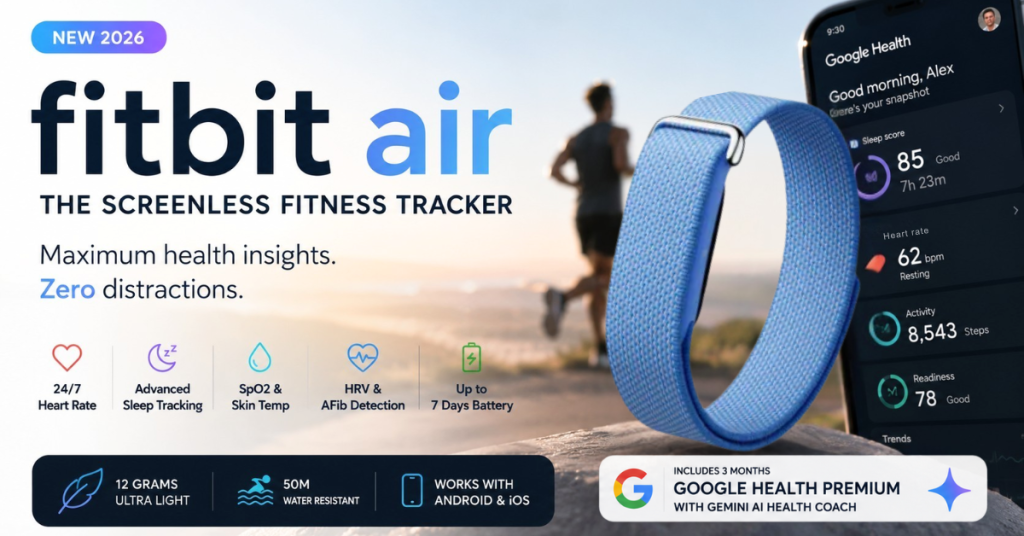
What if the best fitness tracker you’ve ever worn isn’t a smartwatch at all — but a tiny pebble with no screen, no notifications and no subscription required? That’s exactly what Google is betting on with the Fitbit Air. Launched in May 2026 and already generating more buzz than any Fitbit in years, this screenless wearable reimagines what a health tracker should feel like — lighter, simpler, smarter and drastically more affordable than its closest rival. Here’s everything you need to know before you decide if it’s right for you.
The Fitbit Air is Google’s first-ever screenless wrist-worn fitness tracker, officially launched on May 7, 2026, and available from May 26–27 at $99.99 USD / AUD $199. It has no display, no buttons, and no mandatory subscription. It tracks heart rate 24/7, sleep stages, SpO2, skin temperature, HRV and AFib detection — all viewed through the Google Health app on your phone. It weighs just 12 grams, lasts 7 days on a charge, and is water resistant to 50 metres. Every purchase includes a free 3-month trial of Google Health Premium with Gemini AI-powered Google Health Coach. It works with both Android and iOS.
Have you ever wished your fitness tracker felt more like a part of you and less like a clunky gadget weighing down your wrist?
If you’re nodding your head, you aren’t alone. The search for the perfect blend of comprehensive health tracking and sheer, unnoticeable comfort is a never-ending journey for fitness enthusiasts and casual walkers alike. In the fast-paced world of wearable technology, rumors and speculations are always swirling, and lately, the buzz has been all about a potential new device: the “Fitbit Air.”
While not an officially released product from Fitbit (yet!), the concept of a “Fitbit Air” has captured the imagination of many. It represents the ultimate wish list for a next-generation tracker—one that prioritizes a feather-light design without sacrificing the robust health metrics Fitbit is famous for.
Every few years, a product comes along that genuinely makes you rethink a category. The Fitbit Air is one of those products. At a moment when smartwatches are adding larger screens, more apps and more features, Google has done the opposite — stripped everything back to the essentials and built a wearable that does exactly one thing with extraordinary precision: track your health.
No screen to distract you. No notifications buzzing on your wrist. No subscription locked behind a paywall just to see your own data. Just a lightweight sensor pod on your wrist, gathering health data around the clock and surfacing insights through an app when you’re ready to look at them. Whether you’re a fitness enthusiast who’s worn every tracker on the market, or someone who’s tried three smartwatches and put them all in a drawer — the Fitbit Air deserves your attention in 2026.
What Is the Fitbit Air?
The Fitbit Air is Google’s newest addition to the Fitbit lineup — and its most radical departure from what came before. Where previous Fitbits like the Charge 6 and Inspire 3 had screens, the Fitbit Air deliberately has none. It’s a small, oval-shaped sensor pod that clips onto a band on your wrist, 25% smaller than the Fitbit Luxe and 50% smaller than the Inspire 3, and weighing just 5.2 grams as a pod (12 grams total with the band).
Google officially launched the Fitbit Air on 7 May 2026 as a screenless, lightweight fitness tracker. Fitbit Air is described as the smallest Fitbit tracker yet — a proactive wellness partner that uses high-fidelity sensor technology in a tiny, discreet pebble that enables advanced health and fitness tracking.
The design philosophy is simple and intentional: instead of building another device that competes with your phone for your attention, the Fitbit Air goes completely silent on your wrist — no taps, no buzzes, no glowing screen to check mid-conversation. It just collects data, and when you’re ready to see it, you open the Google Health app. This isn’t a compromise or a budget decision. It’s a deliberate design choice that most people who’ve worn a Fitbit Air for a week say changes how they feel about wearables entirely.
Why Screenless? The Philosophy Behind the Design
Screenless fitness trackers grew 88% in sales between 2024 and 2025, while smartwatch fatigue has crept into mainstream conversation. Whoop’s CEO put it bluntly: “If it has a screen, then it’s a watch.” Google is positioning the Fitbit Air for users who want rich health data without notification overload. The no-screen design also enables the 7-day battery life — eliminating the display that drains most smartwatch batteries in under 48 hours.
Fitbit Air Full Specifications — 2026
| Fitbit Air — Full Specifications | |
| Launch Date | May 7, 2026 (announcement) — Ships May 26–27, 2026 |
| Price (US) | $99.99 standard / $129.99 Stephen Curry Special Edition |
| Price (Australia) | AUD $199 RRP — includes 3-month Google Health Premium trial |
| Price (UK) | £84.99 |
| Display | None — screenless by design |
| Weight | 12g total (5.2g pod only) |
| Battery Life | Up to 7 days on a single charge |
| Water Resistance | 50 metres — swim-proof, shower-safe |
| Sensors | Heart rate (continuous), SpO2, skin temperature, optical sensor, accelerometer |
| Health Tracking | 24/7 heart rate, sleep stages, SpO2, HRV, resting heart rate, skin temp, AFib detection |
| Activity Tracking | Steps, active minutes, auto workout detection, calorie burn |
| GPS | Connected GPS (via smartphone) |
| Compatibility | Android + iOS (iOS 16.4+ required) via Google Health app |
| App | Google Health (free) — replaces Fitbit app |
| AI Features | Google Gemini-powered Health Coach (requires Google Health Premium) |
| Subscription | Not required for core features. Google Health Premium: $9.99/month (unlocks AI Coach) |
| Included in purchase | 3-month Google Health Premium trial for eligible users |
| Available at (Australia) | Google Store, JB Hi-Fi, Harvey Norman, OfficeWorks, Telstra |
| Sleep Accuracy | 15% more accurate sleep tracking than previous Fitbit devices |
The Allure of the Fitbit Air Concept
Why is the idea of a Fitbit Air so appealing? It comes down to one simple fact: the best fitness tracker is the one you actually want to wear all day and all night.
Many excellent trackers on the market today offer incredible features—built-in GPS, ECG apps, stress management scores—but they can sometimes feel a bit bulky. If you’re trying to track your sleep, a heavy watch can be uncomfortable. If you’re lifting weights, a thick band can get in the way of your grip.
The “Fitbit Air” concept represents the holy grail: maximum capability with minimum physical presence. Think about the Apple MacBook Air or the iPad Air; the “Air” moniker in tech universally signals a focus on thinness, lightness, and portability. A Fitbit bearing this name would promise to be practically invisible on your wrist while still capturing every heartbeat and step.
What Would a “Fitbit Air” Actually Look Like?
If we imagine this ideal device, what are the key design elements that would define it?
- Ultra-Slim Profile: The core defining feature. It would need to be significantly thinner than the current Charge series, perhaps even thinner than the Inspire 3.
- Featherweight Materials: The body would likely utilize advanced, lightweight materials—maybe a specialized polymer or a very thin aluminum casing—to keep the grams to an absolute minimum.
- Breathable, Minimalist Bands: The standard band wouldn’t be a solid strap of silicone. Instead, imagine a perforated design, a woven nylon mesh, or a hyper-thin silicone band designed specifically for maximum airflow and minimal skin contact.
- Curved Design: To truly feel “invisible,” the tracker would need to hug the natural curve of your wrist perfectly, preventing it from snagging on sleeves or feeling obtrusive.
- A “Disappearing” Display: Rather than a bright, always-on square screen, a Fitbit Air might utilize an OLED display that blends seamlessly into the band, only illuminating when you turn your wrist or tap it.
Key Features We’d Expect in a Fitbit Air
A tracker can’t just be light; it has to be useful. If Fitbit were to release a device under the “Air” banner, what health and fitness features would be absolutely essential? Let’s break down the expected capabilities.
1. Advanced Heart Rate Monitoring (PurePulse)
Your heart rate is the foundation of almost all fitness tracking. A Fitbit Air would need the latest iteration of Fitbit’s PurePulse technology.
- Continuous Tracking: 24/7 heart rate monitoring to accurately track calorie burn, resting heart rate (a crucial indicator of overall cardiovascular health), and heart rate zones during workouts.
- Irregular Heart Rhythm Notifications: Keeping an eye out for signs of atrial fibrillation (AFib) is becoming a standard feature, and even a lightweight tracker should include this potentially life-saving capability.
2. Comprehensive Sleep Tracking
Because an ultra-light device is perfect for wearing to bed, its sleep tracking capabilities need to be top-tier.
- Sleep Stages: Accurately detailing how much time you spend in Light, Deep, and REM sleep.
- Sleep Score: Providing a simple, daily number to help you understand your sleep quality at a glance.
- Smart Wake: A silent alarm that wakes you during an optimal, lighter sleep stage so you feel more refreshed.
- Snore & Noise Detect: (If a microphone is included) To identify environmental factors disrupting your rest.
3. Stress Management and Recovery
Modern fitness isn’t just about pushing hard; it’s about recovering smarter.
- Daily Readiness Score: This premium feature helps you decide if you should push for a hard workout or focus on recovery based on your sleep, heart rate variability (HRV), and recent activity.
- Stress Management Score: Assessing your body’s physical response to stress.
- Guided Breathing Sessions: On-wrist prompts to help you center yourself and lower your heart rate.
4. Activity and Workout Tracking
Of course, it has to track your moves.
- Automatic Exercise Recognition (SmartTrack): The device should know when you start walking, running, or swimming without you having to press a button.
- Multiple Exercise Modes: Specific tracking for yoga, cycling, weights, and more.
- Active Zone Minutes: Tracking the time you spend in target heart rate zones, a metric endorsed by major health organizations.
5. Smart Features for the Everyday
Even a minimalist tracker needs to keep you connected.
- Smartphone Notifications: Call, text, and app alerts so you don’t miss important updates.
- Find My Phone: A simple but incredibly useful tool.
- Google Fast Pair: For seamless setup with Android devices (given Google’s ownership of Fitbit).
Fitness Tracking and Built-in GPS
Of course, the Fitbit Air excels at what Fitbits are known for: fitness tracking.
- All-Day Activity Tracking: It tracks your steps, distance, active zone minutes, and calories burned throughout the day.
- Built-in GPS: This is a major plus for runners and cyclists. You can track your pace and distance without needing to bring your phone along.
- Multiple Exercise Modes: Whether you’re swimming, cycling, running, or doing yoga, the Fitbit Air has a specific mode to track your workout accurately.
The Big Question: Built-in GPS vs. Connected GPS
This is the biggest dilemma when designing a lightweight tracker.
- Built-in GPS: Allows you to track pace and distance on runs or bike rides without bringing your phone. However, the GPS antenna requires space and significantly drains the battery, which usually requires a larger, heavier device.
- Connected GPS: Relies on your phone’s GPS. This keeps the tracker small and preserves battery life, but it means you must carry your phone during outdoor workouts if you want accurate distance mapping.
For a true “Fitbit Air,” Connected GPS is the most likely route. The priority is thinness and lightness; forcing a GPS antenna into that tiny space might compromise the core “Air” philosophy.
Why Choose the Fitbit Air?
With so many smartwatches and fitness trackers on the market, why should the Fitbit Air be at the top of your list?
It’s Accessible and User-Friendly
You don’t need a degree in sports science to understand the data the Fitbit Air provides. The accompanying Fitbit app is renowned for being intuitive and easy to navigate. It presents your data in clear, colorful graphs and provides actionable insights rather than just raw numbers.
The Power of the Fitbit Community
When you buy a Fitbit, you’re not just buying a device; you’re joining a massive global community. The app allows you to connect with friends, join challenges, and share your achievements. This social aspect can be incredibly motivating and make your fitness journey a lot more fun.
Premium Insights (Fitbit Premium)
While the Fitbit Air comes with a robust set of free features, you have the option to upgrade to Fitbit Premium. This subscription service unlocks even deeper insights, including a Daily Readiness Score (which tells you if your body is ready for a tough workout or needs rest), advanced sleep analytics, and access to premium workouts and mindfulness sessions. Many Fitbit Air devices come with a free trial of Premium, allowing you to test the waters.
Why the Screenless Design Actually Improves Sleep Tracking
The single biggest reason people don’t use their smartwatch for sleep tracking is comfort — a screen, buttons and a chunky case make it uncomfortable to sleep in. At 12g total, the Fitbit Air is lighter than most wedding rings. The comfort implication: you genuinely forget it’s there, which means you actually wear it to bed for sleep tracking — the use case most smartwatch owners skip. More nights of sleep data = more accurate circadian rhythm insights over time.
Google Health App + Gemini AI Coach — The Brain Behind the Fitbit Air
The Fitbit Air is just the hardware. The real product is what happens when that hardware connects to Google’s new platform: the Google Health app — a complete redesign and relaunch of the Fitbit app ecosystem, now powered by Google’s Gemini AI.
The Google Health app replaces the Fitbit app and works on both Android and iOS. It’s where all your Fitbit Air data lives — your sleep graphs, heart rate trends, activity summaries, SpO2 levels, HRV scores and AFib history. The app design is clean, intuitive and built around daily and weekly insights rather than just raw numbers.
Free Features vs Google Health Premium
What’s Free vs What Requires Google Health Premium
| Feature | Free (No Subscription) | Google Health Premium ($9.99/mo) |
| 24/7 heart rate data | ✅ Free | — |
| Sleep stages + duration | ✅ Free | — |
| SpO2 monitoring | ✅ Free | — |
| Skin temperature trends | ✅ Free | — |
| Heart rate variability (HRV) | ✅ Free | — |
| AFib detection + alerts | ✅ Free | — |
| Step count + activity tracking | ✅ Free | — |
| Gemini AI Health Coach | ❌ | ✅ Premium only |
| Personalised workout plans | ❌ | ✅ Premium only |
| Advanced sleep insights | Basic | ✅ Deep insights |
| Nutrition guidance | ❌ | ✅ Premium only |
| Included with purchase | — | ✅ 3 months free trial |
| Core health tracking is entirely free. Google Health Premium adds the AI coaching layer. After the 3-month trial, it auto-renews at $9.99/month (USD) unless cancelled. Cancel anytime. | ||
The 3-Month Trial Is Genuinely Generous
The 3-month Google Health Premium trial gives you actual access to the AI coaching features and a real chance to see if the $10/month subscription price is worth it without any charges upfront. Use the trial actively — try the Gemini AI Coach, follow a workout plan, use the nutrition guidance. After 3 months you’ll have a clear picture of whether Premium adds enough value for your lifestyle to justify the ongoing cost.
Fitbit Air vs Whoop — The Definitive Comparison
The screenless tracker category has been dominated by Whoop for years. Now Google has entered it directly, and the comparison is worth breaking down honestly — because the right choice depends entirely on your priorities.
Fitbit Air vs Whoop 5.0 — Complete 2026 Comparison
| Factor | Fitbit Air | Whoop 5.0 | Winner |
| Upfront cost | $99.99 (US) / AUD $199 | Device free, subscription required | Fitbit Air ✓ |
| Subscription | Optional ($9.99/month for AI Coach) | Mandatory — $199+/year | Fitbit Air ✓ |
| 3-year total cost | $100–$460 | $597–$1,077 | Fitbit Air ✓ |
| Works without subscription? | Yes — all core tracking free | No — device useless without subscription | Fitbit Air ✓ |
| Screen | None | None | Tie |
| Battery life | 7 days | 4–5 days (on-wrist charging) | Fitbit Air ✓ |
| Water resistance | 50m (swim-proof) | Yes (swim-proof) | Tie |
| AFib detection | Yes | No | Fitbit Air ✓ |
| iOS compatibility | Full (iOS 16.4+) | Full | Tie |
| Strain/recovery scoring | Basic (via AI Coach) | Advanced (daily Strain + Recovery scores) | Whoop ✓ |
| Athlete-level HRV analytics | Good | Elite-level | Whoop ✓ |
| Brand & ecosystem | Google / Fitbit — massive global scale | Whoop — specialist brand | Fitbit Air ✓ |
| The Fitbit Air wins on value, accessibility and features for most users. Whoop remains superior for serious athletes who want elite-level strain scoring and are willing to pay the subscription cost. For anyone else, the Fitbit Air delivers remarkable value. | |||
At just a fraction of Whoop’s cost, Google’s latest Fitbit device has already generated a lot of chatter in the run-up to its release. What’s crucial is that the Fitbit Air isn’t reliant on a service — you can simply buy the device and enjoy its core health tracking metrics. By comparison, the Whoop Strap is tied to its subscription and becomes useless without it.
Fitbit Air vs Pixel Watch 4 — Google’s Own Ecosystem Compared
If you’re deciding between the Fitbit Air and the Pixel Watch 4, you’re essentially choosing between two different philosophies of how technology should fit into your life. They’re not really competing products — they serve different needs entirely.
Fitbit Air vs Pixel Watch 4 — Quick Comparison
| Factor | Fitbit Air | Pixel Watch 4 |
| Price | $99.99 US / AUD $199 | $299–$399 US |
| Screen | None (screenless) | Yes — AMOLED colour display |
| Battery life | Up to 7 days | ~24–48 hours |
| OS | No OS — app-connected | Wear OS 5 |
| Notifications | None | Full smartphone notifications |
| Apps | No on-device apps | Full app ecosystem (Play Store) |
| Health tracking | Deep, continuous, 24/7 | Strong, with AFib, ECG |
| Sleep tracking comfort | Excellent — forget it’s there | Bulky — many skip sleep tracking |
| Payments | No | Google Pay — yes |
| Best for | Health-first, distraction-free users | Full smartwatch functionality seekers |
Google’s Two-Pronged Strategy — Explained
The Pixel Watch is the ‘do-everything’ premium smartwatch, running Wear OS and directly competing with Apple and Samsung. This leaves Fitbit free to double down on what it’s always done best: basic and dependable health tracking with marathon battery life for an entry-level price. The Fitbit Air and Pixel Watch 4 are designed to complement each other, not compete.
Fitbit Air — Honest Pros and Cons
Pros
- No mandatory subscription — core tracking free forever
- Exceptional 7-day battery life
- Incredibly lightweight (12g) — genuinely comfortable 24/7
- AFib detection included at this price
- Works with both Android AND iPhone
- 50m water resistance — swim-proof
- 15% more accurate sleep tracking than previous Fitbits
- Gemini AI Coach with 3-month free trial
- No notifications — genuinely distraction-free
- Available at major Australian retailers (JB Hi-Fi, Harvey Norman)
- Dramatically cheaper than Whoop over 3 years
Cons
- No screen — you can’t glance at time or stats
- No GPS (uses phone GPS only — connected GPS)
- No notifications, payments or apps
- AI Coach requires ongoing subscription ($9.99/month after trial)
- Strain scoring less detailed than Whoop for serious athletes
- Requires smartphone to see any data
- Stephen Curry Special Edition limited availability
- No ECG feature (AFib detection only, not clinical ECG)
Is the Fitbit Air Right for You? — Honest Assessment
The Fitbit Air is perfect for you if…
- You’ve bought a smartwatch and never worn it to bed
- You want health data without notification overload
- You’re budget-conscious but want serious tracking
- You have an iPhone and want a Google-quality tracker
- You want AFib detection without paying $300+ for a smartwatch
- You’re interested in sleep tracking above all else
- You’ve been curious about Whoop but not the price
- You want something you can wear in the pool and shower
- You don’t want to charge your device every night
The Fitbit Air probably isn’t for you if…
- You need to see the time on your wrist
- You want to receive messages and notifications
- You need standalone GPS for outdoor runs
- You’re an elite athlete needing Whoop-level strain scoring
- You want to pay with your wrist (Google Pay)
- You want a device that works independently of your phone
- You need ECG (not just AFib detection)
Where to Buy the Fitbit Air — Availability and Pricing
Fitbit Air — Where to Buy by Country
| Country | Price | Retailers | Availability |
| United States | $99.99 / $129.99 (Special Edition) | Google Store, Best Buy, Amazon | Ships May 26, 2026 |
| Australia | AUD $199 RRP | Google Store, JB Hi-Fi, Harvey Norman, OfficeWorks, Telstra | In-store from May 27, 2026 |
| United Kingdom | £84.99 | Google Store, Currys, Argos, Amazon UK | In-store from May 26, 2026 |
| Canada | CAD pricing TBC | Google Store, Best Buy Canada | May 2026 |
| Accessory bands are available separately from AUD $59 (Australia) / ~$39 (US). A Stephen Curry Special Edition is available in limited territories. Pre-orders were open from May 7, 2026. | |||
The Challenges of Building the Fitbit Air
If the idea is so great, why isn’t it already here? Creating an ultra-thin, hyper-capable fitness tracker presents significant engineering hurdles.
The Battery Dilemma
This is the biggest enemy of thin tech. Advanced sensors (like continuous optical heart rate monitors) and bright OLED screens require power. Batteries require physical space. To make a device incredibly thin, you have to shrink the battery. To keep the battery life acceptable (Fitbit users expect at least 5-7 days), the device must be incredibly power-efficient. Balancing a vibrant display, constant health monitoring, and a tiny battery is a massive engineering challenge.
Sensor Accuracy in a Slim Profile
Optical heart rate sensors work by shining light into your skin and measuring the blood flow. For accurate readings, the sensor needs to sit flush and securely against your wrist. If a device is too thin or light, it might shift around more easily during vigorous exercise, leading to inaccurate data. Designing a lightweight band that keeps the sensors perfectly positioned without feeling tight is crucial.
Durability
A tracker you wear 24/7 takes a beating. It gets banged against doors, submerged in water, and covered in sweat. Making a device thinner often means making it more fragile. A true Fitbit Air would need a screen (perhaps Gorilla Glass) and a casing that can withstand daily life despite being wafer-thin.
Is the “Fitbit Air” Just a Dream?
While “Fitbit Air” isn’t an official product name on the shelves right now, the trend toward this concept is very real.
Look at the evolution of wearable tech. The general trajectory is always toward smaller, faster, and more efficient. Fitbit (now backed by Google’s massive engineering resources) is constantly iterating on its designs. The Inspire 3 is significantly more capable and refined than the original Inspire.
Furthermore, we are seeing the rise of Smart Rings (like the Oura Ring or the Samsung Galaxy Ring). These devices prove there is a massive market for health tracking that is completely unobtrusive. While smart rings are excellent, they lack a display, which many users still want for quick glances at the time or their daily steps.
A “Fitbit Air” style tracker—a hyper-thin band with a minimalist display—is the logical next step for users who want the unobtrusiveness of a ring but the immediate feedback of a wristband. It’s highly probable that future iterations of the Inspire or Luxe lines will lean heavily into this “Air” philosophy.
Getting the Most Out of Your Fitbit Air
So, you’ve got your Fitbit Air. How do you ensure you’re maximizing its potential?
Set Realistic Goals
Don’t try to change your entire lifestyle overnight. Start by setting achievable goals within the Fitbit app. Aim for 10,000 steps a day, or try to get 7 hours of sleep. The app will celebrate these small victories, keeping you motivated.
Wear It Consistently
The Fitbit Air needs data to provide accurate insights. Wear it all day and all night (except when charging or bathing, though it is water-resistant) to get the most accurate picture of your health. The more you wear it, the smarter its insights become.
Pay Attention to Your Scores
Don’t just look at your steps; pay attention to your Sleep Score and Stress Management Score. These are powerful indicators of your overall well-being. If your Sleep Score is consistently low, it might be time to look at your bedtime habits.
Engage with the App
The Fitbit app is your command center. Log your water intake, track your meals (if that’s a goal), and participate in community challenges. The more you put into the app, the more you’ll get out of the Fitbit Air experience.
Frequently Asked Questions — Fitbit Air
What is the Fitbit Air?
Currently, “Fitbit Air” is not an official product released by Fitbit or Google. It is a popular concept and rumored idea among tech enthusiasts representing the ideal ultra-lightweight, ultra-thin fitness tracker that focuses on maximum comfort and “barely-there” wearability while still offering comprehensive health tracking.
Does the Fitbit Air require a subscription?
No, the basic features of the Fitbit Air, including step tracking, heart rate monitoring, basic sleep tracking, and built-in GPS, are free to use without a subscription. However, to access advanced features like the Daily Readiness Score, in-depth sleep analytics, and premium workouts, you will need a Fitbit Premium subscription.
Is the Fitbit Air waterproof?
Yes, the Fitbit Air is water-resistant up to 50 meters. This means you can safely wear it in the shower, in the pool, or the ocean. Just be sure to dry the band afterward to prevent skin irritation.
How long does the Fitbit Air battery last?
With typical use, the Fitbit Air battery can last up to 6+ days on a single charge. However, if you use the built-in GPS frequently or have the always-on display enabled, the battery life will be significantly shorter.
What is the Fitbit Air & what makes it different?
The Fitbit Air is Google’s smallest tracker yet — a proactive wellness partner that uses high-fidelity sensor technology in a tiny, discreet pebble that enables advanced health and fitness tracking like 24/7 heart rate, heart rhythm monitoring with AFib alerts, SpO2, resting heart rate, heart rate variability, sleep stages and duration. What makes it different is the screenless design — no display, no notifications, no distractions. All data is viewed in the Google Health app on your phone. It weighs just 12 grams total, lasts 7 days on a charge, and works with both Android and iPhone.
How much does the Fitbit Air cost?
Because the Fitbit Air is currently a rumored concept rather than an official release, there is no official price tag just yet. However, if it falls into the entry-level or ultra-lightweight category alongside the Inspire series, you could expect it to cost anywhere in the ballpark of $99 to $149 USD.
Does the Fitbit Air require a subscription?
Like current Fitbit models, a hypothetical Fitbit Air would likely offer basic fitness tracking, step counting, heart rate data, and standard sleep metrics for free out of the box. However, to unlock advanced insights—like your Daily Readiness Score or in-depth sleep profiles—you would likely need a Fitbit Premium subscription.
Does the Fitbit Air work with iPhone?
Yes! Even though Google owns Fitbit, their devices remain fully compatible with both iOS and Android smartphones. You would simply need to download the Fitbit app from the Apple App Store to sync your Fitbit Air with your iPhone seamlessly.
What is the Fitbit Air battery life?
While an incredibly thin design usually means a smaller battery, Fitbit is known for excellent power optimization. An ultra-light Fitbit Air would likely aim for a solid battery life of 5 to 7 days on a single charge, similar to the current Inspire 3 or Luxe models, so you aren’t stuck charging it every single night.
Can I swim with the Fitbit Air?
Absolutely. Modern Fitbit trackers are built to withstand sweat and water. A Fitbit Air would undoubtedly be water-resistant up to 50 meters, meaning you could confidently wear it in the shower, at the beach, or while tracking your laps in the pool.
Is the Fitbit Air better than the Whoop?
The answer depends entirely on your fitness goals. The Whoop 4.0 is a screen-less, subscription-heavy device designed for hardcore athletes who are obsessed with recovery data. A Fitbit Air would likely be better for you if you prefer having a built-in screen to check the time and your daily steps at a glance, and if you don’t want to pay a hefty monthly fee just to access your fundamental health data.
Where can I buy the Fitbit Air in Australia?
Because the Fitbit Air hasn’t been officially announced or released yet, it is currently unavailable for purchase anywhere in the world. If and when it does launch, Australian shoppers will be able to find it on the official Google Store, as well as major local tech retailers like JB Hi-Fi, Harvey Norman, The Good Guys, and Amazon AU.
How accurate is the heart rate monitor on the Fitbit Air?
The Fitbit Air uses advanced optical sensors that provide highly accurate heart rate tracking for most everyday activities and steady-state cardio workouts. However, like all wrist-based optical sensors, it may occasionally struggle with rapid changes in heart rate during high-intensity interval training (HIIT) or exercises that involve a lot of wrist movement (like weightlifting).
Does the Fitbit Air track blood pressure?
No, the Fitbit Air does not measure blood pressure. It tracks heart rate, but those are two different metrics. If you need to monitor your blood pressure, you should use a dedicated blood pressure cuff.
The Future is Light
The Fitbit Air is one of the most compelling wearable product launches in years — not because it does more, but because it does exactly the right things without doing anything unnecessary. At $99.99 (US) / AUD $199, with no mandatory subscription, AFib detection, 7-day battery life and compatibility with both Android and iPhone, it delivers extraordinary value in a product that weighs less than a ring.
The screenless design isn’t a limitation — it’s the point. If you’ve ever stopped wearing a smartwatch because it was too heavy, too distracting or too uncomfortable to sleep in, the Fitbit Air solves every one of those problems simultaneously. Google’s first screenless fitness tracker is an amazing achievement, one that takes the concept of in-depth health analysis and opens it up to the masses with a budget price.
The only caveats are real: if you need GPS, notifications, on-wrist time display or payments, this isn’t your device. But if health tracking is your goal — and especially if sleep data and AFib monitoring matter to you — the Fitbit Air in 2026 is the easiest “yes” in the screenless tracker category.
The desire for a Fitbit Air—a device that seamlessly integrates into our lives without weighing us down—highlights the changing expectations of fitness enthusiasts. We no longer just want data; we want data without friction.
While we wait to see what Google and Fitbit officially announce next, the current lineup offers excellent choices that lean into this philosophy. The journey toward a healthier you doesn’t require carrying extra weight on your wrist. Whether you choose the minimalist Inspire 3 today or hold out hope for the ultimate featherweight tracker of tomorrow, the most important step is the one you take right now. Keep moving, keep tracking, and find the balance that works for you.