





If you could get the same screenless health tracking that serious athletes pay $200+ a year for — for just $99.99, once, no subscription required — would you even hesitate? That’s the exact question the Fitbit Air forces you to ask about Whoop. After 6 years of owning the screenless tracker category, Whoop now has its first real challenger. But cheaper doesn’t automatically mean better. We’ve broken down every spec, every cost, every feature difference — so you get the honest answer.
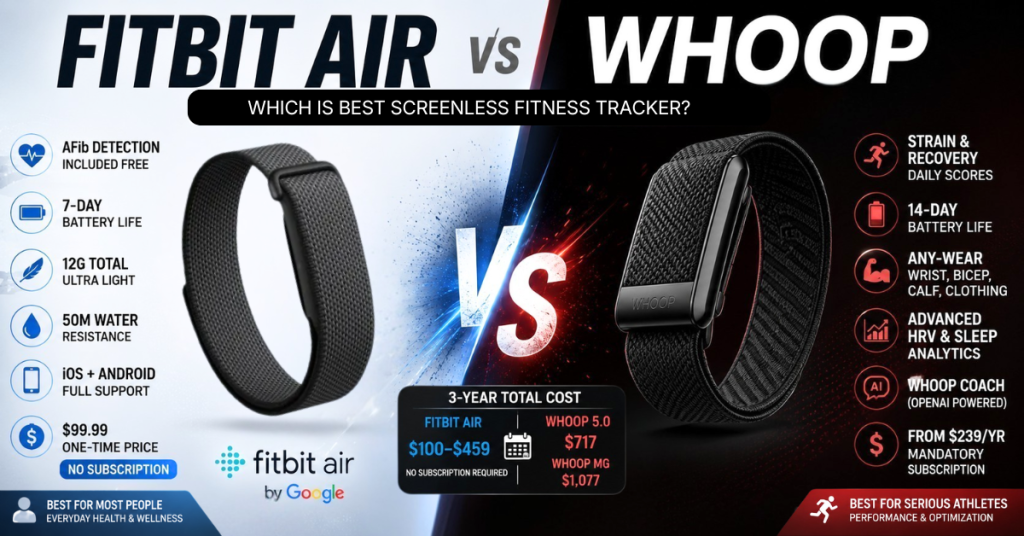
In the Fitbit Air vs Whoop battle for the best screenless fitness tracker in 2026: Fitbit Air wins for most people — at $99.99 one-time with no mandatory subscription, AFib detection included free, 7-day battery, and full iOS + Android support, it delivers remarkable value. Whoop wins for serious athletes who need daily Strain + Recovery scoring, 14-day battery, on-wrist charging, bicep/calf wear options, and more advanced HRV analytics. The cost difference over 3 years: Fitbit Air = $100–$459. Whoop 5.0 = $717. Whoop MG = $1,077.
For six years, if you wanted a screenless fitness tracker that silently measured your health around the clock without a screen, notifications, or distractions, there was exactly one answer: Whoop. And for six years, you paid for that privilege — $199 to $359 per year, every year, with no option to just buy the hardware once.
On May 7, 2026, Google changed that entirely. The Fitbit Air launched at $99.99 — one-time purchase, no subscription required for core features, compatible with both Android and iPhone, and packing AFib detection that Whoop doesn’t even include at its standard tier. Side-by-side photos from early adopters show the Air is roughly half the size of a Whoop on the wrist. And Google’s distribution — JB Hi-Fi, Harvey Norman, Telstra, the Google Store — puts it in front of an audience that Whoop has never reached.
But cheaper doesn’t automatically mean better. Whoop samples heart rate approximately twice as frequently. Its battery lasts 14 days — twice as long. It straps to your bicep, calf, and even inside special athletic clothing. Its Strain/Recovery scoring system is battle-tested over a decade of athlete data. The subscription model funds a platform that Fitbit has only just begun to build.
In this incredibly detailed, comprehensive guide, we are going to break down absolutely everything you need to know about both of these powerhouse wearables. We will look at their design, comfort, health tracking accuracy, sleep monitoring, battery life, and—perhaps most importantly—their long-term cost. We will also dive deep into the fascinating new world of Generative AI coaching that both platforms use to help you reach your goals.
Whether you are a hardcore marathon runner, a casual gym-goer, or just someone who wants to sleep a little better at night, by the end of this article, you will know exactly which tracker deserves a spot on your wrist.
Let’s dive right into the ultimate showdown!
The Rise of the Screenless Fitness Tracker
Before we answer the question, fitbit air vs Whoop – which is best fitness tracker?, it helps to understand why you might want a screenless tracker in the first place.
For years, companies raced to put the biggest, brightest screens on smartwatches. Devices like the Apple Watch and older Fitbit Versa models became mini-smartphones. While this is great for staying connected, it has a downside. It causes digital fatigue. When you are trying to wind down for bed, the last thing you need is a glowing screen on your wrist reminding you of a work email. When you are lifting weights, you do not want to be distracted by a text message.
Screenless trackers like the Fitbit Air and Whoop 5.0 have a single, focused job: they quietly and accurately collect your health data in the background. They do not distract you. They do not beep at you. They just sit comfortably on your wrist (or elsewhere on your body), gathering millions of data points about your heart rate, sleep, temperature, and movement. Then, you can view all those beautiful, detailed insights on your smartphone whenever you choose to look at them.
It is a more mindful, intentional way to track your health. And right now, the Fitbit Air and the Whoop 5.0 are the two best options on the market.
Fitbit Air vs Whoop — Device Overview
Fitbit Air (Google)
- Launch May 7, 2026
- Price $99.99 (no subscription required)
- Size 5.2g pod / 12g total — lightest ever
- Screen None — screenless by design
- Battery Up to 7 days
- Water 50m depth (164 ft)
- Wear position Wrist only (at launch)
- OS compatibility Android + iOS (full)
- App Google Health app
- AFib detection Yes — free, no sub needed
Whoop 5.0 / Whoop MG
- Launch 2024 (Whoop 5.0) / Whoop MG 2025
- Price $239/yr (Peak) · $359/yr (MG Life)
- Size 1.37 × 0.94 × 0.42 in
- Screen None — screenless by design
- Battery Up to 14 days
- Water IP68 — 32 feet for 2 hours
- Wear position Wrist, bicep, calf, in clothing
- OS compatibility Android + iOS (full)
- App Whoop app
- AFib detection Whoop MG only ($359/yr)
Fitbit Air vs Whoop — Complete Feature Comparison 2026
Fitbit Air vs Whoop 5.0 vs Whoop MG — Full Comparison
| Feature | Fitbit Air | Whoop 5.0 | Whoop MG | Winner |
| Price / Model | $99.99 (once) | $239/yr (sub) | $359/yr (sub) | Fitbit Air ✓ |
| Subscription required? | No — optional | Yes — mandatory | Yes — mandatory | Fitbit Air ✓ |
| Device works without payment? | Yes — forever | No — stops working | No — stops working | Fitbit Air ✓ |
| Battery life | 7 days | 14 days | 14 days | Whoop ✓ |
| Charging method | Remove from wrist | On-wrist wireless pack | On-wrist wireless pack | Whoop ✓ |
| Weight | 12g total (5.2g pod) | Heavier | Heavier | Fitbit Air ✓ |
| Water resistance | 50m / 164ft depth | IP68 / ~32ft | IP68 / ~32ft | Fitbit Air ✓ |
| Heart rate sampling rate | Every 2 seconds | Every 1–2 seconds | Every 1–2 seconds | Whoop ✓ (marginal) |
| 24/7 heart rate | ✅ Yes | ✅ Yes | ✅ Yes | Tie |
| Sleep stage tracking | ✅ Yes (15% more accurate) | ✅ Yes | ✅ Yes | Tie |
| SpO2 (Blood Oxygen) | ✅ Yes | ✅ Yes | ✅ Yes | Tie |
| Heart Rate Variability (HRV) | ✅ Yes | ✅ Yes (more detailed) | ✅ Yes (more detailed) | Whoop ✓ |
| Skin temperature | ✅ Yes | ✅ Yes | ✅ Yes | Tie |
| AFib detection | ✅ Yes — FREE | ❌ No | ✅ Yes ($359/yr) | Fitbit Air ✓ |
| ECG scan | ❌ No | ❌ No | ✅ Yes — Whoop MG only | Whoop MG only |
| Daily Strain scoring | ❌ No | ✅ Yes (hallmark feature) | ✅ Yes | Whoop ✓ |
| Daily Recovery score | Limited via AI | ✅ Yes (hallmark feature) | ✅ Yes | Whoop ✓ |
| Wear positions | Wrist only | Wrist, bicep, calf, clothing | Wrist, bicep, calf, clothing | Whoop ✓ |
| AI coaching | Gemini AI (Premium) | Whoop Coach (included) | Whoop Coach (included) | Tie |
| Step tracking | ✅ Yes | ✅ Yes | ✅ Yes | Tie |
| GPS | Connected GPS (phone) | Connected GPS (phone) | Connected GPS (phone) | Tie |
| Band cost (replacement) | From $34.99 | From $49.99 | From $49.99 | Fitbit Air ✓ |
| iOS support | Full (iOS 16.4+) | Full | Full | Tie |
| Android support | Full | Full | Full | Tie |
| Data compiled from Google, Whoop official specs, independent reviews and hands-on testing reports. May 2026. | ||||
Meet the Contenders: A High-Level Overview
To fairly judge the fitbit air vs Whoop – which is best fitness tracker? debate, we need to properly introduce both competitors. Let’s look at what makes each of these devices special.
The New Kid on the Block: Fitbit Air
Announced by Google in May 2026, the Fitbit Air is a massive leap forward for the beloved Fitbit brand. Google has officially started transitioning the “Fitbit” app name into “Google Health,” and the Fitbit Air is the poster child for this new era.
The Fitbit Air is a tiny, incredibly discreet screenless pebble. It is designed to be worn 24/7 without you even noticing it is there. Coming in at an incredibly aggressive price point of just $99.99, it is positioned to be a major disruptor.
But what really makes the Fitbit Air special is its brain. It is deeply integrated with Google’s powerful Gemini AI. Through the new Google Health Coach, the Fitbit Air doesn’t just show you charts and graphs; it talks to you. It acts as a personalized, AI-powered health coach that can adapt your workout plans on the fly. You can even snap a photo of a complicated workout routine written on a gym whiteboard, and the AI will automatically parse the details and log the workout for you. It feels like pure magic.
The Reigning Champion: Whoop 5.0
Whoop has been the dominant force in screenless tracking for years. Beloved by professional athletes, Olympic runners, and dedicated CrossFitters, Whoop is built around three core pillars: Strain (how hard you work), Recovery (how well your body rests), and Sleep (the foundation of it all).
The Whoop 5.0 continues this legacy with a highly refined, durable sensor that measures an impressive array of biometrics, including heart rate variability (HRV), resting heart rate, respiratory rate, blood oxygen saturation (SpO2), and skin temperature.
Unlike the Fitbit Air, Whoop operates strictly on a subscription model. The hardware itself is technically “free,” but you must pay a monthly or annual subscription fee to use the app and access your data. In return, you get some of the most granular, detailed, and scientifically backed recovery analytics available to consumers today. Whoop also features its own AI, the Whoop Coach (powered by OpenAI), which allows you to chat with your data and get personalized advice.
Design, Comfort, and Aesthetics: What Are You Wearing?
When you are expected to wear a device 24 hours a day, 7 days a week, comfort is king. If a fitness tracker is bulky, heavy, or causes skin irritation, you are going to take it off and leave it on your nightstand. And a tracker sitting on your nightstand cannot track your health! Let’s see how they compare.
Fitbit Air Design
The Fitbit Air sensor is a tiny marvel of engineering. It measures approximately 1.4 by 0.7 by 0.3 inches. It is so lightweight that you will honestly forget you are wearing it.
Google completely nailed the band selection for the Air. You get several options:
- Performance Loop Band: This comes standard in the box. It is made from breathable, recycled materials and is micro-adjustable, meaning you can get the absolute perfect fit.
- Active Band: Made of sweatproof and waterproof silicone, this one features a subtle ribbed design that is perfect for heavy sweaters and swimmers.
- Elevated Modern Band: If you want your tracker to look like a piece of high-end jewelry for a night out, this band turns the silicone pebble into a fashionable bracelet.
- The Stephen Curry Special Edition: Co-designed by the NBA legend himself, this special edition Performance Loop band comes in a beautiful elegant rye brown with a pop of game-day orange, featuring a raised interior print inspired by athletic racing stripes to increase airflow.
Whoop 5.0 Design
The Whoop 5.0 tracking module is very similar in size, measuring 1.37 by 0.94 by 0.42 inches. It is slightly wider but roughly the same overall volume. It features a rugged, premium feel and boasts an IP68 rating, meaning it can survive being submerged in 32 feet of water for up to two hours.
Whoop is famous for its massive ecosystem of bands, known as SuperKnit and HydroKnit bands. They come in hundreds of color combinations, allowing for endless personalization.
However, Whoop has a secret weapon called Any-Wear Technology. You do not have to wear the Whoop on your wrist. You can remove the sensor from the band and slip it into specially designed Whoop apparel, such as sports bras, compression tops, boxers, or bicep bands. For athletes who play contact sports (like basketball or martial arts) where wrist wear is prohibited, this is an absolute game-changer.
The Winner for Design: It is a tie. If you want the smallest possible footprint and love the Stephen Curry special edition, the Fitbit Air wins. If you play contact sports and need the Any-Wear clothing integration, Whoop wins.
fitbit air vs Whoop – which is best fitness tracker for Health Tracking?
At the core of this debate is how well these devices actually track what your body is doing. Both use advanced optical sensors, accelerometers, and temperature sensors. But they present the data very differently.
Heart Rate and Movement
Both the Fitbit Air and the Whoop 5.0 offer highly accurate 24/7 continuous heart rate tracking. They both use photoplethysmography (PPG) sensors to measure your pulse by shining light into your skin.
Whoop tracks a massive variety of specific exercises, from weightlifting to yoga to yard work. In recent years, Whoop has vastly improved its strength training feature. It can actually track the muscular strain of specific movements like squats, bench presses, and deadlifts, rather than just cardiovascular strain. This makes Whoop phenomenal for weightlifters.
The Fitbit Air is no slouch, either. It uses its gyroscope and accelerometer to automatically detect when you start working out. If you go for a run or start cycling, the Fitbit Air knows, and it will send a summary to your phone afterward. Furthermore, the Fitbit Air has a dedicated focus on holistic medical health. It includes heart rhythm monitoring with AFib (atrial fibrillation) alerts. If your heart starts beating in an irregular, potentially dangerous pattern, the Fitbit Air can alert you so you can consult a doctor. Whoop does not offer medical AFib alerts.
The Recovery Battle: Daily Readiness vs. Strain & Recovery
How do these trackers tell you if you should go hard at the gym or take a rest day?
Whoop’s Approach: Every morning, Whoop gives you a Recovery Score from 0% to 100%, color-coded red, yellow, or green. This score is heavily based on your Heart Rate Variability (HRV)—which is the tiny time differences between your heartbeats—as well as your resting heart rate, sleep quality, and respiratory rate. Throughout the day, as you exercise and move, you build up a “Strain” score from 0 to 21. Whoop gamifies fitness by telling you exactly how much Strain you should aim for to match your Recovery.
Fitbit’s Approach: Fitbit uses a similar concept called the “Daily Readiness Score.” By looking at your recent activity levels, your sleep from the night before, and your HRV, Fitbit tells you whether your body is primed for a tough workout or if you need to prioritize recovery. It also tracks “Cardio Load,” which measures the total stress placed on your cardiovascular system over time.
The Winner for Health Tracking: If your primary focus is hardcore athletic training, muscle strain, and pushing your physical limits, Whoop 5.0 wins. If your goal is overall wellness, automatic workout detection, and medical features like AFib alerts, the Fitbit Air wins.
The Ultimate Sleep Tracking Showdown
Sleep is the ultimate performance enhancer. If you are not sleeping well, you will not lose weight, you will not build muscle, and your mental health will suffer. Therefore, in the battle of fitbit air vs Whoop – which is best fitness tracker, sleep tracking is arguably the most critical category.
Fitbit Air: The Sleep Pioneer
Fitbit has long been considered the gold standard for consumer sleep tracking. The Fitbit Air continues this legacy flawlessly. Because the tracker is so thin and light, it is a joy to sleep with.
The Fitbit Air accurately breaks down your night into Light Sleep, Deep Sleep, and REM (Rapid Eye Movement) Sleep, as well as the times you woke up during the night. The Google Health app presents this in easy-to-read charts and gives you an overall “Sleep Score” out of 100. Over time, the app learns your baseline and provides actionable advice. For example, it might tell you that your deep sleep drops on nights when your skin temperature runs high, suggesting you lower your bedroom thermostat.
Whoop 5.0: The Sleep Coach
Whoop is equally obsessed with sleep. Whoop also tracks your sleep stages flawlessly and provides a sleep score. However, Whoop takes it a step further with the “Sleep Coach.”
The Whoop app looks at the strain you accumulated during the day and calculates exactly how much sleep you need to recover fully. It might tell you, “To reach peak performance tomorrow, you need exactly 8 hours and 14 minutes of sleep. You should go to bed at 10:15 PM.” Whoop also features a gentle haptic alarm. Instead of waking up to a blaring smartphone alarm, the Whoop strap silently vibrates on your wrist to wake you up gently at the optimal time in your sleep cycle.
The Winner for Sleep Tracking: Whoop 5.0 narrowly wins here due to the brilliant Sleep Coach recommendations and the silent haptic alarm feature, though Fitbit’s raw data accuracy remains tied for first place.
Sleep is where both devices arguably deliver the most value for most users. Both track sleep stages (light, deep and REM), sleep duration, SpO2 throughout the night, resting heart rate, and skin temperature changes. Here’s how they compare on the metrics that matter.
Fitbit Air’s Sleep Tracking Advantage
Google claims the Fitbit Air delivers 15% more accurate sleep tracking than any previous Fitbit device, thanks to improved sensor algorithms and the natural advantage of the screenless form factor — you actually wear it to bed because it’s light and comfortable enough. At 12g, most users genuinely forget it’s there. The comfort factor is not trivial: research consistently shows that wearers who are conscious of their tracker sleep differently. The Fitbit Air removes that variable entirely. All sleep data flows into the Google Health app with daily readiness and recovery insights.
Whoop’s Sleep Coaching Advantage
Whoop’s sleep coach is one of its most praised features. It tells you exactly when to go to sleep and wake up based on your sleep debt, upcoming schedule and biometric data — not just your historical averages. Whoop also tracks Sleep Performance (how much sleep you got vs how much you needed), and its “Sleep Debt” metric accumulates over weeks to show your chronic sleep deficit. This level of personalised sleep coaching is more actionable than what the Fitbit Air’s standard tier provides — though Google Health Premium’s Gemini AI Coach adds comparable guidance for an additional $9.99/month.
Software, Apps, and AI: Welcome to the Future
We are in the year 2026, and Generative Artificial Intelligence is everywhere. Both of these trackers heavily rely on AI to help you make sense of your data. This is where the fitbit air vs Whoop – which is best fitness tracker? comparison gets truly fascinating.
The Google Health Ecosystem and Gemini AI
With the launch of the Fitbit Air, Google has effectively unified its health ecosystem. The old Fitbit app has transformed into the beautiful, intuitive Google Health app.
The crown jewel of this experience is the Google Health Coach, powered by Google’s Gemini AI. This is not just a dashboard; it is a conversational partner. Imagine you just finished a week of poor sleep. You can open the app and type, “Hey, my sleep has been terrible this week, and my Cardio Load is high. What should I do at the gym today?” The Gemini AI will instantly analyze your personal data and reply: “Since your resting heart rate is up and your sleep is down, I suggest skipping your planned heavy leg day. Instead, try a 30-minute zone-2 cardio session or a restorative yoga flow. I have linked a suggested video for you here.”
Even crazier? The flexible input. If you walk into a gym and see a complex circuit training routine written on a whiteboard, you can literally snap a photo of it with your phone. The Gemini AI will read the whiteboard, understand the exercises, and automatically log the workout and the associated strain into your profile. It is mind-blowing technology.
The Whoop Coach (Powered by OpenAI)
Whoop uses a similar feature called Whoop Coach, powered by OpenAI. Like Gemini, you can chat with it. You can ask, “Why am I so tired today?” and the Whoop Coach will scan your recent data, perhaps noticing that your alcohol intake (which you logged in your daily journal) tanked your HRV, leading to poor recovery.
Whoop’s AI is incredibly good at analyzing habits. Whoop forces you to fill out a daily journal every morning (asking things like: Did you drink alcohol? Did you view screens in bed? Did you take magnesium?). After a month, the AI will give you a report saying, “Wearing a sleep mask increases your REM sleep by 12%.”
The Winner for AI and Software: Fitbit Air wins for convenience and the sheer “wow” factor of photo-logging workouts. Whoop wins for habit tracking and correlating specific behaviors to recovery.
Battery Life and Charging
A fitness tracker is completely useless if it is sitting on a charger.
Fitbit Air Battery Life
The Fitbit Air boasts a very impressive 7-day battery life. This is a massive upgrade over older Fitbit models. Because there is no screen to drain power, the tiny battery sips energy.
Even better is the fast charging. If you realize your Fitbit Air is dead right before a run, plugging it in for just 5 minutes will give you a full day of battery life. A full charge from 0 to 100% takes just 90 minutes. You do have to take the Fitbit Air off your wrist to charge it via its proprietary magnetic cable.
Whoop 5.0 Battery Life
Whoop generally lasts about 4 to 5 days on a single charge. However, Whoop has the most unique charging mechanism in the wearable world.
You never have to take the Whoop off your wrist to charge it. Instead, Whoop uses a small, waterproof wireless battery pack that you slide directly over the sensor while you are still wearing it. You can literally charge your Whoop while you are washing the dishes, typing at your desk, or even taking a shower. Once the Whoop is charged, you simply slide the battery pack off.
The Winner for Battery: Fitbit Air wins for raw longevity (a full week), but Whoop wins for the sheer brilliance of the slide-on battery pack that ensures you never lose a minute of data.
Sensors and Accuracy — Fitbit Air vs Whoop 5.0
Both the Fitbit Air and Whoop use photoplethysmography (PPG) LED sensors for heart rate and oxygen measurement. The hardware is comparable. The differences emerge in sampling frequency and the algorithms that process the raw data.
Sensor Comparison — Fitbit Air vs Whoop 5.0
| Sensor / Metric | Fitbit Air | Whoop 5.0 | Edge |
| Heart rate sensor type | PPG optical LEDs | PPG optical LEDs (5-LED array) | Whoop (more LEDs) |
| Heart rate sampling rate | Every 2 seconds | Every 1–2 seconds | Whoop ✓ (marginal) |
| SpO2 sensors | Yes — continuous capable | Yes — continuous capable | Tie |
| Skin temperature | Yes | Yes | Tie |
| HRV measurement | Yes | Yes — more detailed analysis | Whoop ✓ |
| Accelerometer | Yes — 3-axis | Yes — 9-axis (accel + gyro + mag) | Whoop ✓ |
| ECG electrodes | No | Whoop MG only | Whoop MG only |
| Galvanic skin response | No | No (Whoop 5.0) | Tie |
| Whoop 5.0’s 9-axis IMU and denser LED array give it a technical sensor edge. Whether this translates to meaningfully better tracking for the average user in daily life is debated — both devices produce accurate enough data for health monitoring purposes. | |||
The AFib Bombshell — Free on the Fitbit Air
Atrial fibrillation detection is the most surprising spec of the Fitbit Air.
AFib detection is free on the Fitbit Air
— no subscription required. On Whoop, AFib is only available on the Whoop MG ($359/year), not the standard Whoop 5.0 ($239/year). For anyone concerned about heart rhythm irregularities — particularly those over 50 or with family history of AFib — the Fitbit Air delivers a clinically meaningful feature that Whoop charges 50% more per year to access. This single feature comparison dramatically reshapes the value equation.
Pricing and Subscriptions: The Elephant in the Room
When deciding fitbit air vs Whoop – which is best fitness tracker?, we have to talk about money. This is the single biggest difference between the two devices.
The Cost of the Fitbit Air
Google aggressively priced the Fitbit Air at $99.99.
Here is the best part: You do not need a subscription to use the core features. For a one-time payment of $99.99, you get the hardware, and you get full access to your sleep stages, heart rate data, step counts, and automatic workout detection in the Google Health app forever.
Google does offer a premium subscription called Google Health Premium (which powers the advanced Gemini AI coaching and deeper sleep analytics). This costs $10 a month (or $100 a year). However, every purchase of the Fitbit Air comes with 3 months of this premium service for free. Even if you cancel it after 3 months, your tracker will still work perfectly for basic data.
The Cost of the Whoop 5.0
Whoop takes a completely different approach. The Whoop hardware is free, but the subscription is mandatory.
If you stop paying for Whoop, the app locks you out, and the strap becomes a useless piece of fabric and plastic. The subscription is relatively steep:
- Month-to-month: $30 per month
- Annual membership: $239 per year
- 24-month membership: $399 up front
Let’s do the math over a two-year lifespan:
- Fitbit Air (No subscription): $99.99 total.
- Fitbit Air (With Premium for 2 years): $99 (device) + $190 (21 months of premium after the 3-month trial) = ~$289 total.
- Whoop 5.0 (2-year membership): $399 total.
The Winner for Pricing: The Fitbit Air destroys Whoop in terms of affordability. The fact that the Fitbit Air can function as a highly accurate, subscription-free tracker makes it incredibly consumer-friendly.
The Whoop “Device Lock” Problem — What Nobody Talks About
If you stop paying your Whoop subscription, the device stops working entirely. It doesn’t become a basic step counter. It becomes a silicone bracelet. The Fitbit Air’s business model is the opposite: core health tracking — heart rate, sleep stages, SpO2, HRV, AFib alerts — is free forever, regardless of whether you ever subscribe to Premium. This model alignment with your interests vs the subscription model is a fundamental difference in how these two companies see their relationship with you.
Who Should Buy Which?
We have looked at the data, we have examined the hardware, and we have crunched the numbers. So, in the epic battle of fitbit air vs Whoop – which is best fitness tracker?, what is the final answer?
The truth is, both of these trackers are absolute masterpieces of health technology in 2026. The “best” one depends entirely on your lifestyle, your goals, and your budget.
You should buy the Fitbit Air if:
- You want a one-time purchase. If you hate monthly subscriptions and just want to buy a device and own it, the Fitbit Air is the undisputed winner.
- You are part of the Google Ecosystem. If you use Android, a Pixel phone, or want seamless integration with Google’s Gemini AI, this is the tracker for you. (Though it works great on iOS too!)
- You care about medical alerts. The inclusion of AFib heart rhythm monitoring provides peace of mind that Whoop does not offer.
- You are a casual to moderate fitness enthusiast. If you run, hike, do yoga, or hit the gym a few times a week, the Fitbit Air provides more than enough data to keep you healthy and motivated.
You should buy the Whoop 5.0 if:
- You are a hardcore or competitive athlete. If you are training for a marathon, doing high-intensity CrossFit, or lifting heavy weights, Whoop’s Strain and Recovery metrics are simply unmatched in the industry.
- You want to optimize your habits. If you are a biohacker who wants to know exactly how a glass of wine or 10 minutes of meditation affects your deep sleep, Whoop’s journal and AI analysis will change your life.
- You play contact sports. The ability to remove the Whoop sensor and wear it in your boxer briefs or sports bra via Any-Wear technology is essential for basketball, soccer, and martial arts.
- You don’t mind a premium subscription. If you are willing to pay for top-tier, elite data analysis and you see it as an investment in your body, Whoop is worth every penny.
Frequently Asked Questions — Fitbit Air vs Whoop
Is Fitbit Air better than Whoop?
For most people, yes — the Fitbit Air is the better choice in 2026. At $99.99 one-time with no mandatory subscription, AFib detection included free, 7-day battery, and full iOS + Android support, it delivers remarkable value for everyday health monitoring. Over 3 years, the Fitbit Air costs $100 (free tier) or $459 (with Premium) vs Whoop’s $717–$1,077. Whoop remains better for serious athletes who specifically use its daily Strain and Recovery scoring system and need bicep/calf wear positions. But for the 90%+ of users who aren’t competitive athletes, the Fitbit Air wins on almost every metric that matters for daily health tracking.
What is the main difference in the fitbit air vs Whoop – which is best fitness tracker comparison?
The main difference lies in their target audience and pricing models. The Fitbit Air is a $99 device that tracks excellent holistic health data without requiring a mandatory monthly subscription, making it great for the general public. The Whoop 5.0 requires a mandatory subscription (around $30/month) and provides ultra-detailed recovery, strain, and sleep metrics geared toward hardcore athletes and biohackers.
Does the Fitbit Air require a monthly subscription to work?
No! The Fitbit Air works perfectly fine without a subscription. You can track your steps, continuous heart rate, sleep stages, and automatic workouts for free. Google does offer an optional “Google Health Premium” subscription for $10/month that unlocks advanced Gemini AI coaching and deeper data analysis, but it is not required.
fitbit air vs Whoop – which is best fitness tracker for weightlifting and strength training?
The Whoop 5.0 is the better tracker for weightlifting. Whoop features a specialized “Strength Trainer” mode that measures muscular strain based on the volume and intensity of your lifts, giving you a true picture of how taxing your gym session was. The Fitbit Air is great for cardio and general movement, but currently lacks Whoop’s advanced muscular strain algorithms.
Can you wear the Fitbit Air and Whoop 5.0 in the shower or while swimming?
Yes, both devices are highly water-resistant. The Whoop 5.0 has an IP68 rating, meaning it can be submerged in up to 32 feet of water. The Fitbit Air is also fully water-resistant and suitable for swimming and showering. However, it is always recommended to dry the band and your skin afterward to prevent skin irritation.
Which tracker has the best AI health coach?
Both trackers feature incredible Generative AI, but they shine in different areas. The Fitbit Air uses Google’s Gemini AI, which is fantastic for generating on-the-fly workout plans and allows you to log workouts just by snapping a photo of gym equipment. Whoop uses OpenAI for the Whoop Coach, which excels at deeply analyzing your daily habits (like diet and screen time) and explaining exactly how they impact your physiological recovery.
Can I wear the Fitbit Air if I use an Apple iPhone?
Yes! Even though the Fitbit Air is made by Google, it is fully compatible with both Android and iOS devices. You simply download the Google Health app from the Apple App Store, and it will sync seamlessly with your iPhone.
Individual Verdicts — Honest Scores
Fitbit Air Verdict
Fitbit Air — Exceptional Value, Surprisingly Complete
Google included AFib detection on a $99.99 no-subscription device. That single move reshapes the entire screenless tracker conversation. Add the 7-day battery, 50m depth water resistance (deeper than Whoop), the lightest form factor in the category, full iOS + Android support, and a genuinely free-forever core tracking tier — and the Fitbit Air is one of the most compelling health wearable launches of 2026.
The Fitbit Air doesn’t have Whoop’s Strain score or bicep-band ecosystem. But for the overwhelming majority of users — the ones who want to know how well they slept, how their heart rate trends over weeks, and whether their heart rhythm is showing anything concerning — it delivers more than enough. At a fraction of the lifetime cost.
Whoop 5.0 Verdict
Whoop 5.0 — Still the Athletes’ Choice, But Harder to Justify for Everyone Else
Whoop 5.0 is still excellent hardware with a mature platform built over a decade of athlete testing. Its Strain/Recovery scoring system is genuinely useful for structured training, its 14-day battery with on-wrist charging is a technical triumph, and the bicep-band ecosystem serves athletes that no wrist-only tracker can.
But Whoop’s position became dramatically harder the moment the Fitbit Air launched. The subscription model — which made sense when Whoop had no competition — now asks you to pay $600–$1,000+ over 3 years for a device that stops working if you miss a payment, with no AFib detection on the standard tier. Whoop remains the right choice for serious athletes. For everyone else, the Fitbit Air is now the honest answer.
Final Verdict: Fitbit Air vs Whoop
The screenless tracker market looks completely different than it did 6 months ago. Here’s how to decide in 60 seconds.
Choose Fitbit Air if…
You want AFib detection, 7-day battery, full iOS support, and serious health tracking for $100 once — with no subscription required for core features.
Choose Whoop if…
You’re a serious athlete who depends on daily Strain + Recovery scoring, needs 14-day battery with on-wrist charging, or trains in positions where wrist wear doesn’t work.
Disclaimer: Health and fitness trackers provide estimations of your physical state and should not replace professional medical advice. Always consult with a doctor before beginning a new fitness regimen or if you have concerns about your heart health.