





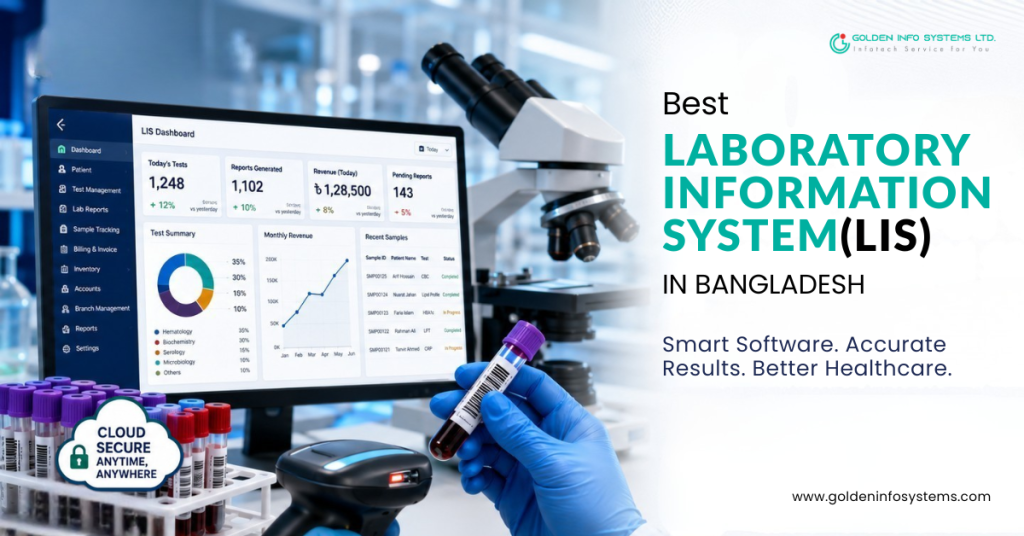
Are you still relying on manual paperwork and endless Excel sheets to run your diagnostic center, risking human errors that could literally cost lives?
Did you know that nearly 70% of all medical decisions rely strictly on laboratory test results, yet labs using manual, paper-based reporting experience an error rate of up to 15%? In the fast-paced medical field, a single mislabeled sample or delayed report isn’t just an inconvenience—it can drastically alter a patient’s treatment path.
If you run a hospital, clinic, or diagnostic center in Dhaka, Chittagong, or anywhere else in the country, you already know how chaotic a busy lab can get. Between managing patient samples, tracking inventory, ensuring accurate billing, and delivering error-free reports on time, the pressure is immense. The healthcare sector is evolving fast, and falling behind on technology is no longer an option.
To solve this chaos, you need the Best Laboratory Information System (LIS) in Bangladesh. A smart, cloud-based LIS software does not just organize your data; it completely transforms your daily operations, improves patient trust, and protects your bottom line.
In this comprehensive, easily understood guide, we will break down the top 10 systems available in the market right now. We will explore their features, how they can transform your daily operations, and exactly what you need to look for before making a buyer’s decision.
Let’s dive into finding the perfect digital partner for your laboratory!
What is a Laboratory Information System (LIS)?
A Laboratory Information System (LIS) is a specialized software solution designed to manage and automate the workflow of a medical laboratory. From the moment a patient registers at the front desk or requests a home sample collection, the LIS takes over.
It tracks the sample using barcodes, integrates directly with lab machines (like your hematology or biochemistry analyzers) to fetch results automatically, generates a digital report, and handles all the billing and accounting in the background. Simply put, it is the digital brain of your diagnostic center.
As we look at the top cloud infrastructure trends moving into 2026—where resilience, scalability, and digital growth are dominating the IT sector—moving your lab to a robust, cloud-based LIS ensures your business is protected against data loss and is ready to scale across multiple branches.
Key Features to Look for in the Best Laboratory Information System (LIS) in Bangladesh
Before you invest in any software, you must ensure it has the right tools to handle the unique challenges of the Bangladeshi healthcare market. Here is what the top-tier systems offer:
- Barcode Integration: To eliminate sample mix-ups and ensure 100% accuracy.
- Machine Integration: The software must connect directly to your lab analyzers (Sysmex, Cobas, etc.) to fetch results without manual typing.
- Home Sample Collection Management: A highly demanded feature in Bangladesh post-pandemic.
- Complete Accounting & Billing: Integrated invoicing, discount management, and expense tracking.
- Branch Management: The ability to control multiple diagnostic center branches from one central admin panel.
- Inventory Management: Automated alerts when reagents, chemicals, or medical supplies are running low.
Why You Need the Best Laboratory Information System (LIS) in Bangladesh
Before we rank the top software providers, let’s talk about why upgrading your system is critical for your business and your patients.
A Laboratory Information System (LIS) is a specialized software solution that manages your entire laboratory operations efficiently, right from the moment a sample is collected to the second the final result is reported.
Here is why upgrading to a premium LIS is the smartest business move you can make:
- Zero Human Error: Say goodbye to handwriting mistakes. With barcode integration and automated machine results, data moves directly from the analyzer to the report.
- Lightning-Fast Turnaround Times (TAT): Your patients want their results yesterday. A great LIS automates the workflow, allowing you to process more tests in half the time.
- Cloud Resilience: Tying back to the top cloud infrastructure trends, modern LIS platforms save your data securely in the cloud. You never have to worry about a hard drive crashing or losing a patient’s history.
- Financial Control: Revenue leakage is a massive problem for diagnostic centers. Integrated billing, invoicing, and expense management ensure every single test is paid for and accounted for.
Now, let’s explore the market leaders.
The 10 Best Laboratory Information System (LIS) in Bangladesh
After analyzing features, user-friendliness, local support, and scalability, here is our curated list of the top 10 LIS software providers you can trust for your medical facility.
1. G-LIS (Lab Information System) – The Ultimate All-in-One Solution
Taking the number one spot is G-LIS, an incredibly powerful, intuitive, and modern system designed specifically for the unique demands of the Bangladeshi healthcare market.
G-LIS manages laboratory operations efficiently, from sample collection to result reporting. It ensures accurate data processing, streamlines your workflow, and improves the overall quality of your laboratory services. Ultimately, this system contributes to faster and more reliable diagnostic outcomes for your patients.
If you want a system that works flawlessly without requiring a steep learning curve for your staff, G-LIS is the gold standard.
Key System Features of G-LIS:
Patient Module: Your patients are the heart of your business. The G-LIS Patient Module allows your front-desk staff to register patients in seconds. It captures essential demographic data, tracks patient history, and provides a seamless onboarding experience. No more long queues at your reception desk! A centralized database where you can access a patient’s entire medical history, previous test results, and demographic details in seconds.
Home Sample Collection Management: A highly demanded feature in Dhaka today. Easily schedule, track, and manage phlebotomists who travel to patients’ homes for sample collection.This is a game-changer for the Bangladeshi market. Since the pandemic, patients prefer the convenience of home services. G-LIS offers a dedicated module to schedule, track, and manage phlebotomists who travel to patients’ homes. You can track sample pickup times and ensure the sample reaches your lab safely and efficiently.
Test Management: Customize your test parameters, normal values, and critical alerts. This is the core engine of your lab. The Test Management feature allows you to define testing parameters, set normal/abnormal reference ranges, and manage the entire lifecycle of a sample. It links directly with your lab machines to pull data automatically, saving your pathologists hours of manual typing.
Lab Report Module: Generate beautiful, professional, and easy-to-read reports that automatically highlight abnormal values. Say goodbye to poorly formatted, confusing paper reports. The Lab Report Module generates beautiful, professional, and easy-to-read diagnostic reports. Pathologists can digitally sign these reports, and the system can instantly email or SMS them directly to the patient or the referring doctor.
Accounting Report: Get instant insights into your daily, weekly, or monthly revenue.
Inventory Management: Never run out of crucial reagents. The system tracks your stock and alerts you before items expire or run low. Are you losing money because expensive reagents are expiring on your shelves? The G-LIS Inventory Management feature tracks every single chemical, test kit, and consumable in your lab. It alerts you when stock is running low and tracks expiration dates, ensuring you never waste money on expired materials again.
Branch Management: Do you have multiple diagnostic centers? Manage all your branches from one single, centralized dashboard. If you are dreaming of digital growth and scaling your business, you need Branch Management. Whether you have two collection booths or twenty full-scale labs across Bangladesh, G-LIS lets you manage all of them from one single screen. You can monitor the revenue, test volume, and inventory of every branch in real-time.
Bar Code Integration: Scan a barcode, and the system instantly knows the patient, the test, and the required tube. It eliminates sample mixing. This feature alone makes G-LIS worth the investment. As soon as a patient registers, the system prints a unique barcode label. This label is attached to the sample tube. From that moment on, every machine and technician simply scans the barcode. This ensures 100% accuracy and completely eliminates the risk of sample mix-ups.
Billing and Invoicing: Fast, transparent, and accurate billing at the front desk. No more manual calculations. Financial health is just as important as patient health. G-LIS handles complex billing, corporate discounts, and referral commissions effortlessly. The Accounting Report feature gives you a crystal-clear view of your daily, weekly, and monthly revenue.
Expense Management: Track where your money is going, from purchasing chemicals to paying utility bills. Track your overheads, from electricity bills to staff salaries and reagent purchases. By having your income and expenses in one system, you get an accurate picture of your lab’s actual profitability.
Best For: Clinics, diagnostic centers, and large hospital networks looking for a highly reliable, feature-rich, and scalable solution.
Explore G-LIS Features Here
2. Sara LIS (Sara Software)
Coming in a close second is Sara LIS. Known for its strong presence in the local market, Sara Software offers a robust cloud-hosted platform. Their LIS is highly praised for its centralized report generation, which is perfect if you operate a chain of pathology labs.
Key Benefits:
- Direct Instrument Connectivity: It connects directly to your lab machines (like Sysmex or Roche analyzers), pulling data automatically.
- Patient Portal: Patients can log in online to download their own reports, reducing crowds in your waiting room.
- Error-Free Transcription: By bypassing manual typing, Sara LIS ensures that reports pose no risk to patient safety.
- End-to-End Traceability: Excellent barcode-based sample tracking.
- Referral Management: Built-in CRM tools to track doctor referrals and calculate commissions easily.
- Online Report Delivery: Patients can securely get their reports via SMS or a patient portal, reducing crowds in your waiting room.
- Cloud-Hosted: Ensures you can monitor your lab’s performance from your smartphone anywhere in Dhaka or beyond.
Best For: Multi-branch diagnostic centers that need centralized management and strong cloud capabilities.
3. MySoft LIS (MySoft Limited) The Cloud-Based Pioneer
MySoft Limited has been a pioneering force in Bangladeshi healthcare software. Their LIS is known as the “Brain of the Laboratory.” MySoft focuses heavily on global standards like HL7 and LOINC, making it a great choice for internationally accredited labs.
Key Benefits:
- Hardware Independent: It runs on Windows, Mac, or Linux through a simple web browser. You don’t need expensive server rooms.
- Digital Signatures: Pathologists can review and sign urgent reports digitally from their tablets, even while stuck in Dhaka traffic.
- Predictive Inventory: Smart analytics help you prep resources before your lab hits peak hours.
- Machine Interfacing: MySoft has excellent integration capabilities, connecting directly with popular analyzers from brands like Roche, Sysmex, and Abbott.
- Visual MIS Dashboards: It turns raw lab data into visual charts, helping management make quick, informed decisions.
- Zero Downtime Updates: Being a true cloud solution, updates happen seamlessly in the background without disrupting your lab’s operations.
Best For: Large hospitals and enterprise-level labs aiming for international accreditation standards.
4. LUCID LIS (Lucid Tech)
Lucid Tech provides an excellent LIS that stands out for its integrated blood bank management and intelligent queue management system (QMS). If your hospital runs a busy blood bank alongside regular pathology, LUCID LIS connects these operations seamlessly. Lucid Tech has made a massive impact on the Bangladeshi healthcare IT sector by combining robust lab management with exceptional queue management systems. Their LUCID LIS is currently trusted by hundreds of diagnostic centers across the country.
What makes LUCID LIS stand out is how it handles the patient experience within the waiting room.
Key Benefits:
- Comprehensive Blood Bank Management: Complete donor management, blood inventory tracking, and safety protocol enforcement. If your facility includes a blood bank, LUCID offers specialized modules for tracking blood groups, donor history, and cross-matching.
- Smart Queue Optimization(QMS): Reduces patient wait times by using digital tokens and display screens in your waiting area. It integrates seamlessly with digital display boards and mobile tokens, reducing patient wait times and preventing chaotic crowds in your waiting area.
- Expense & Procurement: Strong focus on vendor management and tracking operational costs.
- Automated Reporting: Fast turnaround times for standard tests with easy digital verification.
Best For: Hospitals with active blood banks and heavy daily foot traffic requiring queue management.
5. MediSoft (Medistore)
MediSoft offers a comprehensive, cloud-based diagnostic management system. It is heavily favored by smaller clinics and standalone pathology labs because it packages LIS features alongside pharmacy Point of Sale (POS) and HR modules.
Key Benefits:
- Integrated Pharmacy POS: If your lab has an attached pharmacy, this software manages medicine inventory and test billing together.
- Doctor Referral Tracking: Automatically calculates and tracks doctor commissions and referral data accurately.
- Quick Registration: Designed for speed, allowing front-desk staff to register a patient and generate an invoice in seconds.
Best For: Standalone pathology labs and clinics that also operate an in-house pharmacy.
6. SoftClinic GenX LIS
SoftClinic GenX brings an international flavor to the local market. It is engineered with deep insights into healthcare workflows. It is particularly strong in data privacy and role-based access.
Key Benefits:
- Rule-Based Workflows: You can set strict rules for sample validation. A report cannot be printed unless a senior pathologist approves it.
- Dynamic Data Visibility: Front desk staff only see billing, technicians only see test data, and doctors see the full clinical picture.
- Automated Communication: Sends SMS nudges to patients for report collection or follow-up tests.
Best For: Mid-to-large labs that prioritize strict data security and automated patient communication.
7. Arch HMS & LIS (Esteem Soft Limited)
Arch is a popular cloud-based solution from Esteem Soft Limited. While it is primarily a Hospital Management System, its integrated laboratory module is highly effective for facilities that want an all-in-one ERP (Enterprise Resource Planning) system.
Key Benefits:
- Seamless Hospital Integration: Lab data flows directly to the inpatient wards and the doctor’s Outpatient Department (OPD) screens.
- Affordable Scaling: Good pricing models for hospitals that are just starting out and plan to grow.
- Customizable Templates: Easy-to-edit templates for complex biopsy or histopathology reports.
Best For: Newly established hospitals that need a unified system for both patient wards and the laboratory.
8. PrideHealth LIS (Pridesys IT)
Pridesys IT is one of Bangladesh’s leading corporate IT companies, and their PrideHealth platform is an enterprise-grade solution. Their LIS focuses heavily on big data analytics and operational efficiency.
Key Benefits:
- Deep Analytics: Generates highly detailed visual graphs showing disease trends or lab revenue over years.
- High Scalability: Built on robust architecture that can handle millions of patient records without slowing down.
- Corporate Integration: Easily connects with external corporate HR systems for corporate health check-up billing.
Best For: Large corporate healthcare networks and government medical facilities.
9. Smart Software LIS
Smart Software Ltd has gained trust since 2014 by offering very user-friendly interfaces. Their LIS is designed so that even staff members with minimal computer experience can learn to use it within a day.
Key Benefits:
- Intuitive UI: Large buttons, clear menus, and simple navigation.
- Mobile Friendly: Managers can check daily revenue and test counts right from their smartphones.
- Rapid Deployment: The software can be installed and staff can be trained in a remarkably short time frame.
Best For: Smaller labs or rural diagnostic centers transitioning from paper to digital for the very first time.
10. JBRSOFT LIS (Specialized Health Tech)
JBRSOFT Limited offers specialized solutions, including public health surveillance and pharmacy operations. Their laboratory modules are excellent for labs involved in specialized research or government reporting.
Key Benefits:
- Interoperability: Seamless data exchange bridges with national databases (like WHONET for antimicrobial resistance tracking).
- High Uptime: Built on resilient network infrastructure ensuring 99.98% uptime.
- Audit-Friendly: Maintains a deep, unchangeable audit trail of who edited what result and when.
Best For: Research laboratories, NGO clinics, and labs focusing on specialized public health data.
Must-Have Features in Your Next Laboratory Information System
Choosing the Best Laboratory Information System (LIS) in Bangladesh is a big decision. As you compare providers, ensure your chosen software includes these non-negotiable features (which come standard in top-tier systems like G-LIS):
1. True Barcode Integration
Without barcodes, your lab is at risk of human error. The system must generate a unique barcode for every sample at the front desk. When the technician scans this barcode, the software should instantly know which tests to run. This entirely eliminates the nightmare of mixing up Patient A’s blood with Patient B’s blood.
2. Bi-Directional Machine Interfacing
Your LIS needs to “talk” to your lab machines. Bi-directional interfacing means the software sends instructions to the analyzer (e.g., “Run a Lipid Profile on this sample”), and the analyzer sends the results directly back to the software. No one has to type numbers from a printout into a computer.
3. Comprehensive Inventory Management
Laboratories lose thousands of Taka every month due to expired reagents or stolen supplies. Your LIS must track every drop of chemical used. It should automatically deduct inventory when a test is run and alert you when stock falls below a safe level.
4. Home Sample Collection Management
In post-pandemic Bangladesh, patients prefer healthcare at their doorstep. A modern LIS allows you to assign a phlebotomist to a patient’s home, track their location, and input sample data via a mobile app on the spot.
5. Rock-Solid Accounting and Billing
Your LIS is also your cash register. It needs to handle complex billing scenarios: partial payments, corporate discounts, doctor referrals, and insurance claims. The expense management module should give you a clear daily profit and loss statement.
Cloud vs. On-Premise LIS: Which is Right for You?
As highlighted in the Top Cloud Infrastructure Trends in 2025, the debate between Cloud and On-Premise software is largely settling in favor of the cloud, but let’s break down what this means for your lab in Bangladesh.
Cloud-Based LIS: The software lives on secure internet servers (like AWS or Google Cloud).
- Pros: You don’t need to buy expensive servers. You can access reports from your phone at home. The software provider handles backups and security.
- Cons: You absolutely must have a reliable internet connection (a backup router or high-speed mobile data is recommended during load shedding).
On-Premise LIS: The software is installed on physical computers sitting inside your lab.
- Pros: It works perfectly even if the internet goes down completely.
- Cons: High initial cost. If a hard drive crashes or a virus hits your local network, you could lose years of patient data unless you manually back it up daily.
The Verdict: For most diagnostic centers in Bangladesh today, a Cloud-Based LIS (like G-LIS or Sara LIS) is the safest, most cost-effective, and most future-proof choice.
How to Successfully Implement Your New LIS
Buying the software is only step one. Implementing it so your staff actually uses it is step two. Here is a quick guide to a smooth transition:
- Audit Your Current Workflow: Before installing the LIS, map out how a patient currently moves through your lab. Where are the bottlenecks?
- Clean Up Your Data: If you are migrating from an old system, clean up your doctor lists, test prices, and inventory lists before transferring them to the new LIS.
- Train in Batches: Don’t train your entire staff at once. Train the front desk on billing first. Then train the technicians on interfacing. Finally, train the pathologists on reporting.
- Run a Beta Test: Run your old paper system and the new digital LIS side-by-side for 3 days to catch any setup errors without impacting patients.
How to Choose the Right LIS for Your Diagnostic Center in Bangladesh
Selecting the Best Laboratory Information System (LIS) in Bangladesh requires careful consideration of your specific needs. Here are a few tips to help you decide:
- Assess Your Size and Scale: Are you a single small lab or a growing chain? If you are scaling, look for software with robust Branch Management (like G-LIS).
- Cloud vs. On-Premise: Cloud infrastructure is the current trend because it offers incredible resilience and scalability without the need for expensive in-house servers. Always prefer cloud-based SaaS models for flexibility.
- Hardware Integration: Make a list of all your lab machines (hematology, biochemistry, immunology). Ensure the software vendor has a proven track record of integrating via API or HL7 protocols with those specific models.
- Local Support: Software bugs happen. You need a company with a strong customer support team based right here in Bangladesh who can respond immediately.
- Request a Demo: Never buy software blind. Request a free demo, run dummy patient data through it, and test the billing and barcode printing yourself.
FAQ: Frequently Asked Questions About LIS in Bangladesh
What is the difference between HIS and LIS?
A Hospital Information System (HIS) manages the entire hospital (beds, wards, OT, HR). A Laboratory Information System (LIS) is a specialized module focused solely on managing pathology and diagnostic lab workflows, including machines, sample tracking, and test reports.
How much does LIS software cost in Bangladesh?
Pricing varies widely based on the size of your facility and the deployment model. Basic cloud-based packages for small labs can start as low as 1,500 TK to 4,000 TK per month with an initial setup fee of around 10,000 TK to 40,000 TK. Enterprise systems for large hospitals can cost significantly more.
Can an LIS integrate directly with my lab machines?
Yes! The Best Laboratory Information System (LIS) in Bangladesh will feature bidirectional machine integration. This means the software sends instructions to the machine (what tests to run based on the barcode) and automatically receives the results, eliminating manual data entry.
Is patient data safe on a cloud-based LIS?
Absolutely. Top providers use advanced encryption, automated daily backups, and robust cloud infrastructure to ensure your patients’ health records and your financial data are protected against local hardware failures or cyber threats. Reputable providers use HIPAA-compliant cloud servers with bank-level encryption. Your data is actually much safer in a professional cloud server than it is in a dusty filing cabinet or a local computer vulnerable to USB viruses.
Do these systems support Bengali language?
Many localized software solutions in Bangladesh (like Sara Software and G-LIS) offer dual-language support (English and Bengali), making it incredibly easy for reception staff and patients to use the system and read invoices.
Take Your Lab to the Next Level
Operating a diagnostic center in Bangladesh is competitive. Patients expect speed, doctors demand absolute accuracy, and you need to keep a tight grip on your finances and inventory.
Manual processes, paper registers, and disconnected billing software simply cannot keep up with the demands of modern healthcare. By investing in the Best Laboratory Information System (LIS) in Bangladesh, you are not just buying software; you are buying peace of mind, operational resilience, and the capacity for massive digital growth.
Whether you choose the incredibly comprehensive G-LIS with its unmatched Home Sample Collection and Branch Management modules, or one of the other fantastic local options, the time to digitize is right now.
By implementing a system like G-LIS, you will instantly notice a smoother workflow, happier patients, faster report delivery, and a significant boost in your daily revenue tracking. Don’t let your competitors leave you behind in the digital dust. Embrace resilience, scale your operations, and start your digital growth journey today.
Are you ready to eliminate errors, speed up your reports, and take total control of your laboratory?