




Are you still drowning in endless paperwork while your patients wait longer than they should for basic care? If you are running a hospital, clinic, or diagnostic center in Bangladesh, you know exactly how chaotic things can get. Lost patient files, billing errors, pharmacy stockouts, and mismanaged doctor schedules are more than just daily annoyances—they directly impact patient health and your hospital’s reputation.
If you are running a clinic, diagnostic center, or a multi-specialty hospital, you already know that managing patient flow, doctors’ schedules, billing, and pharmacy inventory is no small task. You need a digital brain for your operations. Finding the Best Hospital Management Software in Bangladesh is no longer just an “upgrade”—it is a strict necessity to survive, scale, and provide top-tier patient care.
Did you know that while Bangladesh boasts over 7,500 registered public and private healthcare facilities, a recent study suggests that many are still operating on outdated, manual paperwork systems? Yet, in 2026, the tide has aggressively turned. Over 100 major public hospitals and top private clinics are already leveraging advanced digital networks to reduce patient wait times by up to 50% and cut operational errors to near zero.
But what if you could put an end to this chaos today?
Welcome to the digital age of healthcare. Choosing the Best Hospital Management Software systems in Bangladesh is no longer a luxury; it is a critical necessity. A robust Hospital Information System (HIS) enhances operational efficiency, improves patient care by streamlining complex processes, ensures completely accurate data management, and enables quick, life-saving decision-making.
In this comprehensive guide, we will walk you through everything you need to know to transform your medical facility. We will explore the top 10 solutions available in the Bangladeshi market right now, break down their core features, and help you choose the perfect fit for your specific needs.
Whether you are managing a small community clinic in a rural area or a massive multi-specialty hospital in the heart of Dhaka, this guide is built just for you.
Why You Need the Best Hospital Management Software systems in Bangladesh
Before we dive into our top 10 list, let’s talk about why you are here. You are looking for a solution because your current manual systems, or outdated software, are holding your business back.
The healthcare sector in Bangladesh is evolving rapidly. Patients now expect seamless experiences—from online appointment booking to instant digital lab reports sent straight to their phones. If your facility cannot provide this modern convenience, patients will simply go to a competitor who can. The shift towards digital healthcare is no longer just a trend; it’s the standard expectation across the country.
Implementing the right hospital management system (HMS) or Enterprise Resource Planning (ERP) software brings immediate, tangible benefits to your facility that go far beyond just looking modern:
- Zero Paperwork: Imagine a front desk with no massive, overflowing filing cabinets. Everything is stored securely in the cloud or your on-premise servers. This doesn’t just save space; it prevents critical medical records from being lost in a fire, flood, or simple misplacement, ensuring data longevity and security. Staff can spend less time hunting for charts and more time assisting patients.
- Lightning-Fast Billing: No more manual calculations that lead to human error and frustrated patients. The software automatically pulls data from the pharmacy, lab, and doctor consultation to generate an accurate invoice in seconds. This prevents revenue leakage, ensures you get paid for every service rendered, and significantly speeds up the discharge process, freeing up beds faster.
- Enhanced Patient Care: Doctors get instant access to a patient’s complete medical history, allergies, and past prescriptions with a single click. This allows for better, safer clinical decisions, as doctors don’t have to rely on a patient’s memory. It reduces the risk of prescribing conflicting medications and allows for a much more holistic approach to treatment.
- Total Financial Control: You can track every single Taka coming in and going out, dramatically reducing revenue leakage and billing fraud. Detailed financial dashboards allow hospital administrators to see daily, weekly, or monthly profit margins, identify which departments are performing best, and make informed decisions about future investments or cost-cutting measures.
Explore our complete guide on Healthcare IT Solutions here for more insights on modernizing your practice.
What Makes a Great Hospital Management System?
Not all software is created equal. When searching for the Best Hospital Management Software in Bangladesh, you need to ensure it covers all the core operational departments of your facility. It’s not enough to just digitize billing; true efficiency comes from a connected ecosystem.
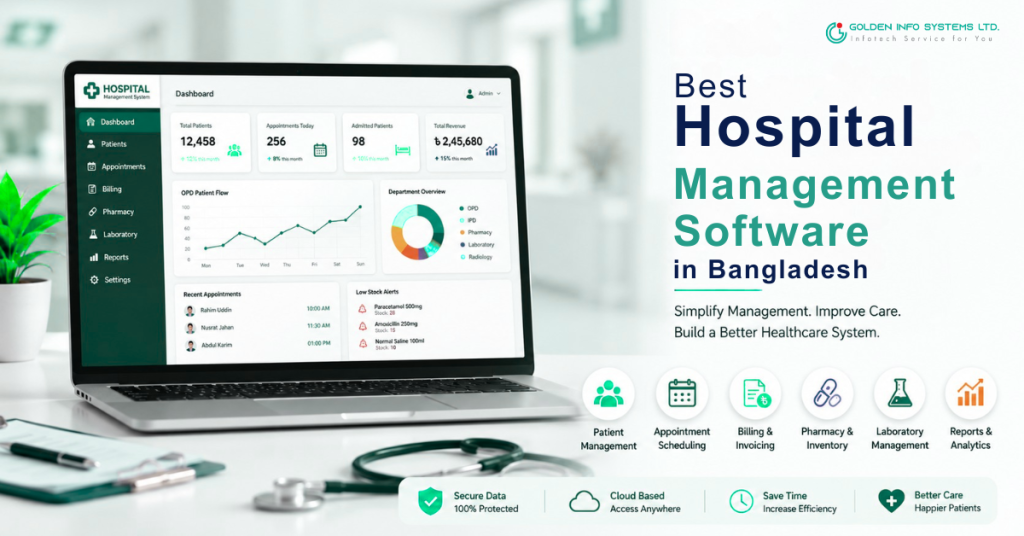
Let’s look at a prime example of what a perfect, top-tier system should look like, based on the industry-leading Hospital Management System (G-HMS) standard.
A standard-setting system plays a crucial role in providing better healthcare services. Here are the Key System Features you must look for in a top-tier HMS:
1. Patient Registration & Management
Your software must capture demographic data, contact information, and medical history effortlessly. It should generate unique patient IDs or health cards to track their entire journey within your hospital. This centralized profile ensures that every time a patient visits, their complete history is instantly available.
2. Out Patient Department (OPD) & Inpatient (IPD) Management
From the moment an outpatient walks in for a consultation to the detailed ward and bed management for admitted inpatients, the software must handle it all without friction. This includes tracking patient transfers between wards, managing dietary requirements, and scheduling regular nurse check-ins.
3. Appointment Scheduling
Patients should be able to book, reschedule, or cancel appointments online or via a mobile app, while front-desk staff can view doctor availability on a dynamic digital calendar. This drastically reduces wait times, prevents double-booking, and improves the overall patient experience right from their first interaction.
4. Electronic Health Records (EHR)
This is the heart of clinical care. EHR digitizes patient charts, treatment plans, immunization dates, and allergy information, making it instantly accessible to authorized doctors. A robust EHR eliminates the problem of illegible doctor handwriting and ensures continuity of care, even if a patient sees different specialists within the same hospital.
5. Billing and Invoicing
Your system must automate complex billing cycles, combining doctor fees, bed charges, OT costs, and medication into one clear, understandable invoice for the patient. This transparency builds trust with patients and significantly reduces disputes at the billing counter.
6. Insurance and Claims Management
As health insurance becomes more common in Bangladesh, your software must be able to process corporate billing and manage third-party insurance claims seamlessly. This involves generating the necessary documentation, tracking claim status, and managing pre-authorizations efficiently.
7. Pharmacy & Medical Inventory Management
Never run out of life-saving drugs again. The software should track expiry dates, manage supply chains, process digital prescriptions directly from the doctor, and send low-stock alerts automatically. It should also track batch numbers to easily manage recalls if necessary.
8. Laboratory & Radiology Management
A built-in Laboratory Information System (LIS) and Radiology Information System (RIS) should integrate directly with your diagnostic machines. This means test results are fetched automatically and attached to the patient’s digital file without manual data entry, eliminating typos and drastically speeding up diagnosis times.
9. Operation Theatre (OT) Management
Scheduling surgeries, managing surgical teams, tracking equipment sterilization, and maintaining pre-and post-operative records must be centralized. This ensures optimal use of expensive OT resources and improves surgical safety protocols.
10. Emergency & Casualty Management
In an emergency, every second counts. The software should allow for rapid, one-click “quick registration” so treatment can begin immediately without administrative delays. Full details can be filled in later once the patient is stabilized.
11. Clinical Decision Support System (CDSS) & AI Integration
Modern systems come with AI tools that flag potential drug interactions, suggest diagnoses based on symptoms, and help doctors make highly accurate clinical decisions. This acts as a crucial safety net, catching potential errors before they affect the patient.
12. Patient Portal
Give power back to your patients. A dedicated portal or app where they can view their medical records, download test reports, and pay bills online empowers patients and reduces the administrative burden on your front desk staff.
13. Reporting & Analytics
You need real-time dashboards showing your hospital’s financial health, patient footfall, and staff performance at a glance. These insights allow management to spot bottlenecks, optimize staffing levels, and plan for future growth based on hard data, rather than guesswork.
14. Discharge and Transfer Management
The discharge process is notoriously slow in many hospitals. A good HMS generates instant discharge summaries, finalizes bills, and clears beds for the next patient in minutes, improving patient satisfaction and increasing hospital bed turnover rates.
The 10 Best Hospital Management Software systems in Bangladesh
Now that you know exactly what features to look for, let’s explore the top providers dominating the Bangladeshi healthcare market in 2026. We have evaluated these systems based on user-friendliness, local support, feature depth, and pricing flexibility.
1. G-HMS (Hospital Management System)
While G-HMS represents the ideal architectural standard (as outlined in the features above), it sets the benchmark for what you should expect from a premium, fully customized solution. If you are building a custom ERP from the ground up or looking for an enterprise-grade white-label solution, the G-HMS framework is your ultimate blueprint. It focuses heavily on AI Integration and Clinical Decision Support Systems (CDSS), making it highly futuristic and adaptable for large, forward-thinking medical colleges and super-specialty hospitals. By establishing this standard, it pushes the entire industry forward, demanding better data structuring and interoperability.
Benefits of Using G-HMS:
- Enhanced Operational Efficiency: Streamlines complex hospital processes from admission to discharge, saving countless administrative hours.
- Improved Patient Care: By automating workflows, it allows medical staff to dedicate more focused time to providing better healthcare services rather than managing paperwork.
- Accurate Data Management: Ensures precision in billing, pharmacy dispensing, and medical records through centralized digital storage.
- Quick Decision-Making: Provides real-time data access and intelligent reporting, empowering doctors and administrators to make swift, life-saving, and cost-effective choices.
Key Features: Complete Electronic Health Records (EHR), Clinical Decision Support System (CDSS), Advanced AI Integration, Pharmacy Management, Operation Theatre (OT) Management, and comprehensive Billing and Invoicing.
Why You Will Love It: It serves as the ultimate blueprint for modern healthcare IT. If you are aiming to build a future-proof, paperless hospital from the ground up, G-HMS provides a comprehensive, interconnected framework that eliminates the guesswork and standardizes your entire operation.
Best For: Massive hospitals requiring highly customized, AI-driven architectures.
Standout Feature: Deep AI Integration for predictive patient care and automated reporting, acting as a second pair of eyes for busy clinicians.
2. Sara Hospital Management Software
Sara Software is widely recognized as one of the very best choices for Bangladeshi healthcare providers. What makes Sara stand out is its deep understanding of the local market. It isn’t just a generic tool; it is customized for the unique operational challenges of Bangladesh, such as handling complex local billing structures and integrating with local SMS gateways. Their development team is acutely aware of the specific pain points faced by clinic owners here.
- Key Features: Comprehensive OPD/IPD, AI Report generation, integrated LIS (Laboratory Information System), and powerful nurse station modules.
- Why You Will Love It: It offers highly flexible pricing, making it affordable for both small diagnostic centers and large hospitals. Their 24/7 local customer support is incredibly responsive, ensuring you aren’t left stranded during a critical system outage.
- Best For: Medium to large hospitals looking for a balanced, cost-effective, and highly supported system with deep local roots.
3. Medicare HIS by MySoft Limited
MySoft is a giant in the Bangladeshi healthcare IT sector, serving over 300+ clients countrywide. Their Medicare HIS is a powerhouse designed for scale. When a hospital chain expands, Medicare HIS is built to easily integrate new branches into the central system without a complete overhaul.
- Key Features: E-prescription tracking, complete hospital ERP, mobile app integration for doctors and patients, and an incredible HR & Payroll module built right in.
- Why You Will Love It: The electronic medical records (EMR) module is exceptionally well-designed, giving doctors a single-screen view of everything they need. It eliminates departmental silos completely, ensuring that pharmacy, lab, and doctors are all working from the exact same real-time data.
- Best For: Multi-branch hospitals and large healthcare groups that need robust ERP capabilities to manage massive workforces and complex supply chains.
4. Arch HMS by Esteem Soft Limited
Arch HMS is a pioneer in cloud-based healthcare software in Bangladesh and won the prestigious National ICT Award for its contribution to modernizing healthcare. They were among the first to truly prove the viability of cloud systems for high-volume local clinics.
- Key Features: Cloud-based LIS with machine automation (meaning lab machines send results directly to the software), Cloud PACS for radiology, and a dynamic SMS/Email notification system.
- Why You Will Love It: Their focus on machine integration is unmatched. If your diagnostic center handles a massive volume of daily tests, Arch HMS will automate the entire data entry process, ensuring zero human error in medical reports. This drastically reduces the turnaround time for critical test results.
- Best For: Busy diagnostic centers and tech-forward clinics that prioritize speed and automation in their laboratories.
5. Smart Software HMS
Smart Software Limited brings a very user-friendly, highly modular approach to hospital management. If you want software that your staff can learn to use in a single afternoon, this is a strong contender. They emphasize a clean, uncluttered interface that minimizes the training time required for new staff.
- Key Features: Advanced biometrics attendance for staff, excellent pharmacy POS (Point of Sale) with barcode support, and robust online appointment modules.
- Why You Will Love It: Their inventory and stock management module is incredibly detailed, allowing you to track profit and loss on specific medications and medical supplies easily. You can easily identify fast-moving items and adjust your purchasing strategies accordingly to optimize cash flow.
- Best For: Polyclinics and hospitals with very busy in-house pharmacies that need strict inventory control.
6. Link-Up Technology Hospital ERP
Link-Up Technology offers an end-to-end cloud-based solution that prides itself on transparency and real-time reporting. They understand that hospital administrators need data at their fingertips to make immediate decisions.
- Key Features: Automated data backups, highly secure multi-user access with strict role-based permissions, and dynamic profit/loss reporting.
- Why You Will Love It: The financial control you get with Link-Up is fantastic. You can see your hospital’s financial health in real-time, making it an excellent tool for hospital directors and investors. You can track revenue by department, by doctor, or even by specific procedures.
- Best For: Private clinics and administrative-focused hospital owners who prioritize financial oversight and detailed reporting.
7. PrideHealth by Pridesys IT
Pridesys is a heavy hitter in the enterprise software space, and their PrideHealth system brings corporate-level ERP power to the hospital environment. This is for organizations that view healthcare delivery through the lens of strict corporate efficiency.
- Key Features: Full supply chain management, complex financial analytics, automated insurance claim processing, and telemedicine functionalities.
- Why You Will Love It: If you treat hospital management like a corporate enterprise, PrideHealth provides the deep analytics and decision-support tools you need to optimize resource allocation and lower labor costs. It handles the complexities of large-scale procurement and vendor management seamlessly.
- Best For: Corporate hospitals and large healthcare investment groups managing multiple facilities and demanding rigorous financial modeling.
8. Cloud-Hospital ERP by Cloud Solution Ltd
Built on the highly secure Oracle Apex SaaS model, this system focuses heavily on data security, hacking protection, and preventing data loss. In an era where medical data breaches are a significant concern, their architecture provides substantial peace of mind.
- Key Features: Centralized data management, lightweight architecture, and specialized modules for medical colleges.
- Why You Will Love It: It requires very little internal IT infrastructure. Because it is a true cloud SaaS product, you don’t need to buy expensive servers or hire a dedicated server management team to get started. You simply log in and start working.
- Best For: Small to medium hospitals that do not want to invest heavily in on-site IT hardware but require enterprise-grade security.
9. eCure by Daffodil Computers Limited
Backed by one of Bangladesh’s most established ICT conglomerates, eCure is a mature, stable, and highly trusted system used by several prominent hospitals in Dhaka. Their longevity in the market speaks to the robustness of their platform.
- Key Features: Deep integration with pharmacy supply chains, robust patient relation management, and excellent compliance tracking.
- Why You Will Love It: Reliability. Coming from Daffodil, you know the software is backed by a massive infrastructure and a team that isn’t going to disappear overnight. They have the resources to provide consistent updates and long-term support.
- Best For: Traditional hospitals looking for a highly stable, risk-free software transition backed by a major corporate entity.
10. Mediklaud Hospital ERP
Mediklaud focuses on delivering a seamless digital transformation with a beautiful, modern user interface. They emphasize mobility and cloud access, ensuring that healthcare professionals can work efficiently from any device.
- Key Features: Dedicated doctor and nurse role-based dashboards, clinical validation in prescriptions, and advanced business intelligence analytics.
- Why You Will Love It: It is incredibly modern. The UI/UX is clean and intuitive, making it a favorite among younger doctors and nurses who are used to high-quality consumer mobile apps. This significantly boosts adoption rates among staff.
- Best For: Modern boutique hospitals, aesthetics clinics, and progressive healthcare associations that value design and mobility.
Ready to digitize your hospital? Check out our tailored ERP solutions today!
Cloud vs. On-Premise: Which is Best for Your Bangladeshi Hospital?
This is a critical decision. Should your software live on the internet (Cloud) or on computers sitting in your hospital’s back room (On-Premise)?
Just as we discussed previously regarding Top Cloud Infrastructure Trends in 2025: Resilience, Scalability, and Digital Growth, modern healthcare IT is heavily leaning towards the cloud. However, the unique infrastructure challenges in Bangladesh require a thoughtful approach.
The Cloud Approach (SaaS):
- Pros: Lower upfront costs, you can access the system from anywhere (even from your phone at home), and the software provider handles all the security and backups. It allows for incredible scalability as your hospital grows; you simply upgrade your subscription plan rather than buying new hardware. It also guarantees you are always running the latest version of the software.
- Cons: You must have a reliable internet connection. If your hospital is in a rural area with frequent internet drops, a cloud-only system might bring your operations to a halt, preventing you from admitting patients or generating bills. Data residency concerns might also arise if the cloud servers are located outside of Bangladesh.
The On-Premise Approach:
- Pros: Uninterrupted service. Even if the internet goes down, your hospital keeps running on your local network (LAN). You have total physical control over your patient data, which is crucial for compliance with certain strict privacy policies. It can also be faster for transferring large files, like heavy MRI scans, internally.
- Cons: High initial cost for purchasing robust servers, and you need a dedicated, skilled IT team to manage hardware maintenance, manual data backups, and cybersecurity against local threats. If your server fails, your entire hospital system goes down until it is repaired.
The Verdict for Bangladesh: If you are in Dhaka, Chattogram, or a major city with stable fiber-optic internet and redundant power, Cloud is the way to go. It offers better resilience and digital growth potential. However, if you are in a remote Upazila, a hybrid or on-premise system with localized servers is a much safer bet to ensure uninterrupted patient care.
How to Choose the Right Software for Your Facility
Choosing from the 10 best hospital management software in Bangladesh can feel overwhelming. To make the right choice, follow these steps:
- Map Your Needs: Do you need a massive 500-bed management system, or just a simple OPD billing tool? Conduct an internal audit of your biggest bottlenecks before talking to vendors. Don’t pay for complex features you will never use.
- Ask About Machine Integration: If you have a diagnostic lab, ensure the software can automatically read data from your specific brands of Sysmex, Mindray, or Siemens analyzers. Demand proof of integration during the demo.
- Check User-Friendliness: Request a live demo and involve your staff. If your nurses and receptionists find the software confusing, it will fail, regardless of how powerful it is. The interface must be intuitive enough that a new hire can grasp it quickly.
- Demand Local Support: Software bugs happen. When your billing counter is stuck at 2:00 PM with 50 waiting patients, you need a software provider based in Bangladesh who will answer the phone immediately and understand the urgency, not a generic support ticket system in another country.
- Evaluate Scalability: Your 10-bed clinic today might be a 50-bed hospital in five years. Ensure the software architecture can grow with you and that adding new modules or user licenses is a straightforward process.
Frequently Asked Questions (FAQs)
What is the average cost of Hospital Management Software in Bangladesh?
The pricing varies wildly based on your needs. For a small clinic, basic cloud-based packages can start around 4,000 to 5,000 BDT per month. For a medium to large hospital requiring a complete on-premise ERP, you might pay a one-time setup fee ranging from 2,00,000 BDT to over 15,000,000 BDT, plus annual maintenance charges. The key is to calculate the Return on Investment (ROI) based on time saved and revenue leakage prevented.
Is my patients’ data secure with these software providers?
Yes, top providers like MySoft, Sara, and Arch HMS use advanced encryption, secure login credentials, and automated data backups to protect sensitive medical records. Always ask your provider if they comply with standard health data privacy frameworks and request documentation of their security protocols.
Can these systems handle Bengali language inputs?
Absolutely! Many of the top local software systems, such as Sara Software and Hospital Bondhu (a popular online variant), support both English and Bengali. This is crucial for local staff to easily input data and for patients to receive printed prescriptions and discharge summaries that they can actually read and understand.
Will I need to hire a large IT team to run this?
Not necessarily. If you opt for a Cloud-based SaaS model, the software company handles the heavy lifting, server hosting, and security maintenance. You will usually only need basic IT support for your local hardware (printers, PCs, and Wi-Fi routers). If you choose on-premise, however, a dedicated IT team is mandatory.
How long does it take to implement a new hospital management system?
For a small diagnostic center, a cloud system can be set up in less than a week. For a massive multi-specialty hospital requiring customized modules, extensive machine integration, and thorough staff training across multiple departments, full deployment and transitioning from the old system can take anywhere from 3 to 6 months.
Take the Next Step Toward Digital Healthcare
Running a successful hospital in Bangladesh is challenging enough without having to fight against your own administrative processes. By upgrading to one of the Best Hospital Management Software in Bangladesh, you are not just buying a computer program; you are investing in peace of mind, happier staff, and, most importantly, vastly superior patient care.
Whether you choose the highly customized G-HMS architecture, the locally loved Sara Software, or the corporate powerhouse of Pridesys, the right choice will transform your facility into a modern, highly profitable, and life-saving institution. It shifts your focus from managing paperwork to managing patient health.
Your patients deserve a seamless healthcare experience, and your staff deserves the tools to provide it effortlessly.
Stop letting outdated systems hold your hospital back.
Click here to schedule a free consultation with our healthcare IT experts and discover which software package is perfect for your hospital today!