






In 2012, a single software bug caused a major trading firm to lose $440 million in just 45 minutes? It drove the company into bankruptcy almost instantly. While that is an extreme example, it highlights a terrifying reality for modern businesses: software failures are expensive, dangerous, and often irreversible.
Why Quality Assurance Testers Are Essential for Software Development Teams? The answer impacts product quality, customer satisfaction, and your bottom line. QA testers play a critical role in ensuring software quality by systematically identifying bugs, validating functionality, and preventing costly production failures before they reach users.
While developers focus on building features, QA testers provide independent, objective validation that software works correctly across all scenarios. The importance of software testing cannot be overstated: research shows production bugs cost 100x more to fix than those caught during development, poor quality software drives 88% of users to abandon apps, and software failures damage brand reputation for years.
This comprehensive guide explores why QA testers are needed, their responsibilities, the benefits of QA testing, ROI analysis, and why every software development team—from startups to enterprises—needs dedicated quality assurance professionals to deliver reliable, high-quality products.
What is a Quality Assurance (QA) Tester?
To understand why QA is important, you first need to understand who these professionals are. They are the guardians of your user experience and the gatekeepers of your software’s integrity.
Definition and Role Overview
A Quality Assurance (QA) tester is a specialized professional responsible for finding bugs, defects, and issues in software before it reaches the public. Their goal isn’t just to “break” things; it is to ensure the software meets the requirements and provides a seamless experience. They analyze the product from a user’s perspective, looking for logical errors, design flaws, and functionality breaks.
QA Tester vs Software Developer
There is often confusion about why developers can’t just do the testing. The difference lies in the mindset.
- Developers have a constructive mindset. They focus on “How do I make this feature work?” They are often biased toward the “happy path”—the scenario where everything goes right.
- QA Testers have a destructive mindset (in a positive way). They ask, “How can I break this?” or “What happens if a user does this unexpected thing?”
Developers build the house; QA testers represent the inspector who checks if the foundation is solid and the wiring is safe.
QA Tester vs QA Engineer vs Test Analyst
While often used interchangeably, these titles have nuances:
- QA Tester: Focuses on executing tests and finding bugs.
- QA Analyst: Focuses on planning, strategy, and analyzing requirements to prevent bugs.
- QA Engineer: Often implies a more technical role, involving coding for test automation frameworks.
Types of QA Testers (Manual, Automation, Performance)
Your team might need different types of expertise:
- Manual Testing: Human execution of test cases to simulate user behavior.
- Automated Testing: Writing scripts to run repetitive tests automatically.
- Performance Testing: Stress-testing the system to see how it handles heavy traffic.
What Does a QA Tester Do? Key Responsibilities
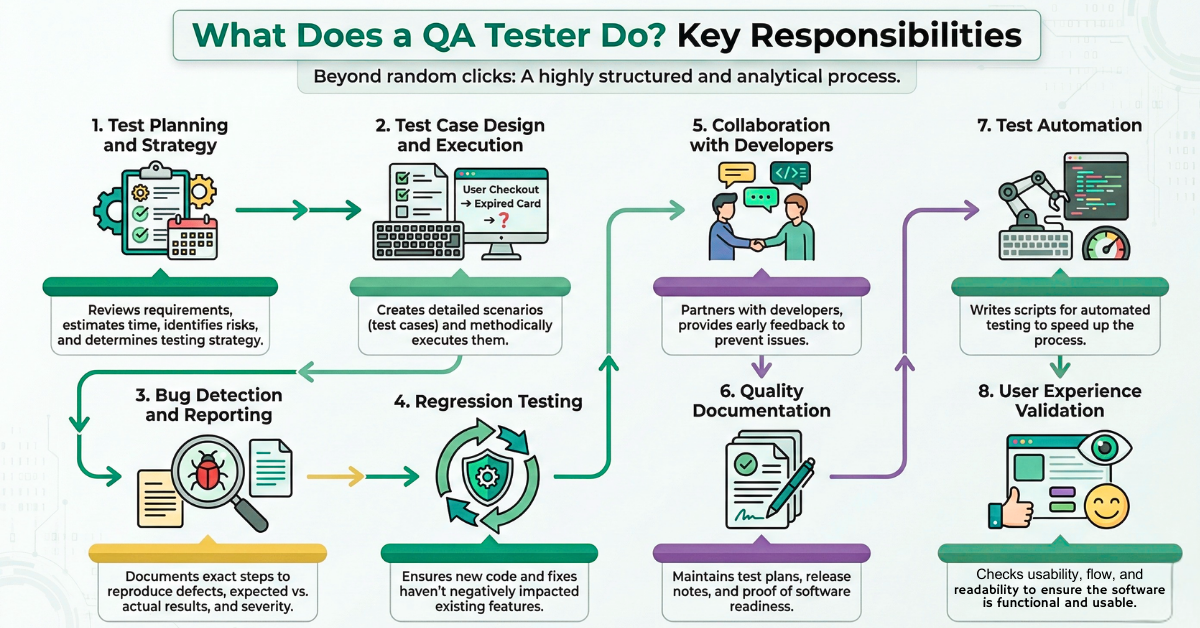
Many people think a QA tester job description just involves clicking buttons randomly. In reality, it is a highly structured and analytical process.
Test Planning and Strategy
Before a single line of code is tested, the QA tester reviews requirements. They estimate how long testing will take, identify high-risk areas, and determine the best testing strategy.
Test Case Design and Execution
Testers create detailed scenarios (test cases). For example, “What happens if a user tries to checkout with an expired credit card?” They then execute these steps methodically.
Bug Detection and Reporting
When a software tester finds a defect, they don’t just say “it’s broken.” They document the exact steps to reproduce it, the expected result vs. the actual result, and the severity. This bug detection is crucial for developers to fix issues quickly.
Regression Testing
Every time a developer fixes a bug, there is a risk they broke something else. Regression testing ensures that new code hasn’t negatively impacted existing features.
Collaboration with Developers
QA and developers work closely together. A good QA acts as a partner, providing feedback early in the cycle to prevent issues from being coded in the first place.
Quality Documentation
From test plans to release notes, QA testers maintain the documentation that proves the software is ready for launch.
Test Automation
Modern QA engineers spend time writing scripts for automated testing. This speeds up the process by allowing computers to run thousands of tests in minutes.
User Experience Validation
Beyond code, they check usability. Does the flow make sense? Is the font readable? User experience testing ensures the software isn’t just functional, but usable.
Why Software Testing is Important: The Big Picture
Why is software testing important? It goes beyond just finding bugs. It is about business survival.
Software Quality Matters to Business Success
Your software is your business. If your app fails, your revenue stops. Software quality assurance ensures your business engine keeps running smoothly.
Cost of Poor Quality Software
Bad software costs billions annually. Between lost sales, wasted developer time, and customer support costs, the price of skipping QA in software development is staggering.
User Expectations
We are living in an era of instant gratification. Users expect apps to load in under 2 seconds. If your software is buggy, they will switch to a competitor instantly.
Competition and Market Standards
Your competitors are likely investing in QA testing. If their app is flawless and yours is buggy, you lose market share. Quality is a key differentiator.
15 Critical Reasons Why Quality Assurance Testers Are Essential for Software Development Teams
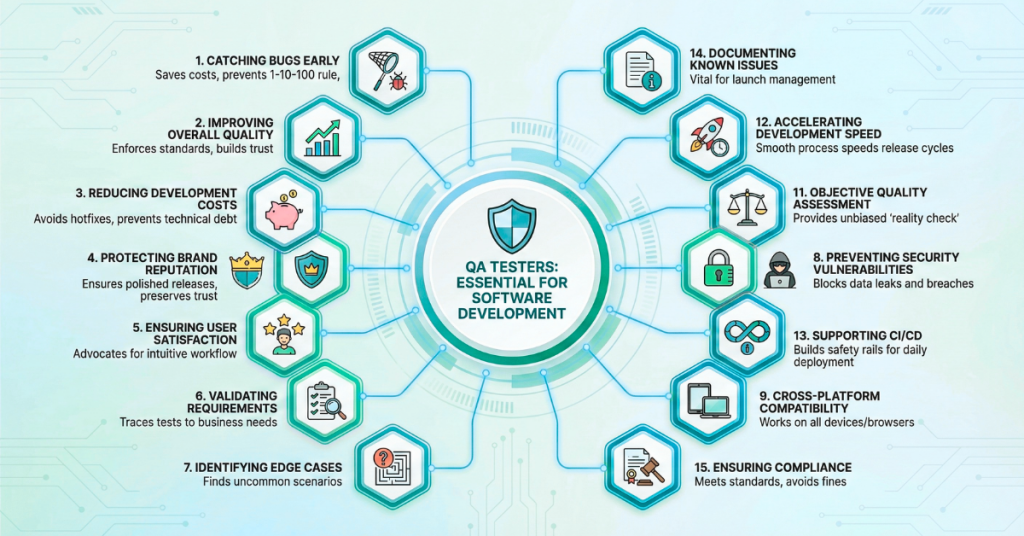
If you are still on the fence, here are 15 detailed reasons why do we need QA testers.
1. Catching Bugs Before They Reach Users
The primary role of a QA tester is to be the safety net.
- Early Bug Detection Saves Costs: Fixing a bug during the design phase costs pennies. Fixing it in production can cost thousands.
- Production Bugs Are 100x More Expensive: The “1-10-100 Rule” states that if a bug costs $1 to fix in design, it costs $10 in development, and $100 in production.
- Real-World Impact: Imagine a banking app that calculates interest incorrectly. Catching that in QA testing saves legal nightmares.
2. Improving Overall Software Quality
QA testers enforce standards. They track quality metrics like defect density and test coverage to ensure the product gets better with every release. This leads to a consistent, professional feel that users trust.
3. Reducing Development Costs
It seems counterintuitive—hiring more people (testers) to save money? Yes.
- ROI of QA Testing: By preventing software defects from reaching production, you avoid expensive hotfixes and emergency patches.
- Long-Term Savings: Clean code is easier to maintain. QA in software development prevents “technical debt” from piling up.
4. Protecting Brand Reputation
A single viral tweet about your app crashing can destroy your brand image. Software failures erode trust. QA testers protect your brand’s integrity by ensuring you only release polished products.
5. Ensuring User Satisfaction
User experience testing is part of QA. Testers advocate for the user. They ensure the workflow is intuitive, preventing user frustration and abandonment. High quality leads to 5-star app store ratings.
6. Validating Requirements Are Met
Developers might build a great feature, but is it the right feature? QA testers trace every test back to the business requirements to ensure the software does exactly what the stakeholders asked for.
7. Identifying Edge Cases Developers Miss
Developers focus on the happy path. QA testers are experts at finding “edge cases”—uncommon scenarios like entering negative numbers in a quantity field or using emojis in a password. These edge cases often cause the worst crashes.
8. Preventing Security Vulnerabilities
Security testing is vital. Testers look for vulnerabilities like SQL injection or data leaks. In a world of GDPR and data breaches, a QA engineer helps keep your user data safe.
9. Ensuring Cross-Platform Compatibility
Your app works on Chrome, but what about Safari? It looks good on iPhone 15, but what about an old Android? Compatibility testing ensures your software works for all your users, not just those with the latest tech.
10. Maintaining Regression-Free Updates
You add a new “Dark Mode” feature, but suddenly the “Login” button stops working. This is a regression. Regression testing (often handled by automated testing) ensures new updates don’t break old features.
11. Providing Objective Quality Assessment
Developers are attached to their code. They have a hard time seeing its flaws. A QA tester provides an unbiased, objective view of the software’s state. They are the “reality check” for the project.
12. Accelerating Development Speed (Paradoxically)
“Doesn’t testing slow us down?” No. Catching bugs early means developers spend less time fixing complex issues later. A smooth QA process creates a rhythm that actually speeds up release cycles over time.
13. Supporting Continuous Integration/Continuous Deployment
In modern DevOps, you deploy code daily. You cannot do this without test automation and CI/CD testing. QA testers build the safety rails that allow high-speed deployment.
14. Documenting Known Issues and Limitations
Sometimes, minor bugs are acceptable to release. QA testers document these “known issues” so customer support teams know how to handle them. This communication is vital for launch management.
15. Ensuring Compliance and Regulatory Standards
For industries like healthcare (HIPAA) or finance (PCI-DSS), software must meet strict standards. QA testers verify compliance, saving you from massive fines and legal action.
The Cost of Not Having QA Testers
What happens if you skip software testing? The consequences can be devastating.
Production Bugs and Emergency Fixes
Without QA, your users become your testers. When they find a critical bug, your development team has to drop everything to fix it. This “firefighting” mode halts progress on new features.
Customer Churn and Lost Revenue
If your checkout page crashes 1% of the time, that is 1% of revenue lost directly. Indirectly, frustrated users leave and never come back.
Developer Time Spent on Support
Instead of building cool new features, your expensive developers are stuck debugging basic issues that a QA tester would have caught in five minutes.
Real-World Disaster Stories
- Knight Capital (2012): A deployment error cost $440 million.
- Nissan (2016): Recalled 3 million cars due to an airbag sensor software bug.
- Starbucks (2015): A register glitch forced stores to give away free coffee, losing millions in sales.
QA Testing ROI: The Business Case
Let’s look at the numbers. Investing in quality assurance importance pays off massive dividends.
Cost Savings Analysis
Imagine a mid-size SaaS company.
- Cost of QA Team: $470,000/year (Salaries + Tools).
- Savings: preventing 200 production bugs (valued at $10k each) = $2,000,000.
- Customer Retention: Preventing churn creates millions in protected revenue.
- Net ROI: Studies show a well-run QA team can generate an ROI of over 1,500%. Every dollar spent on QA saves $16 in future costs.
How QA Testers Work with Software Development Teams
The relationship between QA and developers defines the success of a project.
QA in Agile/Scrum Teams
In Agile, QA is embedded in the team. They don’t wait until the end; they test distinct features during the sprint. This is essential for the agile development lifecycle.
QA in DevOps Culture
DevOps and QA go hand in hand. Testers write automated scripts that run every time code is saved. This “continuous testing” ensures the pipeline stays green.
Shift-Left Testing Approach
“Shift-left” means testing earlier in the process. Instead of testing at the end, QA testers review designs and requirements. Catching an issue here is virtually free.
Types of Software Testing QA Testers Perform
A good QA tester wears many hats. Here are the key testing types they manage:
Functional Testing
Does the button do what it says? Does the form submit data? This is the core of software testing.
Regression Testing
Rerunning tests to ensure unchanged parts of the application function correctly after modifications.
Integration Testing
Do the payment gateway, database, and user interface talk to each other correctly? Integration testing finds bugs in the seams between modules.
Performance and Load Testing
Can your site handle 10,000 users on Black Friday? Performance testers simulate this traffic to prevent crashes.
Security Testing
Checking for vulnerabilities to prevent hacking and data breaches.
API Testing
Testing the backend logic without a user interface. This is crucial for modern microservices architectures.
Manual Testing vs Automated Testing: Both Are Needed
There is a debate about manual testing vs automated testing, but you need both.
When Manual Testing is Essential
- Usability Testing: A robot can’t tell you if a UI is confusing.
- Exploratory Testing: Human intuition is needed to find weird edge cases.
- Ad-hoc Testing: Quick checks for new features.
Benefits of Test Automation
- Regression: Running 5,000 checks in 10 minutes.
- Load Testing: Simulating thousands of users.
- Consistency: Robots never get tired or miss a step.
The Balanced Approach
The best teams use automation for repetitive tasks and human QA testers for complex, creative testing.
Common Misconceptions About QA Testers
Let’s bust some myths about software quality assurance.
“Developers Can Test Their Own Code”
As mentioned, this is like a student grading their own homework. Confirmation bias makes them miss their own mistakes.
“Automation Will Replace QA Testers”
Automation is a tool, not a replacement. You still need a human to design the strategy, write the scripts, and analyze the results.
“QA Testing Slows Down Development”
Short term? Maybe slightly. Long term? It dramatically speeds it up by reducing rework and bugs.
“QA is Just Clicking Buttons”
This is insulting to the profession. It requires deep technical knowledge, logical reasoning, and understanding of complex systems.
When Does Your Team Need a QA Tester?
Startups and MVP Development
Even at the MVP stage, one bad bug can kill your launch. A part-time or freelance QA tester is often necessary.
Growing Teams and Products
Once you have 3-4 developers, you need at least one dedicated QA. The QA to developer ratio is typically 1 QA for every 3-5 developers.
Signs You Need to Hire QA
- Your customers are finding bugs before you do.
- Your developers spend more time fixing bugs than writing new code.
- You are afraid to release on Fridays because things might break.
Skills and Qualities of Effective QA Testers
If you are looking to hire, look for these QA tester skills:
Technical Skills Required
- Knowledge of SDLC and Agile.
- Basic SQL for database checking.
- Understanding of API testing.
- Familiarity with automation tools (Selenium, Cypress).
Soft Skills That Matter
- Attention to Detail: They spot the pixel that is off.
- Communication: They must explain bugs clearly to developers without blaming.
- Curiosity: They constantly ask “What if?”
QA Tester Career Path and Growth
The field of software quality assurance offers a rich career path.
Entry-Level to Senior QA
Junior testers start with manual execution. Senior QAs design strategies and mentor teams.
Specializations
Many move into high-paying niches like Security Testing, Performance Engineering, or Test Automation Architecture.
Certifications
Credentials like ISTQB certification prove a tester’s knowledge of international standards.
Tools QA Testers Use
To do their job, testers rely on a tech stack:
- Test Management: Jira, TestRail, Zephyr.
- Automation: Selenium, Playwright, Cypress.
- API Testing: Postman, SoapUI.
- Performance: JMeter, LoadRunner.
The Future of QA Testing
AI and Machine Learning in Testing
AI is revolutionizing QA. AI tools can now self-heal broken tests and predict where bugs are likely to hide.
Shift-Left and Shift-Right
Testing is expanding in both directions—testing earlier in design (Left) and monitoring quality in production (Right).
QA Testers as Essential Team Members
In the end, Why Quality Assurance Testers Are Essential for Software Development Teams comes down to one thing: Trust. QA testers build trust between your software and your users.
They are not just bug hunters; they are quality advocates who save you money, protect your reputation, and ensure your product delivers on its promises. In a world where software competition is fierce, a skilled QA team is your secret weapon for success.
Don’t wait for a disaster to realize the importance of testing. Invest in quality assurance today, and watch your software development team thrive.
FAQs About QA Testers in Software Development
1. Why can’t developers just test their own code?
Developers have “confirmation bias,” meaning they subconsciously test to prove their code works, not to break it. QA testers provide an objective, fresh perspective essential for finding hidden issues.
2. Is QA testing really necessary for small projects?
Yes. Even small apps can suffer from critical data loss or security breaches. While you might not need a full team, having a dedicated testing process is vital for any software intended for users.
3. How much does hiring a QA tester cost?
The cost varies by location and experience, but the cost of not hiring one is much higher. The ROI of avoiding production bugs and retaining customers usually covers a QA salary many times over.
4. What’s the difference between QA and QC?
QA (Quality Assurance) is process-oriented (preventing defects). QC (Quality Control) is product-oriented (identifying defects in the finished product). Most “QA Testers” actually perform both roles.
5. Do QA testers need to know programming?
For manual testing, no. However, modern QA engineers focusing on test automation need coding skills in languages like Python, Java, or JavaScript to write test scripts.
6. Can automated testing replace manual QA testers? No. Automation is great for repetitive regression tests, but it lacks human intuition. You need manual testers for usability, exploratory testing, and visual verification.
7. How does QA fit into agile development?
In Agile, QA is continuous. Testers work alongside developers in sprints, testing features as they are built rather than waiting for the end of the project.
8. What percentage of the budget should go to QA?
Industry standards suggest allocating 25-30% of the total project budget to software testing and quality assurance activities.
9. When should QA get involved in the development process?
Immediately. The “Shift-Left” approach dictates that QA should be involved during the requirements and design phases to prevent architectural bugs.
10. How do you measure QA effectiveness?
Key metrics include Defect Leakage (bugs found in production vs. testing), Test Coverage, and Mean Time to Detection (MTTD). A low rate of production bugs is