





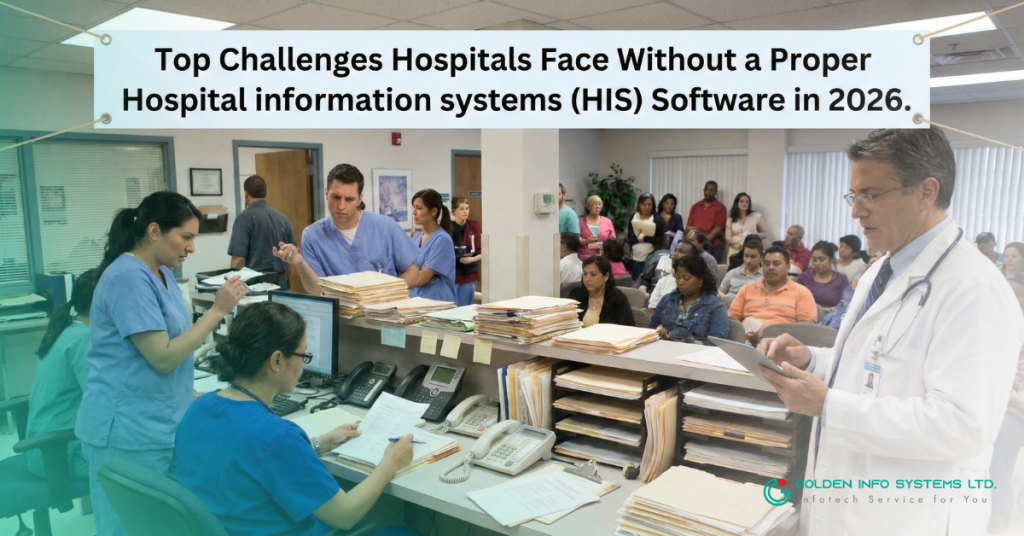
The estimated annual cost of workplace violence and operational inefficiency in hospitals has climbed to over $18 billion? It is a staggering figure, but it points to a deeper truth: the friction in your daily operations is costing you more than just money—it is costing you your workforce, your patient’s trust, and your competitive edge.
If you are running a medical facility today, you are likely feeling the pressure. The healthcare landscape has shifted. We are no longer just talking about digitizing paper records; we are talking about survival in an era of “forced remodeling” of global health funding and strict interoperability mandates.
In this detailed guide, we will explore the top challenges hospitals face without a proper HIS software in 2026. We will break down exactly how the lack of a unified system creates hidden bottlenecks, financial leaks, and dangerous security gaps that could threaten your institution’s future.
1. The Operational Grind: Drowning in Manual Workflows
Imagine your hospital as a high-performance engine. Now, imagine pouring sand into the gears. That is exactly what happens when you rely on disjointed, manual processes instead of a centralized hospital information system.
In 2026, operational efficiency isn’t a luxury; it is the baseline for keeping your doors open. One of the most significant healthcare industry challenges today is the sheer volume of administrative waste. Recent data suggests that administrative expenditures are growing faster than direct patient care spending. When your staff spends 40% of their shift filling out forms, chasing down lab results via phone, or manually entering data into three different spreadsheets, patient care suffers.
The “Silo Effect” on Staff Productivity
Without a proper HIS, your departments act as islands. The pharmacy doesn’t know what the ward needs until a paper slip arrives. The billing department is waiting on coding from the discharge summary, which is sitting in a pile on a nurse’s desk.
This leads to hospital system inefficiencies that are invisible to the naked eye but devastating to the bottom line. Your nurses are burning out not because of the number of patients, but because of the number of clicks, calls, and steps required to do simple tasks.
| Workflow Aspect | Without Proper HIS (The Struggle) | With Integrated HIS (The Solution) |
| Patient Registration | Long queues, repetitive form filling, manual data entry errors. | Self-service kiosks, pre-arrival digital check-in, instant data flow. |
| Lab Order Management | Hand-written slips, lost samples, phone calls for results. | Digital ordering, barcoded tracking, instant results in the EHR. |
| Inventory Control | Stockouts of critical meds, expired supplies on shelves. | Automated alerts for low stock, expiry tracking, auto-reordering. |
| Staff Scheduling | Spreadsheets, frantic calls to cover shifts, overtime costs. | AI-driven rostering based on patient census and acuity. |
The Real Cost of “We’ve Always Done It This Way”
You might think your current manual methods are “free” because you aren’t paying for software. But the cost of labor, the cost of errors, and the cost of slow throughput are the real hospital management problems dragging you down. In 2026, time is your most expensive currency.
2. Top Challenges Hospitals Face Without a Proper HIS Software in 2026: The Financial Black Hole
If operations are the heart of your hospital, revenue is the blood. Without a proper HIS, you are essentially operating with a tourniquet on your cash flow.
One of the critical top challenges hospitals face without a proper HIS software is Revenue Cycle Management (RCM) failure. In 2026, insurance payers have become more sophisticated, using AI to audit claims. If your hospital is still relying on manual coding and disjointed billing systems, you are bringing a knife to a gunfight.
Revenue Leakage and Billing Errors
Healthcare data management challenges often manifest as “leakage.” This happens when services are performed but never billed.
- A patient gets a bedside test, but the paper slip gets lost.
- A specific medication is administered, but not logged in the billing ledger.
- A procedure is coded with an outdated ICD-10 code because your cheat sheet wasn’t updated.
Studies show that hospitals can lose between 1% to 3% of their net revenue purely due to underpayments and denials. In a high-volume facility, that is millions of dollars left on the table.
The Denial Management Nightmare
Denials are rising. Payers in 2026 are requiring stricter evidence for medical necessity. Without an integrated HIS software, gathering the clinical evidence to appeal a denial is a manual, forensic process. Your billing team has to hunt down doctors, find physical files, and fax (yes, fax) documents.
Electronic health record shortcomings in older or non-existent systems mean you lack the “clean data” required for auto-adjudication. You are facing financial losses simply because your systems can’t speak the language of modern payers.
Key Stat: The cost to rework a single denied claim can exceed $118. Multiply that by thousands of claims, and you see why healthcare IT solutions are an investment, not an expense.
3. The Interoperability Wall: Why Data Silos Are Deadly
In 2026, “Interoperability” is not a buzzword; it is a mandate. Governments and regulatory bodies are pushing for FHIR (Fast Healthcare Interoperability Resources) standards to become the default.
Healthcare IT obstacles arise when your hospital cannot share data externally with other providers, or internally between your own departments.
The Fragmented Patient View
When you face lack of proper health information system impact, you effectively blind your clinicians. A doctor treating a patient in the ER might not know that the same patient saw a cardiologist in your outpatient clinic two days ago.
This leads to:
- Duplicate Testing: You order an expensive MRI that was already done last week at a partner facility.
- Medication Errors: You prescribe a drug without knowing the patient recently filled a conflicting prescription elsewhere.
- Delayed Decisions: Critical care decisions are paused while someone waits for a file to be transferred.
The “Fax Machine” Problem
It seems absurd, but without a modern HIS, many hospitals in 2026 are still relying on fax machines and courier services to move patient data. This is not just slow; it is a massive liability. HIS implementation issues often stem from trying to patch together legacy systems that were never meant to talk to each other.
To survive in the modern healthcare ecosystem, you need a system that acts as a central nervous system, not a collection of disjointed organs.
4. Patient Experience and Safety Risks
Your patients have changed. In 2026, the “Amazon effect” has fully taken over healthcare. Patients expect digital access, transparency, and speed. Top challenges hospitals face without a proper HIS software include a rapid decline in patient satisfaction and loyalty.
The Invisible Patient
Without a patient portal—a staple of modern hospital information system suites—your patients feel disconnected. They can’t book appointments online, they can’t see their lab results, and they can’t message their doctor.
When a patient calls your hospital and is put on hold for 20 minutes just to check an appointment time, they don’t blame the receptionist; they blame the hospital. This leads to patient churn. In a competitive market, you cannot afford to lose patients to the clinic down the street that offers an app-based experience.
Safety Concerns and Medical Errors
Electronic health record challenges are directly tied to patient safety. Handwriting illegibility is still a cause of medication errors in hospitals relying on paper charts.
- Adverse Drug Events (ADEs): Without automated interaction checks (which a proper HIS provides), a doctor might miss a dangerous drug-allergy interaction.
- Missed Degradation: In paper-based systems, early warning scores (EWS) are calculated manually. A busy nurse might miss a subtle trend in vitals that a digital system would flag instantly.
The Patient Journey Comparison
| Stage | The Analog Patient (Risky & Frustrating) | The Digital Patient (Safe & Seamless) |
| Booking | Call center hold times, “call back later.” | 24/7 Online booking via app/web. |
| Arrival | “Fill out this clipboard again.” | “Hi, we have your info. Just verify this.” |
| Treatment | Repeating history to 3 different nurses. | Care team views a unified history instantly. |
| Discharge | Waiting hours for paperwork and scripts. | Digital discharge summary & e-prescriptions sent. |
| Follow-up | Patient forgets, condition worsens. | Automated SMS/Email reminders for checkups. |
5. Cybersecurity and Data Security Risks in Healthcare
You might think that keeping records on paper or on a local, non-networked server makes you safer from hackers. In 2026, that is a dangerous myth. Data security risks in healthcare are evolving, and the “security by obscurity” method no longer works.
The Ransomware Target
Hospitals are the #1 target for ransomware because hackers know you cannot afford downtime. If you are using disjointed, legacy software or unpatched local servers (common in hospitals without a proper HIS), you are a sitting duck.
Modern cloud-based HIS providers invest millions in security operations centers (SOCs), encryption, and redundancy. A standalone hospital IT team often cannot match that level of defense.
Compliance is Non-Negotiable
Whether it is HIPAA in the US, GDPR in Europe, or local data protection acts, the regulations in 2026 are stricter than ever.
- Audit Trails: Can you prove who looked at a patient’s physical file? No. A digital HIS logs every single view, click, and edit.
- Disaster Recovery: If a fire or flood hits your record room, that history is gone forever. Healthcare technology setbacks like physical data loss are catastrophic. A cloud HIS ensures your data survives any physical disaster.
6. Strategic Paralysis: Flying Blind
How long does it take you to generate a report on your hospital’s profitability for the last quarter?
- A day?
- A week?
- A month?
If you don’t have a proper HIS, the answer is likely “I can’t get an accurate number.”
The Lack of Business Intelligence
One of the top challenges hospitals face without a proper HIS software is the inability to make data-driven decisions. You are running a multimillion-dollar organization based on gut feeling and outdated spreadsheets.
- You don’t know which departments are profitable and which are bleeding money.
- You can’t predict patient census trends to optimize staffing.
- You can’t track the success of clinical outcomes compared to costs.
In 2026, hospitals are using predictive analytics to forecast admission spikes during flu season or supply chain shortages. Without this intelligence, you are always reacting, never preventing.
7. The Burnout Crisis: Losing Your Best People
We briefly touched on this in operations, but it deserves its own section. The global shortage of healthcare workers has stabilized slightly by 2026, but retention is still a war.
Healthcare IT obstacles are a leading cause of clinician burnout. Doctors and nurses didn’t go to medical school to do data entry. They went to heal people. When you force them to use clunky, outdated, or manual systems, you increase their cognitive load.
Electronic health record shortcomings—specifically poor usability—have been cited as a top reason for physicians leaving practice. By failing to provide modern tools, you are telling your staff that their time isn’t valuable. Implementing a user-friendly HIS is one of the most effective retention strategies you have.
Why You Need a HIS Software Now (The Solution)
After reading about the importance of a HIS software, the path forward should be clear. The cost of inaction is far higher than the cost of implementation.
A modern Hospital Information System is not just a database; it is the operating system for your entire facility. It integrates clinical, financial, and operational data into a single source of truth.
Benefits of Modernizing:
- Streamlined Revenue: Capture every billable cent and reduce denials.
- Enhanced Safety: Automated checks and balances that save lives.
- Happy Staff: Tools that help them do their jobs, not hinder them.
- Future-Proofing: Ready for AI, Telehealth, and whatever 2027 brings.
If you are ready to stop bleeding revenue and start optimizing care, it is time to look at healthcare IT solutions that fit your specific needs.
Explore Our Hospital Information System Features
Frequently Asked Questions (FAQ)
Q1: What are the main risks of not having a HIS in 2026? The risks include severe financial loss due to billing errors and denials, compromised patient safety from fragmented records, high staff burnout due to manual administrative tasks, and significant vulnerability to cybersecurity threats like ransomware.
Q2: How does a lack of HIS software affect patient safety? Without a central HIS, clinicians lack a complete view of patient history, allergies, and current medications. This increases the risk of adverse drug events, duplicate testing, and misdiagnosis. Manual monitoring also means early warning signs of patient deterioration can be missed.
Q3: Can small hospitals survive without HIS software? It is becoming increasingly difficult. While small hospitals may think they can’t afford a HIS, the operational waste and revenue leakage from manual processes often cost more than the software itself. Cloud-based HIS options have made this technology accessible to smaller facilities.
Q4: What is the impact of HIS on hospital revenue? A proper HIS plugs revenue leaks by ensuring accurate charge capture, automating coding, and scrubbing claims before submission to prevent denials. It also speeds up the billing cycle, improving cash flow significantly.
Q5: Is data safer on paper or in the cloud? In 2026, data is generally safer in a secure cloud environment. Paper records are vulnerable to physical damage (fire, flood), theft, and unauthorized access without an audit trail. Cloud HIS providers use enterprise-grade encryption and security protocols that exceed what most hospitals can manage on-premise.
Final thoughts
The year 2026 has brought clarity to the healthcare industry: technology is the dividing line between thriving hospitals and struggling ones. The top challenges hospitals face without a proper HIS software—from financial hemorrhaging to patient safety risks—are existential threats.
You have the power to change the trajectory of your institution. By acknowledging these hospital management problems and investing in a robust, integrated HIS, you aren’t just buying software; you are securing the future of your hospital, your staff, and the patients who trust you with their lives.
Don’t let healthcare technology setbacks define your year. Embrace the digital transformation and watch your efficiency soar.
[Contact Us Today for a Free Demo of the Future of Hospital Management]