





Many hospitals were still spending nearly 80% of their IT budgets just to keep outdated, legacy systems alive?
That is a staggering statistic. Imagine pouring the vast majority of your resources into a car that breaks down every week, guzzles gas, and lacks basic safety features like airbags. That is exactly what happens when healthcare facilities rely on obsolete software. Even more improved is the fact that modern systems have been shown to reduce medical errors by over 27%—a change that literally saves lives.
If you are reading this, you probably already feel the pain. Maybe your staff is burnt out from clicking through endless tabs. Maybe your billing team is drowning in denied claims because of coding errors your system didn’t catch. Or perhaps you are just tired of your data being trapped in silos, making it impossible to see the big picture.
You are not alone. The healthcare landscape has shifted dramatically in the last few years. We have moved from basic digitization to an era of intelligence, interoperability, and patient-centricity. A hospital information system (HIS) is no longer just a digital filing cabinet; it is the central nervous system of your entire operation.
In this guide, we will walk you through the key features every modern hospital information system must have. We won’t just list them; we will explain why you need them and the dangerous cost of ignoring them.
What is a Modern Hospital Information System?
A hospital information system (HIS) is a comprehensive, integrated information system designed to manage all the aspects of a hospital’s operation, such as medical, administrative, financial, and legal issues and the corresponding processing of services.
However, a modern HIS goes far beyond this definition. It doesn’t just “manage” data; it activates it. It uses cloud technology to be accessible anywhere, Artificial Intelligence (AI) to catch errors before they happen, and seamless interoperability to talk to any other system in the world.
If your current system feels like a clunky calculator, a modern HIS is a supercomputer that fits in your pocket.
Why You Need to Upgrade Now (The Problem Awareness)
You might be thinking, “Our current system is annoying, but it works. Why spend the money to upgrade?”
That is a dangerous mindset in 2026. The cost of “making do” is higher than you think:
- The Burnout Tax: Nurses and doctors spend up to 40% of their time on data entry. Clunky interfaces are a leading cause of clinician burnout.
- The Security Risk: Healthcare data breaches cost an average of $9.8 million per incident in 2025. Old systems are open doors for hackers.
- The Patient Experience: Patients today expect to book appointments and see results on their phones. If you can’t offer that, they will go to a provider who can.
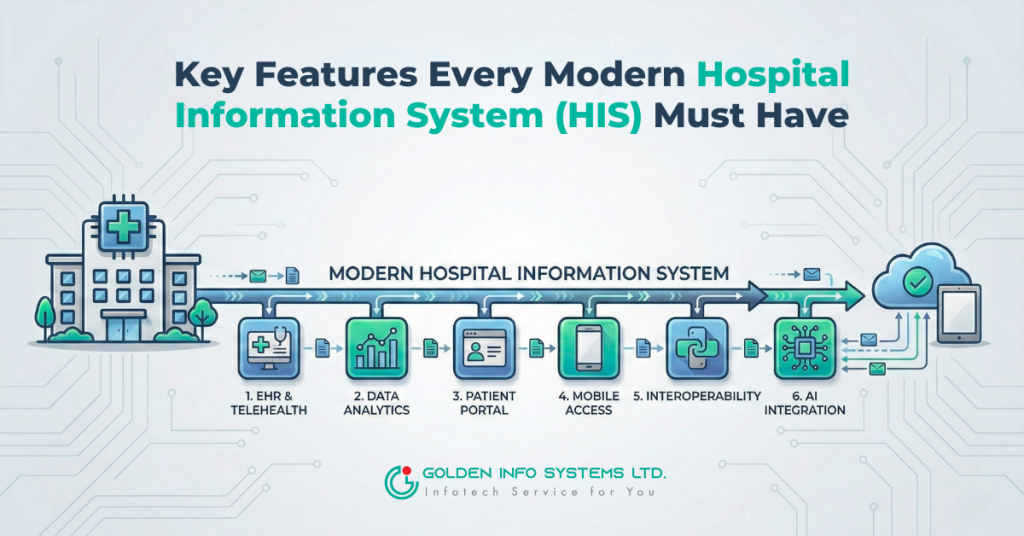
10 Key Features Every Modern Hospital Information System Must Have
To survive and thrive in today’s healthcare market, your software needs to be a powerhouse. Here are the 10 non-negotiable features you should look for.
1. True Interoperability (The Connectivity Engine)
If there is one word you remember from this article, make it Interoperability.
In the past, hospital departments were like separate islands. The lab system couldn’t talk to the pharmacy system, and neither could talk to the billing department. This created “data silos” that slowed everything down.
What to Look For: A modern HIS must support global standards like HL7 (Health Level Seven) and FHIR (Fast Healthcare Interoperability Resources). This means your system can seamlessly exchange data with:
- External labs and imaging centers.
- Government health databases.
- Wearable devices (like smartwatches).
- Other hospitals (essential for referrals).
The Consequence of Ignoring It: Without true interoperability, your staff has to manually re-enter data from one system to another. This doubles their workload and drastically increases the chance of human error.
2. Cloud-Native Infrastructure (The Scalable Foundation)
Is your server room a closet in the basement with a noisy fan and a tangled mess of wires? If so, you are living in the past.
Modern HIS essentials utilize cloud-native infrastructure. This means your data isn’t stored on a physical computer in your building; it is hosted on secure, remote servers (the cloud) managed by experts (like AWS, Google Cloud, or Azure).
Why It Matters:
- Scalability: Need to open a new clinic? You can add users instantly without buying new hardware.
- Disaster Recovery: If a flood or fire hits your hospital, your data is safe and accessible from anywhere.
- Remote Access: Doctors can securely check patient charts from home or while on rounds.
Real-World Scenario: Imagine a specialist needs to consult on a case while traveling. With a cloud-based system, they can log in securely from their laptop, view high-res X-rays, and leave notes in real-time. With an on-premise system, that patient has to wait until the doctor returns.
3. AI-Driven Clinical Decision Support (The Second Brain)
Artificial Intelligence (AI) is no longer sci-fi; it is a standard expectation in healthcare software.
A modern HIS doesn’t just record what you type; it “reads” it and offers help. This feature is often called Clinical Decision Support (CDS).
Key Capabilities:
- Drug Interaction Checks: The system instantly alerts the doctor if a new prescription conflicts with a medication the patient is already taking.
- Sepsis Detection: AI algorithms monitor vital signs in the background and can predict sepsis hours before a human would notice the subtle changes.
- Diagnostic Suggestions: Based on symptoms and lab results, the system can suggest potential diagnoses or recommend further tests.
The “Why”: Medical knowledge is expanding faster than any human can keep up with. AI acts as a safety net, catching potential errors and ensuring your team is using the latest evidence-based protocols.
4. Integrated Telemedicine & Remote Patient Monitoring (The Virtual Wing)
The days of healthcare happening only inside the hospital walls are over.
Top features for hospital information systems now include built-in telemedicine tools. You shouldn’t have to use a separate app like Zoom or Skype to talk to patients. It should be one click within the patient’s chart.
What This Includes:
- Video Consultations: High-quality video calls directly from the HIS.
- Remote Patient Monitoring (RPM): The system connects to devices in the patient’s home (like blood pressure cuffs or glucose monitors) and automatically pulls that data into their record.
The Benefit: This allows you to launch “Hospital at Home” programs, freeing up physical beds for critical cases while keeping chronic patients safe and monitored in their own homes.
5. Automated Revenue Cycle Management (The Financial Shield)
You can provide the best care in the world, but if you don’t get paid, your hospital closes.
Revenue Cycle Management (RCM) is the financial engine of your hospital. Legacy systems required an army of billers to manually code claims and chase down payments. Advanced healthcare system characteristics include automated RCM.
How It Works:
- Automated Coding: The system suggests the correct medical codes (ICD-10/11) based on the clinical notes, reducing “down-coding” (losing money) or “up-coding” (risking audits).
- Eligibility Checks: The system checks a patient’s insurance coverage before they even arrive.
- Denial Management: If a claim is denied, the system analyzes why and helps your team fix it instantly.
6. Zero-Trust Security Architecture (The Digital Fortress)
Healthcare data is more valuable on the black market than credit card numbers. That makes you a target.
Old systems relied on a simple username and password. Modern systems use a Zero-Trust approach. This means the system “trusts no one,” even if they are already inside the network.
Essential Security Features:
- Multi-Factor Authentication (MFA): Requiring a code from a phone in addition to a password.
- Role-Based Access Control (RBAC): A receptionist sees different data than a surgeon. The system strictly limits access based on the user’s job.
- Audit Trails: The system records every single click. You know exactly who opened a file, when, and what they did.
7. Patient Engagement Portals (The Front Door)
Patients want to be partners in their care, not just recipients. A patient portal is their window into your hospital.
What a Modern Portal Does:
- Self-Scheduling: Patients can book their own appointments online without calling.
- Access to Records: They can view lab results, vaccination history, and discharge summaries instantly.
- Secure Messaging: Patients can ask their doctor a quick question without needing a visit.
- Bill Pay: They can view and pay their invoices online.
The Consequence of Ignoring It: Low patient engagement leads to missed appointments (“no-shows”) and unpaid bills. A good portal reduces administrative work for your front desk by up to 30%.
8. Mobile-First Workflow (The Freedom Factor)
Doctors and nurses are constantly on the move. They shouldn’t be tethered to a desktop computer at a nursing station.
Hospital information system features must include robust mobile apps.
Real-World Application: A nurse can scan a patient’s wristband and a medication bag using a smartphone to ensure a match (Barcode Medication Administration). A doctor can dictate notes into their phone while walking from one ward to another.
9. Smart Inventory & Pharmacy Management (The Supply Chain)
Running out of critical medicine during an emergency is a nightmare.
Modern systems use Smart Inventory Management to track every pill and bandage.
- Expiry Alerts: The system notifies you months before medication is set to expire, reducing waste.
- Automated Re-ordering: When stock levels drop below a certain point, the system automatically generates a purchase order.
- Traceability: You can track a specific batch of medicine from the loading dock to the patient’s bedside, which is crucial for recalls.
10. Advanced Analytics & Business Intelligence (The Strategy)
Finally, a modern HIS helps you see the future.
Legacy systems gave you “reporting”—a look at what happened last month. Modern systems give you “analytics”—a look at what will happen next.
Examples:
- Predictive Staffing: “The system predicts a 20% surge in ER visits this weekend due to flu trends. Schedule two extra nurses.”
- Financial Forecasting: “Based on current claim denial rates, cash flow will dip next month.”
- Population Health: “We have 500 diabetic patients who haven’t had a checkup in 6 months. Let’s send them an automated reminder.”
Comparison: Legacy vs. Modern HIS
Still on the fence? Let’s look at the difference side-by-side.
| Feature | Legacy Systems (The Old Way) | Modern HIS (The New Way) |
| Hosting | On-premise servers (requires IT team) | Cloud-native (managed, secure, accessible) |
| Updates | Painful, expensive annual upgrades | Automatic, seamless updates (like your phone) |
| Interoperability | Data silos; difficult to share info | Native FHIR/HL7 integration; seamless sharing |
| User Interface | Clunky, gray screens; hard to learn | Intuitive, modern design; easy to master |
| AI Capabilities | None; passive data entry | Active AI support; alerts, predictions, automation |
| Patient Access | Phone calls and paper records | comprehensive Patient Portal & Mobile App |
| Security | Basic passwords; vulnerable | Zero-trust, MFA, Encryption at rest & transit |
The Hidden Cost of Ignoring These Features
You might look at the price tag of a modern HIS and hesitate. But you must also calculate the cost of not upgrading.
- Lost Revenue: How much money are you losing to denied claims that an automated system would have caught?
- Staff Turnover: How much does it cost to replace a nurse who quit because they were burnt out by administrative paperwork?
- Reputation Damage: What is the cost of a data breach or a publicized medical error?
Investing in modern HIS essentials is not just an IT expense; it is a strategic investment in the survival of your hospital.
How to Choose the Right System (Buyer’s Guide)
Ready to look for a new system? Don’t just pick the first one you see. Follow these steps:
- Map Your Workflows: Understand exactly how your doctors and nurses work before you look at software.
- Demand a Demo: Don’t trust screenshots. Ask vendors to demonstrate specific scenarios (e.g., “Show me how to discharge a patient and bill insurance in under 3 minutes”).
- Check References: Ask to speak to a hospital of similar size that has been using the system for at least a year.
- Prioritize Support: Software breaks. When it does, will the vendor be there? Look for 24/7 support guarantees.
Frequently Asked Questions (FAQ)
Q: How long does it take to implement a modern Hospital Information System?
It varies by size. For a mid-sized clinic or hospital (50-100 beds), a full implementation typically takes 3 to 6 months. This includes data migration, configuring the workflows to match your needs, and—most importantly—training your staff. Do not trust vendors who say they can do it in 2 weeks; proper training takes time.
Q: Is a Cloud-based HIS really secure?
Yes, often more secure than on-premise servers. Top cloud providers (like AWS or Azure) spend billions on security—far more than any single hospital could afford. They offer military-grade encryption, 24/7 threat monitoring, and automated backups. However, security is a shared responsibility; your staff must still use strong passwords and 2-factor authentication.
Q: What is the most important feature for ROI (Return on Investment)?
While clinical features save lives, Revenue Cycle Management (RCM) delivers the fastest financial ROI. By automating billing and reducing claim denials, many hospitals see a cash flow increase of 10-20% within the first year of switching to a modern HIS.
Q: Can a modern HIS integrate with my old equipment?
Mostly, yes. As long as your older lab machines or X-ray devices support the HL7 standard (which most equipment made in the last 20 years does), a modern HIS can connect to them via an “Interface Engine.”
The Future is Here
The gap between hospitals with modern systems and those without is widening. Key features every modern hospital information system must have—like AI, cloud connectivity, and true interoperability—are no longer “nice-to-haves.” They are the baseline for safe, efficient, and profitable healthcare.
You owe it to your patients, your staff, and your bottom line to equip your facility with the best tools available. Don’t let outdated technology hold you back.
Ready to transform your hospital?
[Schedule a Free Demo of Our Next-Gen HIS Today]
Take the first step toward a smarter, safer hospital.