





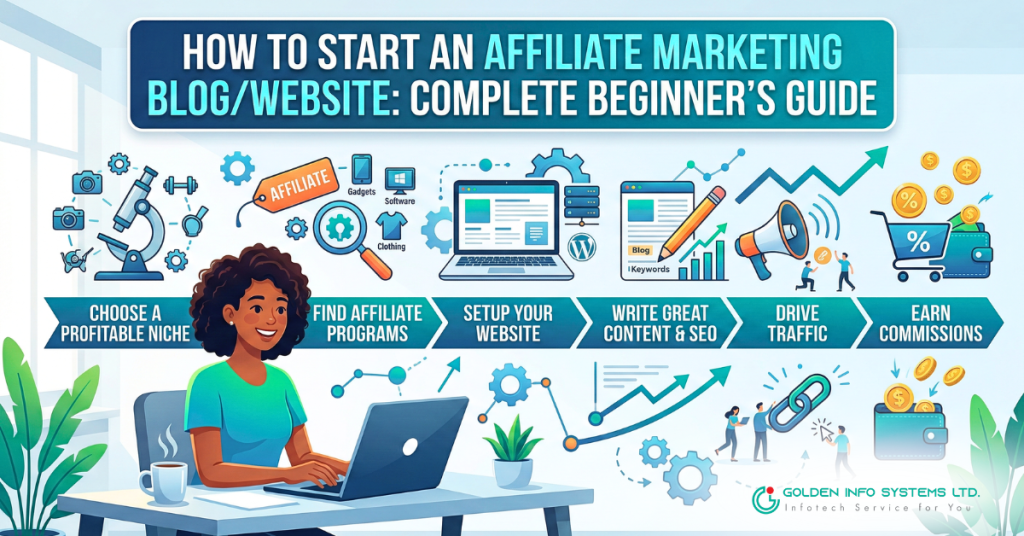
The affiliate marketing industry is projected to hit a staggering $17 billion globally? What’s even more surprising is that over 81% of top brands now rely on affiliate marketing programs to drive their sales, and 16% of all online orders come directly from affiliate links.
If those numbers gave you a sense of the massive scale of this industry, you are probably wondering how to start affiliate marketing and grab your piece of the pie. Whether you want a side hustle or aim to build a full-time digital empire, learning how to start affiliate marketing is one of the most accessible paths to passive income today.
Want to learn how to start affiliate marketing and create a profitable online business? This comprehensive affiliate marketing for beginners guide walks you through every step of launching a successful affiliate marketing blog or website from scratch.
Affiliate marketing is one of the most accessible ways to earn passive income online—you promote other companies’ products and earn commissions on sales, without creating your own products, handling inventory, or dealing with customer service.
Whether you’re looking to start affiliate marketing with no money or have a modest budget, this step-by-step affiliate marketing tutorial covers everything: choosing a profitable niche, setting up your affiliate website, creating content that converts, driving traffic, and earning your first commission. By following this complete guide to affiliate marketing, you’ll understand exactly how to start an affiliate website, avoid common mistakes, and build a sustainable online income stream that can eventually replace your day job.
What is Affiliate Marketing?
Before you can master how to start affiliate marketing, you need to understand exactly what it is. At its core, affiliate marketing is a performance-based business model where you earn a commission by promoting other companies’ products or services.
How Affiliate Marketing Works
When you start affiliate marketing website ventures, the process looks like this:
- You find a product you like and trust.
- You sign up for their affiliate program and receive a unique tracking link (an affiliate link).
- You promote that link on your affiliate marketing blog, website, or social media.
- A reader clicks your link and makes a purchase.
- You earn a percentage of that sale (your commission).
The Affiliate Marketing Business Model
The affiliate marketing business model is incredibly simple. You act as the bridge between the consumer and the product creator. Because you don’t have to create products, handle shipping, or manage customer service, it is the perfect low-risk online business. This is exactly why affiliate marketing for beginners is so highly recommended.
Why Start an Affiliate Marketing Website?
Learning how to start an affiliate website gives you digital real estate. Unlike social media platforms where algorithms can hide your content overnight, an affiliate marketing website is an asset you own completely. It allows you to build an email list, rank on Google using SEO, and create a sustainable passive income affiliate marketing machine.
Realistic Expectations: Income and Timeline
How long does it take to make money with affiliate marketing? If you are a beginner, average affiliate marketing income ranges from $0-$1,000 per month during your first year. Intermediate marketers earn $1,000-$10,000 monthly, and advanced affiliates scale to $10,000+. The typical timeline to your first sale is 3-6 months. This requires patience, but the long-term payoff is life-changing.
Is Affiliate Marketing Right for You?
Understanding how to start affiliate marketing as a beginner means knowing what you are signing up for.
Pros and Cons of Affiliate Marketing
Pros:
- Low startup costs (you can learn how to start affiliate marketing on a budget).
- No product creation or customer support required.
- Ability to work from anywhere in the world.
- True passive income potential.
Cons:
- It takes time to see results (not a get-rich-quick scheme).
- You must learn SEO and content creation.
- Income can be inconsistent at the very beginning.
Skills Needed for Success
To succeed in affiliate marketing, you need basic writing skills, a willingness to learn SEO (Search Engine Optimization), and patience. You do not need to be a coding genius or a marketing expert. Affiliate marketing for beginners step by step is all about learning as you grow.
Time and Budget Requirements
How much does it cost to start affiliate marketing? You can build an affiliate marketing website from scratch for under $100 for your first year. As for time, plan to dedicate at least 5 to 10 hours a week to write content and optimize your site.
Common Myths Debunked
“It’s too late to start.” False. With new products, software, and trends (like AI and cloud infrastructure) emerging daily, there are always new niches. “You need a massive following.” False. A small, highly targeted audience reading your affiliate marketing blog converts much better than a million random followers.
Step 1: Choose Your Affiliate Marketing Niche
If you want to know the best way to start affiliate marketing, it begins with choosing the right niche. This is responsible for 30% of your success.
What is a Niche and Why It Matters
An affiliate marketing niche is a specific segment of a broader market. Instead of writing about “technology” (too broad), you might write about “cloud infrastructure trends for small businesses” or “mechanical gaming keyboards.” A tight niche helps you rank faster on Google and builds trust with a specific audience.
Best Niches for Affiliate Marketing
Some of the most profitable affiliate niches include:
- Health & Fitness: Weight loss, home workouts, supplements (Commission: 10-30%).
- Personal Finance: Credit cards, investing apps, budgeting (Commission: $25-$500 per sale).
- Technology: Software/SaaS, web hosting, AI tools (Commission: 20-75%).
- Home & Garden: Furniture, smart home tools, decor (Commission: 4-8%).
- Hobbies: Photography, gaming, golf (Commission: 5-20%).
- Pet Care: Dog training, premium pet food (Commission: 5-15%).
How to Research Profitable Niches
When learning how to start affiliate marketing, use the 3-P Framework for niche selection:
- PASSION (Personal Interest): Pick topics you enjoy researching. You don’t need to be an expert yet, but you must be able to write 100+ articles without burning out.
- PROFIT (Commercial Viability): Look for niches with good commission rates (5-50%+) and high-ticket options. Check if there are Amazon affiliate program products or ClickBank offers in this space.
- PEOPLE (Audience Demand): Use Google Trends to ensure people are actively searching for this topic.
Evaluating Niche Competition
Avoid extreme competition. If every search result is dominated by Forbes, NYT, and massive tech giants, as a beginner, you will struggle. Look for niches with low competition affiliate keywords where smaller affiliate blogs are ranking on page one.
Passion vs Profit: Finding the Balance
Don’t choose a highly profitable niche (like credit cards) if you hate finance. You will quit before you make money. Balance a topic you genuinely like with a proven monetization track record.
Niche Examples and Case Studies
For example, instead of a broad “pets” site, a successful affiliate marketer might build a site entirely dedicated to “caring for senior Golden Retrievers.” This high-intent, low-competition affiliate niche converts incredibly well.
Step 2: Research Affiliate Programs in Your Niche
Once you have a niche, you need to find products to promote. This is a crucial phase when figuring out how to start affiliate marketing.
Types of Affiliate Programs
There are physical product programs (lower commissions, high conversion rates) and digital product/software programs (high commissions, recurring payouts).
Best Affiliate Networks for Beginners
Affiliate networks are platforms that host thousands of different programs in one place. The best affiliate programs for beginners include:
Amazon Associates Program
The Amazon affiliate program is perfect for beginners. While commissions are lower (1-10%), their conversion rate is incredibly high because people already trust Amazon. It has a 24-hour cookie duration.
ClickBank, ShareASale, CJ Affiliate
- ShareASale: Great for physical and digital products across multiple niches. Cookie duration is usually 30-90 days.
- CJ Affiliate: Houses major premium brands. Best for established sites.
- ClickBank: Phenomenal for high paying affiliate programs in the digital product space, offering 50-75% commissions.
High-Ticket vs Low-Ticket Affiliate Programs
Low-ticket items (a $20 dog toy) might pay you $1. You need massive traffic to make a living. High-ticket affiliate niches (like a $2,000 SaaS software plan) might pay you $500 per sale. The best strategy is to mix both on your affiliate marketing website.
Commission Structures Explained
You will encounter flat-rate commissions ($50 per sign-up) and percentage-based commissions (10% of the cart value). Some software programs even offer recurring commissions, meaning you get paid every month the customer stays subscribed!
How to Evaluate Affiliate Programs
Look at the commission rate, cookie duration (how long you have to earn the commission after they click), payment threshold, and the program’s overall reputation.
Step 3: Choose Your Platform (Website vs Social Media)
A massive part of learning how to start affiliate marketing is choosing where you will host your content.
Why a Website is Recommended
Do I need a website for affiliate marketing? While you can start without one, learning how to start an affiliate website is highly recommended. A website is the only asset you truly own and control. It allows you to leverage SEO for affiliate marketing, driving free, passive organic traffic for years.
Website vs Social Media for Affiliates
Social media is great for quick engagement, but a WordPress affiliate website is best for long-term wealth. Social algorithms change daily, but a helpful, SEO-optimized affiliate marketing blog post can rank on Google and generate sales 24/7.
Blog, YouTube, Instagram, TikTok Options
You can do affiliate marketing on TikTok or Instagram by putting links in your bio. YouTube affiliate marketing is also highly lucrative for product reviews.
Multi-Platform Strategy
The most successful affiliate marketing business model involves starting an affiliate blog first to capture search traffic, and then using social media or Pinterest to drive additional traffic to those blog posts.
Step 4: Get a Domain Name for Your Affiliate Website
If you have chosen to build a site, the next step in how to start an affiliate website is getting your web address.
Choosing the Perfect Domain Name
Your domain name for affiliate marketing is your brand. It should be memorable, easy to spell, and related to your niche.
Domain Name Best Practices
Always try to get a .com extension. Avoid using numbers or hyphens, as they look spammy. Don’t pigeonhole yourself; instead of best-cloud-servers.com, choose something brandable like CloudTechInsights.com.
Where to Buy Domains (Namecheap, GoDaddy)
You can purchase domains from registrars like Namecheap or GoDaddy.
Domain Cost and Registration
A domain typically costs between $10 to $15 per year. It is a tiny investment needed for affiliate marketing success.
Step 5: Choose Web Hosting for Your Affiliate Site
You cannot figure out how to start affiliate marketing without understanding web hosting.
What is Web Hosting?
If your domain name is your house’s address, your web hosting is the land the house is built on. It is where your affiliate website’s files are stored on the internet.
Best Hosting Providers for Beginners (Bluehost, SiteGround, HostGator)
For a beginner affiliate marketing website setup, you want reliable and cheap affiliate website hosting.
- Bluehost: Highly recommended for beginners (around $2.95/month).
- SiteGround: Exceptional speed and customer service (around $3.99/month).
- HostGator: Very budget-friendly (around $2.75/month).
Shared vs VPS vs Dedicated Hosting
When you start affiliate marketing website building, shared hosting is all you need. You share server space with other sites to keep costs down. As your traffic grows to over 50,000 monthly visitors, you can upgrade to VPS (Virtual Private Server).
Hosting Costs and Features to Look For
Expect to pay $36-$120 for your first year of hosting. Look for hosts that offer a free SSL certificate, one-click WordPress installation, and 24/7 support.
How to Purchase and Set Up Hosting
Simply go to a host like Bluehost, choose their basic plan, enter your domain name, and complete the checkout.
[CTA: Ready to start? Click here to get Bluehost hosting for just $2.95/month and a free domain!]
Step 6: Install WordPress and Set Up Your Website
Now it is time for the fun technical part of how to create an affiliate website.
Why WordPress is Best for Affiliate Marketing
Do not use free platforms like Blogger, and be cautious with Wix or Squarespace affiliate site setups if you want total control. A self-hosted WordPress affiliate website (WordPress.org) is the absolute industry standard. It powers over 40% of the internet and is incredibly SEO-friendly.
Installing WordPress (One-Click Install)
Most major hosts offer a “One-Click WordPress Install” right from your hosting dashboard. With a single click, your blank affiliate marketing website is created.
WordPress Dashboard Overview
Spend an hour clicking around your new dashboard. Familiarize yourself with “Posts” (where you write articles), “Pages” (for static pages like About Us), and “Plugins” (apps for your site).
Essential WordPress Settings
Go to Settings > Permalinks and change it to “Post name.” This makes your URLs look clean (e.g., yoursite.com/best-affiliate-tools) which is vital for affiliate website SEO.
Installing SSL Certificate (HTTPS)
An SSL certificate puts the little padlock icon next to your URL, proving your site is secure. This is a mandatory ranking factor for Google. Most hosts provide this for free; just ensure it is activated in your dashboard.
Step 7: Choose and Install an Affiliate Marketing Theme
Design matters when learning how to start an affiliate website. A professional design builds trust.
Best WordPress Themes for Affiliate Marketing
Your WordPress theme for affiliate sites dictates how your blog looks. The best themes are lightweight and fast. Top recommendations include GeneratePress, Astra, and Kadence.
Free vs Premium Themes
You can absolutely start affiliate marketing with no money for a theme by using the free versions of Astra or GeneratePress. Premium themes (usually $50-$60 one-time) offer more customization, but they aren’t strictly necessary on day one.
Theme Features to Look For
Prioritize speed and readability. Your text should be dark against a white background with a large, easily readable font (like 18px).
Installing and Customizing Your Theme
In WordPress, go to Appearance > Themes > Add New. Search for Astra, click Install, and then Activate. Use the WordPress Customizer to add your site title and a simple text logo.
Mobile Responsiveness and Speed
Over 60% of your readers will be on mobile devices. Ensure you have a mobile-friendly affiliate website. Check your site on your phone to ensure menus work and text isn’t cut off.
Step 8: Install Essential Plugins for Affiliate Marketing
Plugins add functionality to your site. Part of the affiliate marketing for beginners step by step process is installing the right tools.
SEO Plugins (Yoast SEO, Rank Math)
To help Google understand your content, install either Rank Math or Yoast SEO. They provide a checklist right inside your post editor to ensure you are hitting SEO targets.
Affiliate Link Management Plugins (ThirstyAffiliates, Pretty Links)
Affiliate links are often long and ugly (e.g., merchant.com/?aff_id=12345&trk=abc). Use a free affiliate link management plugin like Pretty Links to cloak them into something clean like yoursite.com/go/product.
Analytics Plugins (Google Analytics, MonsterInsights)
To track your visitors, you need analytics for affiliate sites. MonsterInsights allows you to connect Google Analytics easily so you can see your data directly in WordPress.
Speed Optimization Plugins
Install a caching plugin like LiteSpeed Cache or WP Rocket to make your pages load in under 2 seconds.
Security Plugins
Protect your digital asset with a security plugin like Wordfence to block hackers and spam bots.
Email Marketing Plugins
When you are ready to build an email list for affiliates, plugins like WPForms allow you to easily embed newsletter sign-up boxes on your site.
Step 9: Create Important Pages
Before you launch your affiliate website and start publishing posts, you need core foundational pages to look legitimate to both readers and affiliate networks.
About Page
People buy from people they trust. Write a compelling About Page explaining who you are, why you started this affiliate marketing blog, and how you plan to help the reader.
Contact Page
Include a simple contact form (using WPForms) and a professional email address (like [email protected]).
Privacy Policy and Disclaimer
You legally must tell users how you handle their data. Use a free online privacy policy generator to create this.
Affiliate Disclosure Page (FTC Compliance)
This is strictly required. The FTC requires an affiliate link disclosure stating that you make a commission if someone clicks your links and buys. Put a brief disclosure at the top of every single blog post, and link to a longer, dedicated Affiliate Disclosure page.
Terms and Conditions
This protects you legally by outlining the rules for using your website.
Step 10: Plan Your Content Strategy
You know how to start affiliate marketing on the technical side; now you need a content strategy for affiliate marketing. Content is what drives traffic and sales.
Types of Affiliate Content That Convert
The most profitable affiliate marketing content ideas target “buyer intent.” These are people holding their credit cards, just waiting for a final recommendation.
Here are the top types:
Product Reviews and Comparisons
Writing honest product reviews and affiliate marketing style is highly lucrative. (e.g., “Bluehost Web Hosting Review : Is It Fast Enough?”).
Best [Product] Lists and Roundups
These “listicles” gather the best options for a specific user. (e.g., “7 Best WordPress Themes for Affiliate Sites”).
How-To Guides and Tutorials
Educational content builds authority. An article on “How to Install WordPress” can naturally include your affiliate link to a hosting provider.
Buyer’s Guides
Comprehensive guides like “What to Look for When Buying a Gaming Laptop” help users make informed decisions.
Resource Pages
A “My Tools” or “Resources” page detailing the exact software and tools you use in your business is a goldmine for soft-selling affiliate products.
Creating a Content Calendar
Plan your affiliate blog post ideas in advance. Aim to publish 2-3 high-quality articles per week during your first 6 months. Consistency is how you rank affiliate website content.
Step 11: Do Keyword Research for SEO
If you just write about whatever pops into your head, no one will find you. Keyword research for affiliate marketing is the secret weapon for traffic.
Why Keyword Research Matters
Keyword research tells you exactly what people are typing into Google, how many people are searching for it, and how hard it is to rank for that phrase.
Free Keyword Research Tools (Google Keyword Planner, Ubersuggest)
If you are starting affiliate marketing with no money, use the Google Keyword Planner, AnswerThePublic, or the free version of Ubersuggest to find topic ideas.
Paid Tools (Ahrefs, SEMrush, Moz)
Once you have a budget, tools like Ahrefs or SEMrush ($99+/month) give you incredibly accurate data to spot easy-to-rank keywords.
Finding Low-Competition Keywords
Look for search terms with a high search volume but low keyword difficulty (KD). As a beginner, target keywords with a KD of under 20.
Long-Tail Keywords for Affiliates
Short keywords like “web hosting” are impossible to rank for. Instead, target long-tail keywords (high intent/conversion) like “best managed web hosting for small cloud infrastructure startups.” They have lower traffic but incredibly high conversion rates.
Search Intent and Buyer Keywords
Always write for the user’s intent. If they search “what is an affiliate link,” they want information (Informational intent). If they search “HostGator vs Bluehost,” they are ready to buy (Commercial/Buyer intent). Focus heavily on buyer intent keywords.
Step 12: Write Your First Affiliate Blog Posts
Now it is time to write. When wondering how to start affiliate marketing, writing the actual content is where most people get stuck.
How to Structure Affiliate Content
A standard affiliate blog post should have:
- Hook: Identify the reader’s problem.
- Quick Answer/Summary: Give the top recommendation right away for impatient readers.
- Detailed Body: Discuss pros, cons, features, and pricing.
- Conclusion: Give a final verdict.
Writing Honest Product Reviews
Never lie to your audience just to make a sale. Successful affiliate marketing relies on trust building. Highlight the flaws of a product. If a product is expensive or hard to use, say so! Readers appreciate honesty and will trust your recommendations more.
Creating Compelling Headlines
Your H1 title needs to compel clicks. Instead of “Best Running Shoes,” use “9 Best Running Shoes for Flat Feet (Tested & Reviewed).”
Using Images and Videos
Break up text with screenshots, original photos of the product (if you own it), or embedded YouTube videos. This improves the user experience affiliate site metrics.
Adding Affiliate Links Naturally
Don’t spam links in every sentence. Add affiliate links where it makes natural sense, such as on the product name or in a clear button.
Call-to-Action Best Practices
Tell the reader exactly what to do. Use clear, buyer intent CTAs like: [CTA: Click here to check the current price of Product X on Amazon]
Content Length and Quality
Google loves comprehensive content. Your buyer’s guides and reviews should typically be 1,500 to 3,000 words long, thoroughly answering every possible question the user might have.
Step 13: Optimize Your Content for SEO
Writing great content isn’t enough; you must optimize it. SEO for affiliate marketing ensures Google can read and rank your site.
On-Page SEO Basics
Place your target keyword in the first 100 words of your article, in your URL, and sprinkled naturally throughout the text.
Title Tags and Meta Descriptions
Your Title Tag is the blue clickable link on Google. Your Meta Description is the short text beneath it. Ensure your target keyword is in both, and write them to be highly clickable.
Header Tags (H1, H2, H3)
Use proper heading structure. Your main title is H1. Your main sections are H2s. Sub-points under H2s are H3s. This helps Google understand the hierarchy of your post.
Internal and External Linking
Link out to high-authority external sites (like Wikipedia or a manufacturer’s site) to show you do research. More importantly, use internal linking. Link from your new blog post back to older, related posts on your site.
Image Optimization and Alt Text
Large images slow down your site. Compress them using a tool like TinyPNG before uploading. Always fill out the “Alt Text” field with a description of the image so visually impaired users (and Google) know what it is.
Mobile Optimization
Keep your paragraphs short (2-3 sentences max). Massive walls of text are impossible to read on a mobile phone and will cause users to leave your site immediately.
Page Speed Optimization
A fast site ranks better. Ensure your caching plugin is working and you aren’t overloading your site with heavy widgets.
Step 14: Build an Email List
If you ask any 7-figure marketer how to make money with affiliate marketing safely, they will tell you the money is in the list.
Why Email Marketing Matters for Affiliates
Google rankings can drop, and social media accounts can be banned. Your email list is yours forever. Email marketing for affiliate marketing allows you to promote products directly to a warm audience on demand.
Choosing an Email Marketing Service (Mailchimp, ConvertKit, GetResponse)
Start with a free or cheap provider. Mailchimp is free for up to 500 subscribers. ConvertKit is built specifically for creators and affiliates, making it highly recommended once you have a small budget.
Creating Lead Magnets
People won’t give you their email for nothing. Offer a “Lead Magnet” – a free PDF, checklist, or template in exchange for their email address. (e.g., “Download my Free 10-Step Cloud Migration Checklist”).
Setting Up Opt-in Forms
Place opt-in forms at the bottom of your blog posts, in your sidebar, and as an exit-intent pop-up using your email plugin.
Email Sequence for Affiliate Promotions
Once someone subscribes, set up an autoresponder for affiliates. Send them a welcome email, followed by 3-4 emails providing pure, helpful value. In the 5th email, you can naturally promote a relevant affiliate product.
Email Marketing Best Practices
Don’t just spam affiliate links. Build a relationship, share personal stories, and provide exclusive tips to your newsletter subscribers.
Step 15: Drive Traffic to Your Affiliate Website
You have built the site and written the content. Now, how to get traffic to affiliate website pages?
Organic Traffic Through SEO
As discussed, organic traffic for affiliate sites via Google SEO is the holy grail. It is free, passive, and highly targeted. However, it takes 3-6 months to kick in.
Social Media Marketing
While waiting for SEO, share your posts on social media. Social media strategy for affiliates should focus on platforms where your target audience hangs out.
Pinterest for Affiliate Marketing
Pinterest is technically a visual search engine, not just social media. Create highly visual pins for your blog posts. Pinterest affiliate marketing can drive massive traffic to lifestyle, DIY, finance, and tech blogs very quickly.
YouTube Video Marketing
Repurpose your blog post into a video. Talk about the product on camera, put your affiliate link in the description, and embed the YouTube video inside your blog post. This boosts your website SEO and gets you YouTube traffic.
Guest Posting and Backlinks
Reach out to other bloggers in your niche and offer to write a free article for them in exchange for a link back to your site (a backlink). Backlinks for affiliate website growth are like “votes of confidence” in the eyes of Google.
Paid Advertising (Google Ads, Facebook Ads)
Paid traffic affiliate marketing is advanced. Only attempt this once your site is already converting organically; otherwise, you risk losing money quickly.
Free vs Paid Traffic Sources
For the first year, stick 100% to free traffic sources (SEO, Pinterest, YouTube) to keep your affiliate marketing budget low and learn what content naturally converts.
Step 16: Join and Apply to Affiliate Programs
Now that you have some content and traffic, you are ready to monetize.
When to Apply to Affiliate Programs
Don’t apply on day one. Affiliate networks want to see a professional-looking site with at least 10-15 solid articles and a privacy policy before they approve you.
Application Requirements
You will need to provide your website URL, your traffic generation strategy, and your tax information (for payouts).
Getting Approved (Tips)
Be honest in your applications. If you are new, say so, but highlight your content strategy and SEO plans. Having a clean, fast website with great design ensures a 99% approval rate.
Managing Multiple Affiliate Programs
Keep a spreadsheet of all the affiliate networks you join, your login details, and your specific affiliate links.
Affiliate Agreement Terms to Understand
Read the fine print. Some programs forbid you from running paid ads to their links, or bidding on their brand name in Google Ads. Breaking these rules will get you banned.
Step 17: Add Affiliate Links to Your Content
Knowing where to put affiliate links is an art form that directly impacts your affiliate conversion rate.
Where to Place Affiliate Links
Place your first link within the first 20% of the article. If a reader is in a hurry, they should be able to click and buy without scrolling to the bottom.
Link Cloaking and Management
Use your Pretty Links plugin to cloak ugly links. Instead of brand.com/aff_123, use yourdomain.com/go/brand. This looks trustworthy and stops people from stealing your affiliate ID.
Text Links vs Banner Ads vs Buttons
Text links placed naturally in sentences work best. Large, high-contrast buttons (e.g., “Check Current Price”) also have incredibly high click-through rates. Avoid clunky banner ads; banner blindness is real, and users ignore them.
Disclosure Requirements (FTC Guidelines)
To remain FTC compliant, your affiliate link disclosure must be clear, conspicuous, and placed before any affiliate links appear in the post. A simple “This post contains affiliate links, which means we may earn a commission…” is sufficient.
Tracking Your Affiliate Links
Most affiliate networks provide a dashboard showing how many clicks and sales you generated. Track which pages are sending the most clicks so you can replicate that success.
Step 18: Track Your Performance and Analytics
You can’t improve what you don’t measure.
Setting Up Google Analytics
Google Analytics shows you how many people visit your site, where they come from, and how long they stay. Install it immediately upon launch.
Google Search Console Setup
Google Search Console is a free tool that tells you exactly which keywords your site is ranking for on Google. It is the most important tool for SEO.
Affiliate Dashboard Analytics
Check your affiliate networks weekly to monitor your earnings per click (EPC) and overall conversion rates.
Key Metrics to Monitor (Traffic, Clicks, Conversions)
Focus on increasing affiliate clicks. If a page gets 1,000 visitors but only 5 clicks, your links are hidden or your copy isn’t persuasive.
A/B Testing and Optimization
Test different button colors, change your headlines, and update old content. Conversion optimization affiliate site tweaks can double your income without needing any extra traffic.
Step 19: Scale and Grow Your Affiliate Income
Once you make your first $100, you have proven the concept. Now it is time to scale affiliate marketing business operations.
Creating More Content
The fastest way to grow is to publish more targeted SEO content. Expand your keyword research and cover every single topic in your niche.
Expanding to Multiple Niches
Once your first site is earning a stable passive income with affiliate marketing, you can take your profits and learn how to start an affiliate website in a completely different niche.
Diversifying Income Sources
Don’t rely solely on one affiliate program. Promote 5-10 different software tools or physical products. You can also add display ads (like Mediavine) or create your own digital products later.
Outsourcing Content Creation
Reinvest your earnings to hire freelance writers. This removes you from the daily grind and turns your side hustle into a full-time affiliate marketing business.
Building Authority and Trust
Become the go-to expert in your niche. Get interviewed on podcasts, build a thriving email list, and engage with your community.
Advanced Strategies
As you grow, experiment with high ticket affiliate niches, advanced SEO link-building campaigns, and complex email automation funnels.
How Much Does It Cost to Start Affiliate Marketing?
A major question beginners have is the cost to start affiliate website ventures. Here is a realistic breakdown.
Minimum Budget Breakdown
DIY Approach (First Year):
- Domain: $10-15/year (Namecheap, GoDaddy)
- Hosting: $36-120/year or $3-10/month (Bluehost, SiteGround)
- Theme: $0-60 one-time (Astra Free or Premium)
- Tools and Plugins: $0-50/month (Free Yoast SEO, Free Analytics)
- Email Marketing: $0 (Mailchimp is free up to 500 subs)
Total Startup Cost: $50-200 (first year)
You can easily start an affiliate marketing blog for under $100 out of pocket.
Optional Investments
Once you make money, you can invest in premium tools like Ahrefs for SEO ($99/mo), premium web design, or freelance writers ($50-$150 per article).
How Long Does It Take to Make Money?
Success in affiliate marketing requires setting realistic expectations. Here is the typical timeline.
Realistic Timeline Expectations
- First 3 Months (Setup and Content): You are building the site and writing your first 20-30 articles. Income is $0. Traffic is very low. Google is just discovering your site.
- Months 3-6 (Traffic Growth): Your SEO starts working. You get your first consistent trickle of visitors (500-3,000/month). You might make your first few sales ($50-$500/month).
- Months 6-12 (First Sales and Income): Momentum builds. You have 50+ articles. You start ranking on page 1 for low-competition keywords. Income grows to $500-$2,000/month.
- Year 2+ (Scaling and Growth): Your site is an established authority. Traffic surges past 10,000+ visitors. You scale to $2,000-$10,000+ per month.
Factors Affecting Success Speed
Your speed depends on niche selection (low competition = faster), content quality, SEO knowledge, and consistency.
Common Affiliate Marketing Mistakes to Avoid
Many fail because they fall into these traps. Here are the affiliate marketing mistakes to avoid:
- Choosing Too Broad a Niche: Trying to be the next Amazon. Narrow it down!
- Promoting Too Many Products: Focusing on quantity over quality confuses readers.
- Not Disclosing Affiliate Relationships: This can get you banned from networks and fined by the FTC.
- Neglecting SEO: Writing without keyword research is like shouting into the void.
- Focusing Only on High-Commission Products: Don’t promote garbage just because it pays $100 a sale. Promote quality.
- Giving Up Too Early: 90% of people quit in month 4, right before the SEO traffic kicks in.
- Not Building an Email List: You are leaving massive money on the table.
- Copying Other Affiliate Sites: Google penalizes duplicate content. Be original.
- Ignoring Analytics: Flying blind without tracking what works.
Best Tools and Resources for Affiliate Marketers
To build a professional affiliate site, leverage the best tools for affiliate marketing:
- Website Building Tools: WordPress, Elementor (page builder), GeneratePress.
- SEO and Keyword Research Tools: Ahrefs, SEMrush, Ubersuggest, Google Search Console, Yoast SEO.
- Content Creation Tools: Grammarly, Google Docs, Canva (for images).
- Link Management Tools: Pretty Links, ThirstyAffiliates.
- Email Marketing Platforms: ConvertKit, Mailchimp, GetResponse.
- Analytics and Tracking: Google Analytics, MonsterInsights.
- Social Media Management: Tailwind (for Pinterest), Buffer.
Affiliate Marketing Success Stories and Examples
Looking for inspiration? There are countless affiliate website examples that prove this business model works. Sites like Wirecutter (bought by the NYT) started as simple tech review affiliate blogs. NerdWallet is a massive affiliate site in the finance niche.
What Successful Affiliates Do Differently
The top 5% of affiliates who make $10,000+ a month do three things: They pick highly specific niches, they write incredibly helpful, honest content that is better than the competition, and they stay consistent for years, not months.
Legal and Compliance Requirements
Protect your business by following the rules.
- FTC Affiliate Disclosure Requirements: Always clearly state that you earn a commission.
- GDPR Compliance: If you have European visitors, you must have a cookie consent banner.
- Terms of Service & Privacy Policy: Have these pages linked in your website footer.
- Copyright and Fair Use: Never steal images from Google. Use free stock photo sites like Pexels or Unsplash, or create your own graphics.
Next Steps: Your Affiliate Marketing Action Plan
Ready to take action? Here is your 30-Day Launch Plan checklist for getting started with affiliate marketing:
Affiliate Marketing Launch Checklist (19 Steps)
Pre-Launch (Week 1):
- 1. Choose your niche (use the passion + profit framework).
- 2. Research 5-10 affiliate programs in your niche.
- 3. Buy a domain name ($10-15).
- 4. Purchase web hosting ($3-10/month via Bluehost or SiteGround).
Setup (Week 2):
- 5. Install WordPress.
- 6. Install a fast affiliate theme (like Astra).
- 7. Add essential plugins (Yoast SEO, Pretty Links, MonsterInsights).
- 8. Create important pages (About, Contact, Disclosure, Privacy).
Content (Week 3):
- 9. Plan your content strategy (brainstorm 10+ article ideas).
- 10. Do keyword research (find 20+ low-competition keywords).
- 11. Write your first 5 blog posts (product reviews, tutorials).
- 12. Optimize them for on-page SEO.
Monetization (Week 4):
- 13. Apply to affiliate programs.
- 14. Add cloaked affiliate links to your content.
- 15. Set up an email marketing account and opt-in form.
- 16. Install Google Analytics to track visitors.
Ongoing Monthly Tasks:
- 17. Promote your content on Pinterest and social media.
- 18. Continue writing 2-3 SEO-optimized articles a week.
- 19. Track, analyze, and optimize your conversions.
FAQs About Starting an Affiliate Marketing Blog
How do I start affiliate marketing?
To start affiliate marketing, choose a specific niche, build a WordPress website, sign up for affiliate programs (like Amazon Associates or ShareASale), write SEO-optimized content reviewing those products, and naturally insert your unique affiliate links into the text.
Can you start affiliate marketing with no money?
Yes, you can start affiliate marketing with no money by promoting links on free platforms like TikTok, YouTube, or Medium. However, investing $50-$100 in a self-hosted WordPress website is highly recommended for long-term success and asset ownership.
Do I need technical skills to start?
No. Modern web hosting providers offer one-click WordPress installations, and themes use simple drag-and-drop builders. If you can use Microsoft Word and send an email, you have the technical skills required.
Can I do affiliate marketing without a website?
Yes, you can use social media, YouTube, or email lists. However, a website gives you control, search engine traffic (SEO), and a central hub for your business, making it the most stable method.
What is the best niche for affiliate marketing?
The best niche balances your personal interest, high product demand, and good commission rates. Evergreen affiliate niches like health/fitness, wealth/finance, software (SaaS), and pet care are incredibly profitable and beginner-friendly.
Is affiliate marketing worth it in 2026?
Absolutely. With the industry projected to hit $17 billion, brands are relying on affiliates more than ever to drive direct-to-consumer sales. It remains one of the lowest-risk, highest-reward online business models.
How do beginners make money with affiliate marketing?
Beginners make money by finding low-competition, long-tail keywords (e.g., “best budget cloud hosting for students”), writing an incredibly helpful review article targeting that keyword, and embedding their affiliate link so searchers can purchase the recommendation.
How do taxes work with affiliate income?
Affiliate income is considered self-employment business income. You are responsible for tracking your earnings and reporting them on your taxes. You will fill out W-9 forms when joining US-based affiliate networks.
What’s better: Amazon Associates or other programs?
Amazon Associates is best for beginners due to high conversion rates and massive trust, though commissions are low (1-10%). Other networks like ClickBank or direct SaaS programs are better for high-ticket, high-percentage (30-70%) commissions. A successful strategy uses both.
Start Your Affiliate Marketing Journey Today
Figuring out exactly how to start affiliate marketing doesn’t have to be overwhelming. By breaking it down into manageable steps—choosing a profitable niche, setting up a fast WordPress affiliate website, writing helpful SEO content, and building trust with your audience—you can create a sustainable online business from scratch.
Remember, affiliate marketing for beginners is a marathon, not a sprint. The marketers who succeed are the ones who commit to the process for at least 6 to 12 months, consistently publishing great content.
You have the roadmap, you know the tools, and you understand the strategy. Now, it is time to take action.