





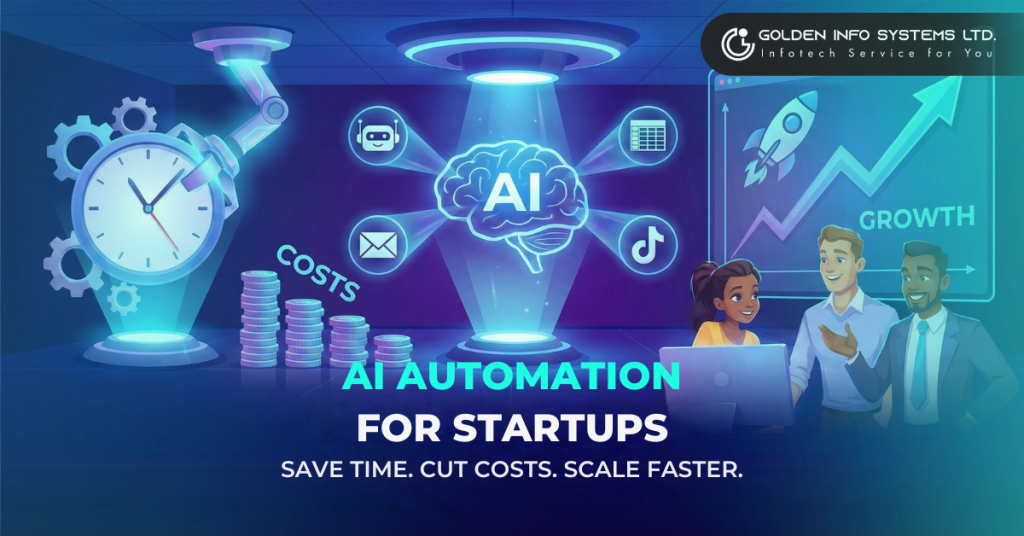
Startups lose nearly 30% of their revenue simply due to inefficiencies and manual processes?
It’s a startling fact. In the early days of building a business, every dollar and every minute counts. Yet, countless founders find themselves buried under a mountain of repetitive tasks—data entry, scheduling emails, chasing invoices, and answering the same customer questions over and over again.
If you are feeling overwhelmed by the sheer volume of “busy work” required to keep your business running, you are not alone. But there is a better way.
The solution isn’t working harder; it’s working smarter. This is exactly how AI automation saves time & cuts costs for startups.
By integrating AI automation for startups, you can clone your best employees (digitally speaking), reduce human error, and free up your team to focus on growth rather than maintenance.
In this comprehensive guide, we will explore how AI for small business is changing the game. We will break down exactly how you can use automation tools for startups to slash your budget, reclaim your schedule, and scale faster than you thought possible.
What Is AI Automation for Startups?
Before we dive into the savings, let’s clear up the definitions. What is AI automation for business?
Many people hear “AI” and think of ChatGPT writing a poem or generating a funny image. But for a business owner, AI automation is much more powerful. It is the combination of Artificial Intelligence (AI) and Business Process Automation.
In simple terms, it means using smart software to handle repetitive, rule-based tasks that usually require human intelligence.
For a startup, this looks like:
- Software that automatically replies to customer support tickets.
- Tools that write personalized sales emails and send them out.
- Systems that organize your receipts and expenses without you touching a spreadsheet.
AI for small business isn’t about complexity; it’s about simplicity. It acts as a digital workforce that works 24/7, never gets tired, and costs a fraction of a human salary. By using artificial intelligence for startups, you aren’t just buying software; you are buying back your freedom.
Why Is This Crucial Now?
The market is faster than ever. Big competitors have massive teams and endless budgets. To compete, you need to move faster and spend less. Automation tools for startups level the playing field. They allow a team of three people to output the work of a team of ten.
How AI Automation Saves Time?
Time is the only resource you cannot buy more of. Or can you?
When you look at how to use AI to save time in business, you realize that you can effectively “buy” time by offloading tasks to machines.
Here is how AI automation saves time in your daily operations:
1. Eliminating Context Switching
Every time you stop working on a strategic plan to answer a simple email, your brain has to switch gears. It takes an average of 23 minutes to get back into deep focus after an interruption. AI time-saving tools handle those interruptions for you. By batching tasks or having an AI assistant handle scheduling, you protect your “deep work” time.
2. Speeding Up Content Creation
Marketing is essential, but writing blog posts, social media captions, and newsletters takes hours. AI content creation tools can draft a 1,000-word article or a month’s worth of social media posts in minutes. You still need to review and edit, but the heavy lifting is done instantly.
3. Instant Data Analysis
Imagine you have a spreadsheet with thousands of customer rows. You need to find trends. Doing this manually takes days. AI efficiency tools can analyze that data in seconds, telling you exactly which customers are most likely to buy again.
4. 24/7 Customer Service
If a customer has a question at 2:00 AM, they don’t want to wait until you wake up. AI chatbots for business can resolve up to 80% of routine queries instantly. This saves your support team hours of typing the same answers over and over again.
Pro Tip: Start by tracking your time for one week. Circle every task that is repetitive and doesn’t require your unique creative input. These are your prime targets to automate repetitive tasks.
How AI Automation Cuts Costs?
Cash flow is the lifeblood of any startup. If you run out of cash, the dream is over. This is where AI cost reduction becomes a survival strategy, not just a luxury.
Here is how does AI reduce costs specifically for lean startups:
1. Reducing Payroll Pressure
Labor is usually the biggest expense for a startup. You might think you need to hire a Marketing Assistant, a Data Entry Clerk, and a Customer Service Rep. That could easily cost $150,000 a year in salaries, benefits, and taxes.
AI tools for businesses can handle the baseline work of these roles for a subscription cost of $50 to $200 a month. You aren’t replacing humans entirely; you are delaying the need to hire until you absolutely have to. You can scale your output without scaling your headcount.
2. Minimizing Human Error
Mistakes cost money. A typo in an invoice, a missed sales lead, or a scheduling error can lead to lost revenue. Automated business processes are precise. AI doesn’t forget to follow up with a lead, and it doesn’t make math errors in spreadsheets.
3. Lowering Operational Costs
Reduce operational costs with AI by streamlining workflows. For example, AI can optimize supply chains to reduce waste, or optimize ad spend to ensure you aren’t wasting marketing budget on the wrong audience.
4. Making Experts Affordable
Hiring a CFO or a high-level Data Scientist is expensive. However, affordable AI tools for startups can provide high-level financial insights and data forecasting that used to require an expensive consultant.
Manual vs. AI Automation: A Cost Comparison
Let’s look at the numbers. Is AI worth it for startups? We will compare the cost of doing common business functions manually (or hiring for them) versus using AI automation benefits for startups.
| Business Function | Traditional Method (Cost/Year) | AI Automation Method (Cost/Year) | Estimated Savings |
| Customer Support | hiring 1 Support Agent: $45,000 | AI Chatbot + Helpdesk: $1,200 | $43,800 |
| Content Writing | Freelance Writers: $20,000 | AI Writing Assistants: $600 | $19,400 |
| Data Entry | Part-time Assistant: $25,000 | Data Extraction AI: $400 | $24,600 |
| Graphic Design | Retainer Agency: $12,000 | AI Design Tools: $360 | $11,640 |
| Sales Outreach | SDR (Sales Rep): $60,000 | AI Email Automation: $3,000 | $57,000 |
Note: These are estimates based on average US salaries and popular software pricing. Your actual savings may vary, but the potential is undeniable.
This table clearly answers how much AI can save businesses. We are looking at potential savings of over $150,000 a year for a small team. That is money you can reinvest into product development or marketing.
Top Use Cases: Where to Apply AI in Your Business?
Knowing you should automate is one thing. Knowing what to automate is another. Let’s look at the most impactful startup use cases for automation.
1. AI Marketing Automation
Marketing is a beast. You need to be everywhere at once. AI marketing automation allows you to:
- Social Media: Schedule posts, generate captions, and even reply to comments automatically.
- Email Marketing: Segment your audience based on behavior and send hyper-personalized emails that feel like they were written by a human.
- Ad Optimization: AI tools can test hundreds of ad variations to see which one gets the cheapest clicks, saving you ad spend.
2. AI Sales Automation
You hate cold calling? So does everyone else. AI sales automation takes the pain out of prospecting.
- Lead Scoring: AI analyzes your leads and tells you which ones are ready to buy, so you don’t waste time on cold leads.
- Outreach: AI agents can send LinkedIn connection requests and follow-up messages automatically.
- Meeting Notes: AI tools listen to your sales calls, transcribe them, and summarize the action items instantly.
3. AI Customer Service Automation
We touched on this, but it’s vital. AI customer service automation isn’t just about chatbots.
- Ticket Routing: AI reads incoming support emails and automatically assigns them to the right department (e.g., “This is a billing issue, send to Finance”).
- Self-Service: AI search bars on your website can predict what a user is looking for and serve them the help article before they even ask a question.
4. AI Accounting Software for Startups
Finances are scary for many founders. AI accounting software for startups makes it manageable.
- Expense Categorization: You scan a receipt; the AI reads it, extracts the date and amount, and categorizes it as “Meals & Entertainment.”
- Cash Flow Forecasting: AI looks at your bank history and predicts future cash flow, warning you if you might run low on funds next month.
5. HR and Recruiting
Finding talent is hard. Best AI automation tools for HR can scan thousands of resumes in seconds to find the best candidates, schedule interviews automatically, and even help onboard new employees.
Best AI Automation Tools for Startups
You are probably asking, “What are the best AI tools for startups?” The market is flooded, but here are the heavy hitters that offer the best AI ROI for small business.
For General Productivity & Workflow
- Zapier: The glue of the internet. It connects different apps (like Gmail and Slack) so they can talk to each other. Essential for AI workflow automation.
- Notion AI: A workspace that organizes your notes, projects, and docs, with built-in AI to summarize and write for you.
For Marketing & Content
- Jasper / ChatGPT: The leaders in text generation. Great for blogs, emails, and ad copy.
- Canva (Magic Studio): Incredible for creating graphics without design skills.
- Buffer / Hootsuite: For scheduling social media.
For Sales & CRM
- HubSpot: Offers powerful AI tools for drafting emails and managing customer data.
- Apollo.io: Uses AI to find contact info for leads and automate outreach sequences.
For Customer Support
- Intercom (Fin): An AI bot that actually learns from your help center to answer complex questions.
- Zendesk: Uses AI to prioritize tickets and suggest answers to agents.
For Operations & Finance
- QuickBooks Online: Uses AI to categorize transactions and match bank feeds.
- Otter.ai: Records and transcribes your meetings so you never miss a detail.
When looking for affordable AI solutions, always check if they have a “Startup Program.” Many of these companies offer 50-90% off for the first year if you are a funded startup or a small business.
Step-by-Step: How to Implement AI Automation?
Don’t try to automate everything overnight. That is a recipe for disaster. Here is a proven framework on how to automate business processes with AI.
Step 1: The Audit
Sit down with your team (or just yourself) and list every task you do in a week.
- Is it repetitive?
- Does it require high-level creativity?
- Is it data-heavy? Mark the repetitive, low-creativity tasks as “Ready for Automation.”
Step 2: The Research
Look for startup productivity tools that solve those specific problems. Don’t buy a tool just because it’s trendy. If your problem is email, look for email AI. If your problem is scheduling, look for scheduling AI.
Step 3: Start Small (The Pilot)
Pick one process. For example, “Automating invoice reminders.” Set up the tool. Test it. Make sure it works perfectly.
Step 4: Measure the ROI
After a month, ask: Did this save us time? Did it save us money? If the answer is yes, keep it. If not, cancel the subscription. This ensures cost-effective AI tools are actually effective.
Step 5: Scale
Once you are comfortable, move to the next process. This is how you scale operations without hiring.
Cost Savings, ROI, and Scalability Benefits
The goal of all this is AI budget optimization and growth.
Scalability is the magic word for investors. They want to know: “If we give you $1 million, can you grow 10x without hiring 10x the staff?”
With business automation software, the answer is yes.
- You can handle 1,000 customer support tickets with the same team size as 100 tickets.
- You can send 5,000 sales emails with the same effort as 50.
AI ROI for small business is often seen within the first 30 days. If a tool costs $50/month but saves you 5 hours of work (valued at $50/hour), your ROI is massive. You spent $50 to save $250.
FAQ: Common Questions About Startup Automation
Here are answers to the most frequently asked questions about AI for business efficiency.
How can AI help startups save money?
AI helps startups save money by reducing the need for large headcounts, minimizing costly human errors, optimizing advertising budgets, and streamlining operational efficiencies. It allows you to do more with less capital.
Is AI worth it for startups?
Yes, absolutely. For cash-strapped startups, the low monthly cost of AI tools is significantly cheaper than hiring employees. The return on investment (ROI) regarding time saved and increased output is usually immediate.
Will AI replace my employees?
It is unlikely to replace them entirely, but it will change their jobs. How startups can use AI is to augment their team. Your marketing manager stops writing boring social captions and starts planning high-level strategy. It makes your employees better, not obsolete.
What are the best AI tools for startups on a budget?
For tight budgets, look at free or low-cost tools like ChatGPT (content), Canva (design), Zapier (free tier for automation), and Wave (accounting). These offer affordable AI tools for startups to get started.
How do I ensure my data is safe with AI?
Always check the privacy policy of the automation tools for startups you choose. Look for SOC 2 compliance and ensure they do not use your proprietary data to train their public models if you have sensitive IP.
The Future of Your Startup is Automated
The business landscape is changing rapidly. We are moving into an era where AI automation for startups is no longer a “nice-to-have”—it is a necessity for survival.
By embracing AI for small business, you are doing more than just cutting expenses. You are building a resilient, scalable, and efficient organization. You are freeing yourself from the mundane to focus on the magnificent.
By implementing these strategies, you can:
- Save time by removing repetitive tasks from your plate.
- Cut costs by keeping your team lean and efficient.
- Scale operations faster than your competitors.
The future of business belongs to those who work smarter, not just harder.
Do not let your competitors get ahead because they adopted automation tools for startups while you were still doing things manually. The technology is accessible, affordable, and ready for you to use today.
Are you ready to reclaim your time and skyrocket your efficiency?
Don’t wait until you are drowning in work. Start your automation journey today. Explore our suite of AI integration services and see exactly how we can help you build a leaner, more profitable business.