





Did you know that the digital healthcare market in Bangladesh is currently valued at over $14 billion and is growing at a staggering 10.3% annually? In a country where patient volume is skyrocketing and the demand for “Smart Bangladesh” services is reshaping every industry, sticking to paper-based records or outdated offline software is no longer just an inconvenience—it is a business risk. If you are a hospital administrator, clinic owner, or healthcare decision-maker in Dhaka, Chittagong, or anywhere across the nation, the pressure to modernize is real.
You have likely heard the term “cloud” thrown around in tech circles, but what does it actually mean for your daily operations? Imagine a consultant in Gulshan viewing a patient’s X-ray from a rural clinic in Sylhet instantly on their phone. Imagine your billing department automatically plugging revenue leaks without manual audits. This is the reality of a cloud-based hospital information system (HIS).
In this comprehensive guide, we will walk you through everything you need to know about adopting a cloud-based hospital information system (HIS) in Bangladesh in 2026. From cost savings to data security under the new Data Protection Act, we have got you covered.
What is a Cloud-based Hospital Information System (HIS)?
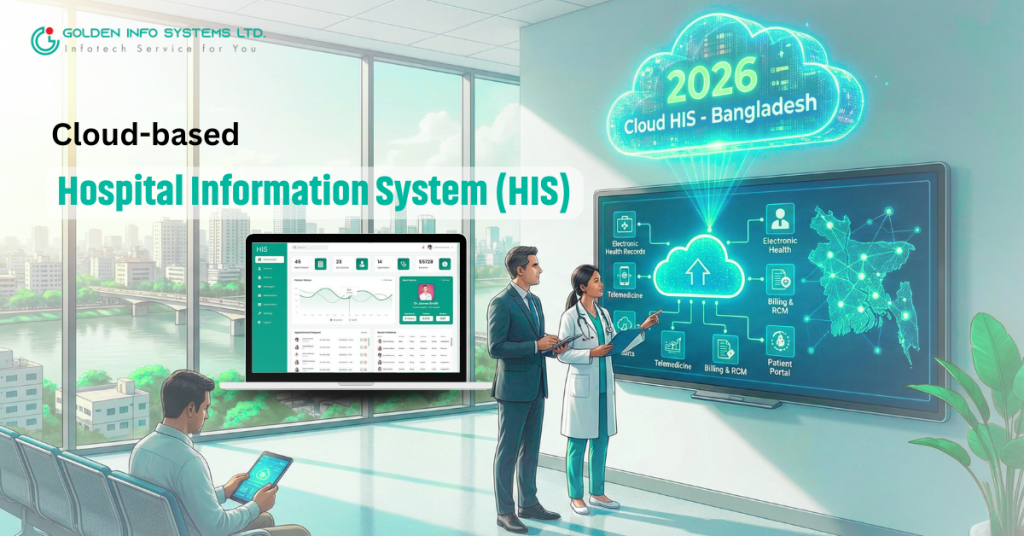
A cloud-based hospital information system (HIS) is a comprehensive, centralized software solution that manages all aspects of a hospital’s operations—medical, administrative, financial, and legal—hosted on remote, secure servers rather than on physical computers located inside your hospital.
To understand the shift, we must look at the legacy model. Traditionally, hospitals relied on “on-premise” software. This required you to purchase massive servers, install them in a dedicated air-conditioned room, purchase expensive software licenses, and hire a full-time IT team to manage cables, backups, and viruses.
A cloud-hosted healthcare system, however, operates on the SaaS (Software as a Service) model. It is accessed entirely via the internet, much like how you use Gmail, Facebook, or Netflix. You do not own the servers; the service provider does. They handle the heavy lifting of security, updates, and maintenance. You simply log in via a secure web browser or mobile app, and your hospital is operational.
Core Components of a Modern HIS
A robust cloud HIS is not just a digital filing cabinet; it is the central nervous system of your hospital.
- Electronic Health Records (EHR) System: This goes beyond simple notes. It includes digital patient history, allergies, vaccination records, DICOM imaging (X-rays/CT scans), and lab reports. It ensures that a patient’s history follows them from the ER to the ICU to the outpatient clinic.
- Patient Management & Experience: This module handles the entire patient journey—from online registration and appointment scheduling to queue management (reducing crowded waiting rooms) and automated SMS reminders for follow-ups.
- Revenue Cycle Management (RCM): This is critical for financial health. It manages billing, integrates with insurance providers for claims processing, handles corporate billing, and tracks outstanding payments.
- Pharmacy & Inventory Management: It tracks drug stock levels in real-time, manages expiry dates (preventing waste), handles supplier orders, and even provides drug interaction warnings to doctors during prescribing.
- Telemedicine Integration: In 2026, telemedicine is a standard offering. A cloud HIS offers built-in high-definition video consultations, allowing you to expand your clinic’s reach beyond your physical geography.
- Business Intelligence (BI) Dashboards: For owners, this provides a bird’s-eye view. See real-time bed occupancy rates, daily revenue, doctor performance, and patient footfall trends on a single screen.
Why Bangladesh Needs Cloud HIS Solutions Now (2026 Context)
The landscape of healthcare technology in Bangladesh has shifted dramatically over the last five years. With the government’s strong push for the Bangladesh Digital Health Strategy 2023–2027, private and public healthcare facilities are racing to become interoperable and data-driven.
1. Infrastructure Reality Check
Let’s be honest about the challenges of running IT hardware in Bangladesh. Maintaining a server room in a hospital is often an operational nightmare:
- Power Stability: Constant load shedding requires expensive generator fuel and industrial-grade UPS systems to prevent server crashes and data corruption.
- Hardware Degradation: High humidity and dust common in our environment can damage sensitive server equipment, leading to costly replacements.
- Talent Scarcity: Finding and retaining skilled network engineers who can manage complex server architecture is difficult and expensive, especially outside of Dhaka.
A web-based HIS solution removes this entire burden. The cloud provider handles the hardware, electricity, cooling, and security redundancy. You simply need a reliable internet connection. With 5G rolling out in major cities and fiber optic connectivity now reaching rural Upazilas, the barrier to entry has never been lower.
2. The “Smart Patient” Expectation
Patients in 2026 are tech-savvy. They are used to the convenience of Pathao, foodpanda, and Daraz. They expect the same friction-free experience in healthcare. They want to book appointments online at 11 PM, receive their lab reports via email or WhatsApp instead of traveling back to the hospital, and pay bills digitally using mobile financial services (MFS). A modern healthcare technology stack allows you to offer these conveniences, significantly improving patient retention and boosting your brand’s reputation as a forward-thinking institution.
3. Solving the “Doctor Shortage” with Remote Access
Bangladesh still faces a critical shortage of specialist doctors, particularly in rural areas. The doctor-to-patient ratio remains a challenge. A cloud-computing in healthcare approach enables a “Hub and Spoke” model. A specialist sitting in a corporate hospital in Dhaka can review the electronic health records (EHR) of a patient in a remote village clinic instantly. They can view vitals, read notes, and adjust treatment plans in real-time. This isn’t just convenience; it saves lives by democratizing access to expert care.
Key Benefits of Adopting a Cloud-based HIS
When you switch to an advanced hospital management system hosted on the cloud, the benefits are immediate, measurable, and transformative for your business model.
1. Massive Cost Reductions (CapEx vs. OpEx)
This is the biggest driver for Bangladeshi hospital owners who are cost-conscious.
- The Old Way (On-Premise): Requires a massive upfront capital expenditure (CapEx). You pay for servers, networking cables, air conditioning, software licenses, and installation fees. This can run into dozens of Lakhs before you see a single patient.
- The New Way (Cloud-Based): Operates on an operational expenditure (OpEx) model. You pay a predictable monthly or annual subscription fee based on your usage or number of beds.
- Result: You free up significant capital to invest in better medical equipment, facility expansion, or marketing.
2. Unmatched Data Security
“Is my data safe on the cloud?” This is the most common question. In reality, secure healthcare software providers use bank-grade encryption (AES-256 bit) and have dedicated teams of security experts monitoring threats 24/7. Compare this to a local server room:
- Can you afford a 24/7 security team?
- Is your local firewall updated daily against the latest ransomware?
- Is your physical server room locked and fireproof? Cloud providers guarantee this security as part of your subscription. It is far safer than a local server that could be stolen, damaged by fire, or hacked by a novice due to unpatched software.
3. Scalability for Growth
Are you running a 50-bed diagnostic center today but planning for a 200-bed hospital next year? With traditional software, expansion meant buying new servers and re-wiring the building. With customizable HIS platforms, scaling up is as simple as clicking a button or making a phone call to upgrade your plan. You can add new users, new departments, or even entirely new hospital branches to the same system instantly.
4. Disaster Recovery & Business Continuity
Bangladesh is geographically prone to natural disasters like floods, cyclones, and heavy storms. If your hospital faces physical damage, on-premise servers could be destroyed by water or electrical surges, leading to the permanent loss of decades of medical records management system data. With the cloud, your data is not stored in your building. It is backed up in multiple secure, geographically dispersed data centers (e.g., one in Singapore, one in Mumbai). Even if your hospital building is completely compromised, your patient data remains safe and accessible from any temporary location with an internet connection.
Cloud vs. On-Premise HIS: A Detailed Comparison
To help you decide, here is a direct comparison relevant to the local context of Bangladesh.
| Feature | Cloud-based HIS | On-Premise (Legacy) HIS |
| Upfront Cost | Low: Subscription-based (SaaS). Pay as you go. | High: Heavy investment in hardware, licenses, and installation. |
| Maintenance | Zero Headache: Vendor handles updates, security, and backups. | High Burden: Requires in-house IT team for daily maintenance and troubleshooting. |
| Remote Access | Anywhere: Access from home, mobile, or during travel. | Restricted: Usually accessible only via LAN within the hospital premises. |
| Data Security | Bank-Grade: Enterprise encryption and professional monitoring. | Variable: Depends entirely on the competence of your local IT staff. |
| Implementation Time | Fast: Can go live in weeks. | Slow: Can take months to procure hardware and install. |
| Dependency | Internet: Requires stable connectivity (redundancy recommended). | Electricity & Hardware: Dependent on continuous power and hardware health. |
| Updates | Automatic: You always have the latest features for free. | Manual: Upgrades are often painful, expensive, and cause downtime. |
Essential Features of a Future-Proof Medical Software (2026 Edition)
When shopping for healthcare technology solutions in the Bangladeshi market, do not settle for basic features. Ensure your vendor offers these critical, future-proof modules:
1. Integrated Electronic Health Records (EHR)
Your electronic health records (EHR) system should be the heart of the platform. It must support international standards like ICD-10 or ICD-11 coding (increasingly required by insurance companies in Bangladesh) for standardized diagnosis. It should also allow doctors to use customizable templates (e.g., “Dengue Fever Template”) to speed up data entry.
2. Smart Billing & Insurance Management
With health insurance adoption rising in Bangladesh (both corporate and private), your system must handle insurance claims, corporate billing, and co-payments seamlessly. It should also utilize logic to detect “revenue leakage”—automatically flagging services or medicines that were dispensed but not charged for.
3. Mobile-First Ecosystem
The system must extend beyond the desktop.
- For Patients: An app to book appointments, view prescriptions, and pay bills.
- For Doctors: An app to view rounds, check patient vitals remotely, and approve requests.
- For Management: An app to track daily collections and occupancy.
4. Laboratory Information System (LIS) Integration
Your HIS must “talk” to your lab machines (analyzers). When a blood test is done, the results should automatically flow from the machine into the patient’s digital file without manual typing. This eliminates human error and drastically reduces the turnaround time for reports.
5. Localized Support (Bangla & Payment Gateways)
While doctors operate in English, your support staff (receptionists, ward boys) and patients may prefer Bangla. A truly GEO optimized system offers a bilingual interface. Furthermore, it must integrate with local payment gateways like SSLCommerz or ShurjoPay, supporting payments via bKash, Nagad, Rocket, and local bank cards.
Challenges of Implementation in Bangladesh & How to Overcome Them
Adopting innovative healthcare technology is a major change, and it comes with hurdles. Here is how you can navigate the specific challenges found in Bangladesh.
Challenge 1: Unstable Internet Connectivity
The Worry: “What if the internet line is cut? Will my hospital stop running? Will I be unable to bill patients?” The Solution: Choose a “Hybrid Cloud” solution or a system with “Offline Mode.” These systems utilize a local caching server or browser storage. If the internet cuts out, you keep working—admitting patients, billing, and entering notes—locally. Once connectivity returns, the data syncs automatically to the cloud. Additionally, relying on dual-line internet (one fiber, one 4G/5G backup) is standard practice.
Challenge 2: The “Doctor Ego” & Resistance to Change
The Worry: Senior consultants and professors may refuse to type on a computer, preferring their traditional handwritten prescriptions. The Solution: Do not force a “digital-only” policy on day one.
- Digital Assistants: Assign junior doctors or medical assistants to digitize the senior doctor’s notes during rounds.
- Voice-to-Text: Look for HIS tools that support voice dictation.
- Simple UI: Ensure the doctor’s interface works on an iPad/tablet with a stylus, mimicking the feel of writing on a clipboard.
Challenge 3: Data Privacy & Legal Compliance
The Worry: The emerging Data Protection Act creates strict rules about patient privacy and where data is stored. The Solution: Ensure your cloud provider stores data in compliance with Bangladeshi law. Many global providers now offer “data residency” options or partner with local Tier-3 data centers (like those in Kaliakair or Dhaka) to keep sensitive data within national borders. Always ask for a “Data Processing Agreement” that explicitly states you own the data, not the vendor.
5 Steps to Implement Your Cloud-based HIS Successfully
- Audit Your Workflow: Before buying, map out exactly how a patient moves through your hospital—from the guard at the gate to the discharge counter. Identify the bottlenecks. Does the patient wait too long for billing? Is the pharmacy dispensing slow?
- Select the Right Vendor: Don’t just look for the cheapest option. Look for healthcare software solutions with local support in Bangladesh. You need a vendor who answers the phone in Bangla when you have a critical issue at 2 AM.
- Data Migration: If you have old digital records (Excel sheets, legacy software), ensure the vendor has a plan to migrate them to the new digital patient records system so you don’t lose history.
- Role-Based Training: Training is where implementation succeeds or fails. Train receptionists on billing, nurses on vitals entry, and doctors on EMR separately. tailored to their specific jobs. Don’t overwhelm them with features they don’t need.
- Go-Live with a “Soft Launch”: Never switch everything on at once. Start with one department (e.g., Outpatient or Dermatology) for one week. Iron out the bugs, get staff comfortable, and then roll it out to Emergency, ICU, and Inpatient wards.
The Future of Hospital Information Systems (2026-2030)
Investing now means you are building a foundation for the future. Here is what is coming next for digital transformation in healthcare:
- AI-Driven Diagnostics: Your HIS technology will soon utilize AI to flag potential diagnoses based on symptoms and lab results, acting as a “second pair of eyes” to prevent diagnostic errors.
- IoT Integration: Wearable devices (smartwatches, remote monitors) will send patient heart rate, BP, and glucose data directly to your medical data management system in real-time, allowing for proactive chronic disease management.
- Blockchain for Security: Secure healthcare software will increasingly use blockchain to make patient records tamper-proof and fully interoperable between different hospitals, allowing a patient’s record to travel with them securely across the country.
FAQ: Common Questions About Cloud HIS in Bangladesh
Q: Is cloud-based HIS expensive for small clinics or diagnostic centers?
No. In fact, it is significantly cheaper. Cloud-hosted healthcare systems operate on a “pay-as-you-go” model. Small clinics might pay as little as a few thousand Taka per month, avoiding the Lakhs of Taka required for server hardware.
Q: Can I access the system from my home?
Yes! One of the main benefits of web-based HIS solutions is mobility. As an owner, you can view revenue reports, approve discounts, and check bed occupancy from your home in Uttara or while on vacation abroad.
Q: What happens to my data if I stop paying the subscription?
This is a critical contractual point. Reputable vendors of medical records management systems include a “Data Exit Clause.” This allows you to export all your patient and financial data in standard formats (like Excel, PDF, or CSV) within a specific timeframe after cancellation. Always verify this before signing.
Q: Is it compatible with the Bangladesh government’s DHIS2 system?
Most leading healthcare management software in 2026 is built to be interoperable. They can automatically generate the aggregate reports required by the DGHS (Directorate General of Health Services) and push data to the national DHIS2 platform, saving you hours of manual reporting.
Q: How secure is cloud computing in healthcare really?
Cloud providers invest billions of dollars in cybersecurity—far more than any single hospital could afford. They offer military-grade encryption, automated intrusion detection, and physical security at data centers. It is generally much safer than keeping files in a dusty, unlocked server room susceptible to physical theft or local viruses.
Is Your Hospital Ready for 2026?
The shift to a cloud-based hospital information system (HIS) is no longer a “nice-to-have” luxury—it is the operational standard for modern healthcare in Bangladesh. It empowers you to drastically reduce overhead costs, improve patient safety, secure your data against physical and cyber disasters, and deliver the “Smart Health” experience your patients demand.
In an era where digital healthcare solutions are defining market leaders, staying with paper or offline systems is a decision to stay behind. The technology is here, the infrastructure in Bangladesh is ready, and your patients are waiting.
Are you ready to transform your healthcare facility? Don’t let technology hurdles hold you back. Upgrade to a future-proof medical software solution today and watch your efficiency—and revenue—soar.
[Contact us today for a free consultation and demo of the leading Cloud HIS tailored for the Bangladesh market!]