





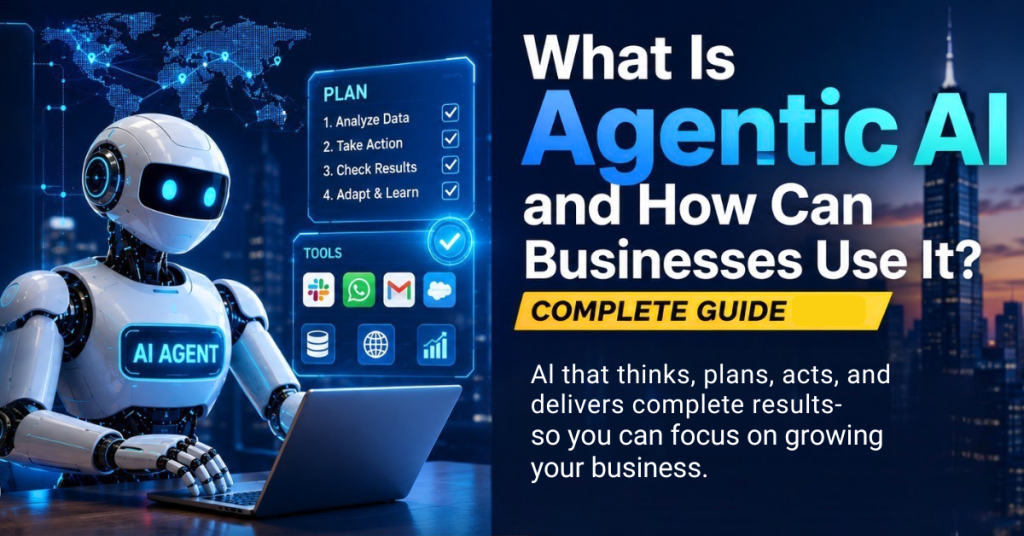
Have you ever wished you could completely clone your best employee—not just to answer questions, but to actually do the work, make decisions, and solve problems while you sleep? For years, we have treated Artificial Intelligence like a highly intelligent digital encyclopedia. We ask it a question, and it gives us an answer. But what if your AI could stop waiting for your instructions and start taking action on its own?
Agentic AI is artificial intelligence that can independently perceive its environment, reason through complex goals, and take multi-step actions — using tools like APIs, code and web browsers — with minimal human input at each stage. Unlike chatbots that respond to prompts, agentic AI acts autonomously from goal to completion. Businesses use it to automate complete workflows: qualifying and following up on sales leads, resolving customer service tickets end-to-end, reconciling financial accounts, monitoring IT systems, screening job applications, and managing supply chain logistics — all without a human involved in every step. The global agentic AI market is growing from $5.2B (2024) to $196.6B by 2034 at a 43% CAGR.
If you are looking at the rapidly changing landscape of enterprise technology and asking, “What Is Agentic AI and How Can Businesses Use It?“, you are in the right place.
We have officially moved past the era where AI merely generates text or images. Welcome to the era of autonomous action. In this comprehensive guide, we will break down exactly what Agentic AI is, how it differs from the AI you are used to, and most importantly, how your business can deploy it today to crush your competition, scale your operations, and dramatically boost your bottom line.
Imagine you have a super-smart robot friend who doesn’t just answer your questions but actually thinks, makes a plan, does the work step by step, checks if everything is correct, and finishes the full job — all with very little help from you. That magic helper is called Agentic AI.
Agentic AI will be one of the fastest-growing technologies in the world. Big companies, small shops, and even students in Asia are talking about it.
In this guide you will learn: what Agentic AI actually is, how it differs from regular AI, real business use cases, a step-by-step adoption roadmap, and the challenges every business should know — all explained in plain language anyone can understand.
Table of Contents
The Evolution of AI: How We Got Here
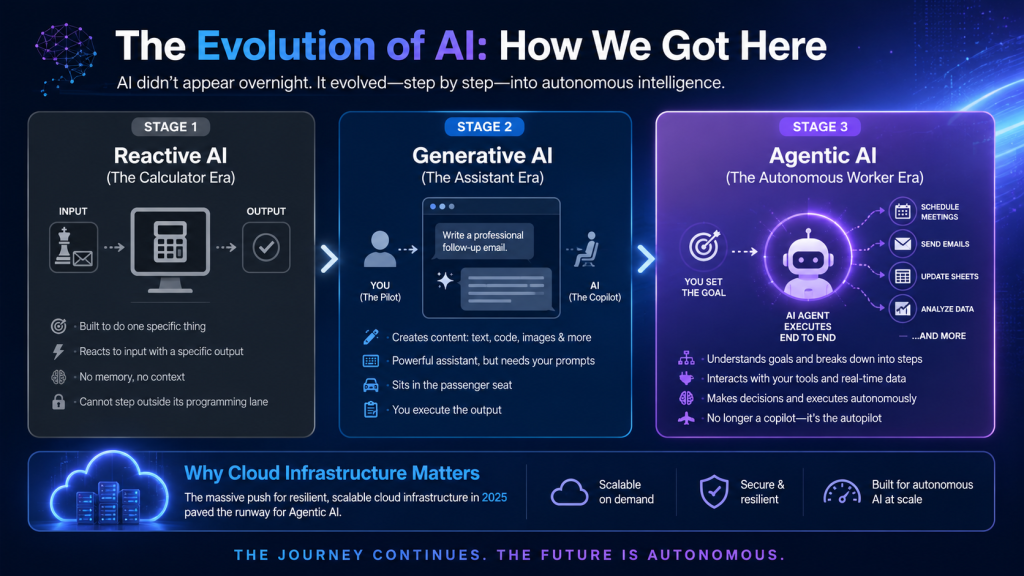
To truly grasp the power of Agentic AI, you first need to understand the journey of artificial intelligence. It helps to think of AI’s evolution in three distinct stages:
Stage 1: Reactive AI (The Calculator Era)
Think of early chess programs or spam filters. These systems were built to do one specific thing. They reacted to a specific input with a specific output. They had no memory, no understanding of context, and zero ability to step outside their programming lane.
Stage 2: Generative AI (The Assistant Era)
This is where tools like ChatGPT, Gemini, and Claude took the world by storm. Generative AI can write code, draft emails, and create stunning images. But it has a major limitation: it is a “copilot.” It sits in the passenger seat. It cannot do anything until you (the human pilot) type in a prompt. Once it gives you the output, its job is done. You are still the one who has to copy the email, open your email client, paste it, and hit send.
Stage 3: Agentic AI (The Autonomous Worker Era)
This brings us to today. Agentic AI does not just answer your questions; it acts on your goals. You give it a high-level objective, and the AI agent breaks that goal down into steps, interacts with your software tools, makes decisions based on real-time data, and executes the task from start to finish. It is no longer just a copilot; it is the autopilot.
If you remember the major push for resilient, scalable cloud infrastructure back in 2025, this is exactly why it mattered. Those massive investments in digital growth were paving the runway for Agentic AI, which requires robust cloud environments to operate autonomously across dozens of applications at once.
What Is Agentic AI? Clear Definition
The word “agentic” comes from “agency” — the capacity to act independently in pursuit of a goal. Agentic AI is artificial intelligence with agency: it perceives its environment, reasons about what needs to happen, takes actions using available tools, evaluates the results, and adjusts its approach until the goal is achieved — all without waiting for a human prompt at each step.
The simplest way to understand agentic AI is to contrast it with what came before. Traditional software follows fixed rules: if X, do Y. Generative AI (like ChatGPT) responds to individual prompts: you ask, it answers. Agentic AI is fundamentally different: you give it a goal, and it figures out how to achieve it.
Agentic AI is Artificial Intelligence that possesses “agency” — meaning it can act like an independent, responsible worker. Unlike traditional chatbots that answer one question and stop, Agentic AI understands a big goal, breaks it into smaller steps, uses different tools, talks to other systems, makes decisions, fixes problems automatically, and keeps working until the job is done.
Let’s look at a clear, simple definition for search engines and everyday readers alike.
In short, Agentic AI refers to artificial intelligence systems (called “agents”) that can understand a high-level goal, independently plan a sequence of actions to achieve that goal, interact with external software tools, and adapt to changes or errors without requiring human intervention.
Think of the word “Agentic.” It comes from the word “Agency.” To have agency means to have the power and authority to act. Agentic AI has the agency to do the work for you.
Simple Analogy
Regular AI: You ask a student to “Write an essay about trees.” The student writes it and hands it back.
Agentic AI: You ask it to “Prepare a full science fair project on saving trees.” It researches, creates a poster, builds a presentation, checks facts, emails the teacher to confirm the date, and submits everything on time — all by itself.
The Four Pillars of an AI Agent
To understand how an AI agent works, you need to look at its four core capabilities:
- Perception (Context Awareness): The agent can “see” and “read” the environment. It can read your emails, scan your CRM, check real-time stock market data, or review your cloud infrastructure metrics.
- Brainpower (Reasoning): Powered by Large Language Models (LLMs), the agent can think. It can analyze the data it perceives, understand the context, and figure out what needs to happen next.
- Action (Tool Use): This is the magic. Agentic AI can use tools. It can browse the internet, trigger an API, query a database, send a Slack message, or update a Salesforce record.
- Memory and Learning (Adaptability): If an agent tries a solution and it fails, it remembers the failure. It adjusts its strategy, tries a new path, and learns for the next time.
In 2026, Agentic AI has moved from experiments to daily real-world use across businesses of all sizes — from small shops to large enterprises across Asia and globally.
A Short History: How Did Agentic AI Come About?
AI started with simple programs following fixed rules, then evolved into Machine Learning (learning from data), and then Generative AI (like ChatGPT in 2022–2023) which amazed the world by creating text, images, and code.
But people quickly realized: “Creating is great, but we also need AI that can do things.” By 2024–2025, companies began building “AI Agents” that could use tools. By 2026, these evolved into full Agentic systems capable of running complex workflows for hours — or even days — with minimal human oversight.
70% of Asia-Pacific organizations expect Agentic AI to transform their business models,
100%+efficiency improvement reported by early adopters in key processes,
2026 Gartner: Agentic AI built into most enterprise software by end of year.
Agentic AI vs Generative AI — What’s the Difference?
This is the most common source of confusion in 2026 — and it’s worth being very clear about, because the two have completely different implications for what you can build and how you should think about deploying AI in your business. Many business owners confuse Generative AI with Agentic AI. Let’s clear up that confusion with a real-world business example.
The Task: You need to research a competitor’s new pricing model and update your internal sales team.
Generative AI is fundamentally reactive. You prompt it, it responds. You ask ChatGPT to write an email — it writes an email. You ask Google Gemini to summarise a document — it summarises the document. Then it waits. It does not take the email it wrote and send it. It does not take the summary it produced and file it. Every subsequent step requires a new human prompt.
Using Generative AI:
- You prompt the AI: “Summarize this article about Competitor X’s new pricing.”
- The AI outputs a summary.
- Your required actions: You must manually find the article, feed it to the AI, copy the summary, open your company’s communication tool (like Slack or Microsoft Teams), find the sales channel, paste the summary, and click send.
Agentic AI is fundamentally proactive. You give it a goal — “follow up with all leads who haven’t responded in 7 days” — and it figures out the steps: check the CRM, identify the relevant leads, personalise a follow-up for each one based on their profile, send the emails, log the activity in the CRM, and report back. No human prompt at each step. The agent decides how to achieve the goal, executes each action, and handles exceptions as they arise.
Using Agentic AI:
- You prompt the AI: “Keep an eye on Competitor X’s website. If they change their pricing, analyze how it compares to ours, and notify the global sales team on Slack with a strategy on how to counter it.”
- Your required actions: None.
- The AI acts as an autonomous worker. It constantly monitors the site. When pricing changes, it pulls your pricing from your database, runs a comparison, drafts a strategy, logs into Slack, and posts the update to the correct channel.
Generative AI requires you to manage the workflow. Agentic AI is the workflow.
Understanding how Agentic AI differs from older systems helps you choose the right tool for the right job.
| Feature | Traditional AI | Generative AI (ChatGPT) | Agentic AI (2026) |
| Primary Job | Follow fixed rules | Create content & answers | Achieve complete goals |
| Needs Human Help | Very high | Medium | Very low |
| Multi-step workflows | No | Limited | Full workflows |
| Learns from mistakes | No | Somewhat | Adapts & improves |
| Real-world example | Calculator | Write an email | Write, send, follow up, update CRM |
| Best for | Simple repetitive tasks | Creative work | Complex end-to-end processes |
Think of Agentic AI as the evolution that combines the best of previous AI types — and adds the power to actually take action in the real world.
The Simplest Analogy
Generative AI is like a highly capable intern who gives excellent answers when asked questions. Agentic AI is like a highly capable employee who you give a project brief — and who independently figures out how to complete it, using all the tools available, without needing you to supervise every step. The shift from generative to agentic AI is the shift from answering questions to completing work.
Agentic AI Market Size and Adoption — 2026 Statistics
The scale of agentic AI adoption in 2026 is striking. This is no longer an experimental technology being piloted in R&D labs — it’s running in production at scale across virtually every industry.
Key Agentic AI Statistics — 2026 (Verified Sources)
- The global agentic AI market was valued at$5.2 billion in 2024and is projected to reach$196.6 billion by 2034(43% CAGR)
- 72% of medium-sized companies and large enterprisesalready use agentic AI, with 21% more planning adoption within 2 years (Gravitee, 2025)
- 93% of business leadersbelieve those who successfully scale AI agents in the next 12 months will gain a durable competitive edge (Capgemini)
- Gartner projects80% of customer service issueswill be resolved by agentic AI without human assistance by 2029
- By end of 2026,40% of enterprise applicationswill include task-specific AI agents (Gartner)
- By 2028,33% of enterprise softwarewill embed agentic AI capabilities
- 89% of enterprisesplan to increase their AI investments in 2026 and beyond (Kore.ai)
- 53% of US businessesdeploying AI agents use them for IT and cybersecurity (PwC)
How Does Agentic AI Actually Work?
You might be wondering what this looks like in practice. No technical background is needed here—this is exactly how an AI agent flows from receiving your goal to completing a complex business task:
1. You Set a Goal
It all starts with a simple command in plain English. For example, you might tell the AI: “Handle all customer complaints about late deliveries this week.” You don’t need to write code or build a workflow; you simply give the agent a high-level objective.
2. Autonomous Planning
Unlike older AI that just generates an immediate text response, an agent pauses to plan. It breaks your massive goal down into logical, bite-sized steps: check incoming orders → identify delayed tracking numbers → contact affected customers → offer solutions → update the CRM records.
3. Using Tools and APIs
This is where the agent becomes a digital worker. It automatically connects to your business tools. It logs into your email, sends personalized messages via WhatsApp, checks your order management system, issues discounts through your payment app, and updates your customer database—all without you lifting a finger.
4. The Reasoning Loop
Real-world business is messy, but AI agents are designed to adapt. If a customer doesn’t reply to an email, the agent’s “reasoning loop” kicks in. It thinks, “Plan A failed, let’s try Plan B,” and automatically tries another channel, like an SMS text. It keeps thinking, testing, and adjusting its strategy until the job is done.
5. Deep Memory
Agentic AI has a memory bank. It remembers past interactions, customer preferences, and previous roadblocks. This allows the AI to provide smarter, faster, and more highly personalized solutions the next time it encounters a similar problem.
6. Human-in-the-Loop Safety
You never lose control of your business. For high-stakes decisions—like issuing refunds over a certain dollar amount, signing contracts, or handling legal issues—the AI pauses. It sends an alert to a human manager and waits for approval before taking action.
The Multi-Agent Future: Many advanced business implementations now use multiple agents working together as a team. Imagine having one agent assigned to research, one assigned to execution, and one acting as quality control. It is exactly like a human department, but operating autonomously at lightning speed.
What Is Agentic AI and How Can Businesses Use It? (Real Business Use Cases)
Now that you know what it is, let’s dive into the core question: What Is Agentic AI and How Can Businesses Use It? You don’t need to be a massive Fortune 500 tech giant to use AI agents. Businesses of all sizes are deploying agentic workflows right now to save time, cut costs, and drive revenue. Here is how you can apply Agentic AI across your company’s departments.
Customer Service and Experience
24/7 support on WhatsApp, Facebook, and websites. Understands problems, checks order details, issues refunds, and follows up — without human agents. A small Dhaka clothing shop can now handle hundreds of daily queries without extra staff. Customer service is often a major bottleneck for growing businesses. Traditional chatbots are frustrating—they just hand users pre-written FAQ links. AI agents handle the complete resolution of routine customer issues: order status, returns, refunds, account changes, FAQs. They read the query, access the relevant systems, take the appropriate action and send a confirmation — without escalation.
Gartner projection: Agentic AI will resolve 80% of customer service issues without human assistance by 2029, reducing support costs by an estimated 30%. An Agentic AI customer service rep is entirely different.
- Autonomous Resolution: If a customer emails saying, “My package hasn’t arrived,” the AI agent reads the email, accesses your shipping software via API, tracks the package, sees it is delayed, automatically processes a $10 refund for the inconvenience within your billing software, and writes a personalized apology email to the customer. All in seconds, with zero human input.
- Account Management: Agents can proactively monitor customer usage. If a user is struggling with your software, the agent can automatically send them a personalized tutorial video based on where they are getting stuck.
Result: 30% reduction in customer support operating costs
Supply Chain and Operations Management
Global supply chains are incredibly complex. If one link breaks, it costs you money. Monitors stock levels, predicts demand, auto-orders from suppliers, and reroutes deliveries during floods or traffic. Critical for monsoon season logistics in South Asia.
Agentic AI monitors inventory levels, forecasts demand using sales data, weather, promotions and seasonality, and autonomously triggers reorder actions when thresholds are met. SPAR Austria’s agentic AI system achieves over 90% prediction accuracy across 1,500+ stores.
The agent does not wait for human approval on routine matches — it autonomously executes decisions constrained by pre-approved rules.
- Predictive Inventory: An AI agent can monitor global weather patterns, local news, and shipping port data. If it detects a hurricane heading toward a port where your goods are arriving, it can autonomously reroute the shipment to a safer port and instantly email your logistics team with the updated route and cost analysis.
- Vendor Negotiation: Incredibly, some businesses are using AI agents to automatically email vendors, compare quotes, and negotiate basic supply contracts based on predefined budget parameters.
Result: 90%+ forecast accuracy; stockouts and overstock dramatically reduced
Lead Qualification, Marketing and Sales Automation
An AI agent monitors inbound leads, analyses prospect data to identify conversion-likely opportunities, sends personalised outreach, handles follow-up replies, and books demos directly into the sales team’s calendar — all automatically. Finds potential customers, researches their needs, sends personalized outreach, books meetings, and updates the CRM. Sales teams focus only on final negotiations — closing more deals in less time. Marketing requires constant testing and adjusting. Agentic AI shines in environments that require continuous optimization.
Example: An agentic AI system can identify high-intent leads from CRM data, launch personalised outreach emails, reply to follow-ups, and book demos with no human intervention (Kore.ai, 2026).
- Autonomous Ad Optimization: Instead of a human checking Facebook or Google Ads daily, an AI agent can monitor ad performance 24/7. If an ad’s Cost Per Click (CPC) gets too high, the agent can autonomously pause the ad, generate a new image and copy using generative tools, launch the new ad, and monitor the results.
- Hyper-Personalized Outreach: An AI sales agent can research a prospect by reading their LinkedIn profile and company news, draft a highly specific personalized email, send it from your CRM, and automatically schedule a follow-up if they don’t reply in three days.
Result: Sales team focuses exclusively on warm, pre-qualified meetings
IT Security and Cloud Infrastructure Management
Remember the cloud infrastructure trends of scalability and resilience we focused on heavily in 2025? Agentic AI is the ultimate manager for those environments.
Security monitoring agents continuously watch for threats, anomalies and policy violations. When a threat is detected, the agent isolates the affected system, generates an incident report, notifies the security team and initiates pre-approved response protocols — in seconds, not hours.
53% of US businesses deploying AI agents use them for IT and cybersecurity (PwC, 2026).
- Self-Healing Systems: If your website experiences a sudden spike in traffic, an IT AI agent can detect the strain on your servers, autonomously provision more server space in your cloud environment, and balance the load to prevent a crash.
- Cybersecurity Defense: Agents can act as autonomous security guards. If they detect a suspicious login attempt, they can instantly lock the account, block the IP address, and begin running a diagnostic scan to ensure no data was breached—all before your human IT team even wakes up.
Result: Threat response in seconds vs hours; 24/7 monitoring without on-call staff
Human Resources and Talent Acquisition
Hiring the right people takes hundreds of hours of manual resume reviewing and scheduling. Automates new employee onboarding: creates accounts, sends welcome documents, schedules training, and answers common HR questions. Saves HR teams many hours every week.
AI agents screen incoming applications against role criteria, schedule initial interviews, send rejection or progression communications, and onboard new hires through standardised workflows — automatically completing the administrative layer of hiring at scale.
High-volume hiring teams can process hundreds of applications per day without increasing HR headcount.
- The Autonomous Recruiter: An AI agent can scan thousands of resumes, identify the top 5 candidates, automatically email them to set up an interview by checking your human hiring manager’s calendar, and even send the candidates a preliminary technical test, grading it before the interview begins.
Result: Hiring cycle time reduced by 50–60%; HR team focuses on final-stage decisions
Financial Modeling and Risk Management
Finance teams spend too much time gathering data and not enough time analyzing it. Auto-checks invoices, detects fraud, creates monthly reports, approves small expenses, and prepares tax data. Banks in India and Singapore use it for faster loan processing.
AI agents reconcile accounts, match transactions, flag anomalies, and generate reports automatically. In financial services, agents automate KYC/AML compliance checks, loan calculations, and continuous credit risk monitoring.
McKinsey reports that banks implementing agentic AI for KYC/AML workflows are realising 200%–2,000% productivity gains.
- Real-Time Auditing: Financial agents can continuously scan every transaction flowing through your business. They cross-reference receipts, invoices, and employee expenses in real-time, instantly flagging anomalies or potential fraud rather than waiting for a monthly manual audit.
Result: CFO closes books faster; accounting team shifts to analysis
Healthcare and Medical Administration
Healthcare systems are often overwhelmed by administrative paperwork and scheduling bottlenecks. Agentic AI is stepping in to streamline patient care and back-office operations.
Healthcare organisations managing tens of thousands of monthly appointments experience double-digit no-show rates. Agentic AI agents automatically contact patients before appointments, confirm attendance, offer rebooking for likely no-shows, and update scheduling systems in real time.
This directly reduces the significant annual revenue lost to appointment gaps without increasing admin staff.
- Autonomous Patient Triage: An AI agent can read a patient’s online intake form, cross-reference their medical history in your secure database, autonomously schedule an appointment with the correct specialist, and instantly send a prescription request for basic symptom relief to the patient’s local pharmacy.
- Insurance Processing: Instead of a human manually handling billing, an AI agent can read clinical notes, assign the correct medical billing codes, submit the claim to the insurance company via API, and automatically follow up or file an appeal if the claim is denied.
Result: Appointment no-show rates significantly reduced; admin costs cut
Manufacturing and Heavy Industry
In manufacturing, precision and uptime are everything. A broken machine doesn’t just cost time; it costs massive amounts of revenue.
- Predictive Maintenance Execution: Instead of merely predicting that a machine might break down, an AI agent monitors real-time vibration and temperature data. If it detects an anomaly, it autonomously orders the necessary replacement part, schedules a maintenance window during off-hours, and alerts your engineering team.
- Autonomous Quality Control: AI agents connected to factory floor cameras can identify defective products on the assembly line, autonomously instruct a robotic arm to remove the item, and instantly adjust the calibration of the upstream machine to prevent further defects.
Education and EdTech
Classrooms are often too large for teachers to give one-on-one attention to every student. Agentic AI offers a personalized learning experience at scale.
- Autonomous Tutoring: An AI teaching agent can monitor a student’s test scores and homework in real-time. If the student consistently struggles with algebra, the agent autonomously generates a customized lesson plan, adjusts the difficulty of future quizzes, and emails a progress report directly to the parents.
- Administrative Automation: Agents can handle the complex nightmare of university admissions. They can autonomously read student transcripts, verify extracurricular activities, score applications based on your institution’s specific rubric, and draft personalized acceptance or rejection letters.
Business Intelligence & Analytics
Management / Strategy
Agentic analytics systems integrate with data warehouses, monitor KPIs automatically, detect anomalies, generate hypothesis-driven analysis, and compose executive-ready reports — without a human analyst compiling the data.
Enterprise organisations implementing this see 40–60% of analyst capacity freed from routine reporting for strategic work.
Result: Queries answered in hours not days; 40–60% analyst capacity freed
E-Commerce and Retail
Online shoppers today expect instant, highly personalized experiences. Agentic AI acts as an autonomous salesperson for every individual customer.
- Dynamic Merchandising: An AI agent tracks exactly what a user is clicking on, cross-references your current inventory levels, autonomously changes the homepage layout to feature products that specific users will love, and instantly creates a limited-time discount code to push them toward a purchase.
- Automated Returns Processing: If a customer initiates a return, the agent approves it based on your store’s policy, generates a return shipping label, flags the inventory system to expect the restocked item, and issues the refund the exact moment the courier scans the package.
Also Worth Noting: IT teams use agents to auto-fix common issues. Legal departments use them to review standard contracts. Agriculture applications advise farmers on optimal planting times and market prices — all with minimal human input.
The Core Benefits of Agentic AI for Businesses
Why should you invest in Agentic AI today? The return on investment (ROI) is staggering when implemented correctly.
- Drastic Cost Reduction: By automating multi-step, complex processes, you reduce the need for large teams handling mundane data entry or basic customer support. You are essentially hiring a tireless digital workforce at a fraction of the cost.
- True 24/7/365 Operations: Your business never sleeps. While your human team rests, your AI agents are closing support tickets, optimizing ad campaigns, and monitoring server health.
- Fewer errors — Consistent rule-following eliminates human mistakes in high-volume processes.
- Scales easily — A growing shop does not need to hire 10 new people immediately; it deploys more agents.
- Infinite Scalability: If you suddenly get 10,000 new customers overnight, a human team would break under the pressure. An Agentic AI system simply scales up its processing power in the cloud to handle the volume.
- Elimination of Human Error: Humans get tired, distracted, and make typos. AI agents execute tasks precisely according to their parameters every single time, ensuring total accuracy in data entry and compliance.
- Elevating Human Talent: When you remove the repetitive, robotic tasks from your human employees’ plates, they are free to do what humans do best: build relationships, think creatively, and drive high-level strategy.
- Better customer experience — Instant replies, personalized service at any hour.
- Frees humans for higher-value work — Employees handle creative, relationship-driven, and strategic tasks instead of repetitive ones.
- Competitive advantage — In 2026, businesses using Agentic AI are growing measurably faster than those that are not.
How to Prepare Your Business for Agentic AI
You cannot simply plug an AI agent into a messy business and expect magic. Preparing for Agentic AI requires some internal housekeeping. Here is your checklist:
Step 1: Digitize and Organize Your Data
AI agents need data to survive. If your customer records are scattered across physical notebooks, Excel files, and three different software platforms, an agent cannot help you. You must centralize your data in a secure, cloud-based data warehouse or a modern CRM.
Step 2: Adopt API-Friendly Software
Agents interact with your business by “talking” to your software through APIs (Application Programming Interfaces). Ensure the tools you use for accounting, marketing, and operations have open APIs so your AI agents can connect to them.
Step 3: Map Your Standard Operating Procedures (SOPs)
An AI agent needs to know the rules of the game. You must document your workflows clearly. Exactly what happens when a customer asks for a refund? What are the exact steps to launch a new product? If a human can follow your SOP, an AI agent can automate it.
Step 4: Start Small with Internal Pilot Programs
Do not automate your entire business on day one. Start with a low-risk internal task. For example, use an AI agent to automatically compile weekly sales reports and email them to the team. Once you trust the agent’s reliability, move it to customer-facing tasks.
How to Start Using Agentic AI in Your Business
Implementing agentic AI doesn’t require a PhD in machine learning or a large in-house AI team. The most successful enterprise deployments in 2026 start small, in a contained workflow, and expand systematically. Here’s the framework that works. Here is a practical, low-risk adoption path:
Identify Your High-Volume, Rule-Driven Workflows
Start by mapping every process in your business that is repetitive, follows clear rules, happens at high volume and currently requires significant human time. Examples: lead qualification, invoice matching, appointment reminders, ticket routing, compliance checks, social media monitoring. These are your prime candidates for agentic AI — the workflows where autonomous action replaces repetitive human decision-making.
Start Small Pick one repetitive daily task — customer reply management or invoice checking — and automate that first.
Choose One Workflow and Define the Goal
Pick the single workflow with the highest volume and clearest rules — and define the agent’s goal precisely. Not “improve our sales process” but “automatically send a personalised follow-up to every inbound lead within 2 hours, update the CRM with the lead’s response, and escalate warm leads to a sales rep for a call.” Specificity is everything. Vague goals produce vague agents.
Define Boundaries, Guardrails and Escalation Rules
Decide what actions the agent can take autonomously and which require human approval. For example: sending follow-up emails (autonomous) vs offering discounts above 20% (requires manager approval). Define what happens when the agent encounters an edge case it can’t resolve. Clear guardrails make agentic AI safe and predictable — and give you confidence to expand its scope over time.
Choose Your Platform and Build the Agent
Select the right platform based on your tech stack and team capability. Low-code options include Microsoft Copilot Studio, Salesforce Agentforce and Make (Integromat). Developer-focused options include LangChain, LangGraph, OpenAI Assistants API and AWS Bedrock Agents. Enterprise platforms like Kore.ai, UiPath and Google Agentspace offer end-to-end agent management. You don’t need to build from scratch — most platforms provide pre-built agent templates for common business workflows.
Choose the Right Tools
Small businesses: Meta AI Business Agent, n8n, Gumloop, basic WhatsApp bots.
Larger companies: Microsoft Copilot Studio, UiPath, Kore.ai, Automation Anywhere.
Test in a Sandboxed Environment
Before deploying to live customers or systems, run your agent in a test environment with representative data. Test every scenario you can think of — the standard case, edge cases, failure scenarios, and what happens when the agent encounters data it hasn’t seen before. Measure its accuracy and decision quality against human benchmarks. Document everything for the governance audit trail.
Prepare Your Data
Clean and organize your records. Accurate, structured data produces dramatically better results.
Deploy, Monitor and Measure
Deploy to a limited scope initially — one team, one region, one product line. Monitor the agent’s decisions closely for the first 2–4 weeks. Track your key metrics: resolution rate, error rate, escalation rate, time saved, cost per action. Establish a feedback loop where the humans reviewing agent exceptions share corrections that improve the agent’s future decisions. Then expand.
Train Your Team
Teach staff how to collaborate with AI tools — focus on reviewing outputs and escalating edge cases.
Test Carefully
Start with low-risk, high-volume tasks. Measure results for 2–4 weeks before expanding.
Measure and Scale
Track time saved, cost reduced, and customer satisfaction improved. Then add more agents progressively
Keep Humans in the Loop
Especially in Asia, where trust and relationships are central to business culture — human oversight is essential for important decisions.
Ready to Deploy Agentic AI in Your Business?
Golden Info Systems Ltd. designs and builds custom AI automation solutions for businesses in Bangladesh and globally — from lead generation agents to full workflow automation and custom AI integration.
Best Agentic AI Platforms and Tools for Businesses in 2026
Top Agentic AI Platforms for Businesses — 2026 Comparison
| Platform | Best For | Technical Level | Key Feature |
|---|---|---|---|
| Microsoft Copilot Studio | Microsoft 365 users, enterprises | Low-code | Deep integration with Teams, Outlook, SharePoint, Dynamics |
| Salesforce Agentforce | Sales and service teams | Low-code | CRM-native agents — lead nurturing, service resolution |
| Google Agentspace | Google Workspace enterprises | Low-code/Pro | Gemini-powered agent orchestration, enterprise search |
| Kore.ai | Enterprises with complex workflows | Pro/Enterprise | End-to-end conversational + agentic AI platform |
| UiPath | Operations automation, manufacturing | Low-code/Pro | RPA + AI agent hybrid — best for process-heavy industries |
| LangChain / LangGraph | Developer teams, custom builds | Developer | Open-source framework — maximum flexibility, multi-agent |
| OpenAI Assistants API | Custom agent development | Developer | GPT-4o-powered agents with tool use and file access |
| AWS Bedrock Agents | AWS-native enterprises | Pro/Enterprise | Cloud-native multi-agent orchestration with governance |
| Make (Integromat) | SMEs, no-code teams | No-code | Visual workflow builder with 1,500+ app integrations |
| Platform selection should be driven by your existing tech stack, team technical capability, and whether you need pre-built agent templates or custom development. Most enterprise deployments combine a low-code platform with developer-built custom integrations. | |||
Challenges and Risks to Consider
Agentic AI is powerful, but every business needs to be aware of its limitations. While the benefits are massive, implementing Agentic AI comes with responsibilities. You must be aware of these potential pitfalls:
- The Hallucination Factor: While improving rapidly, AI can still sometimes make things up (hallucinate). If an agent makes a bad decision based on a hallucination, it can act on it automatically. This is why “human-in-the-loop” safeguards are crucial for critical actions. AI can occasionally produce incorrect outputs. Always have human review for critical decisions.
- Data quality: “Garbage in, garbage out.” Your AI is only as good as the data you feed it.
- Data Privacy and Security: Giving an AI agent access to your databases means you must ensure your cloud infrastructure is rock-solid. You need enterprise-grade security to ensure customer data isn’t exposed. Customer data must be protected. Follow your country’s data laws.
- Job displacement: Routine roles may shrink, but new roles for AI managers and trainers are emerging rapidly.
- Upfront cost: Advanced systems require investment, though many affordable options now exist for SMEs.
- Regulatory compliance: Governments across Asia are actively developing AI governance guidelines — stay updated.
- Loss of Control (Runaway Agents): You must define strict boundaries. For example, if you give an AI agent a budget to run ads, you must set a hard code limit (e.g., “Do not spend more than $500 a day”) so it doesn’t accidentally drain your bank account testing new strategies.
Benefits and Risks of Agentic AI for Businesses
Key Benefits
- End-to-end workflow automation:Unlike basic automation tools that handle single tasks, agentic AI manages entire workflows from trigger to completion — including decision-making, exception handling and cross-system coordination.
- Scales infinitely without proportional cost:A single AI agent can handle 10 tasks or 10,000 tasks with the same infrastructure cost. Human teams scale linearly with workload; agentic AI scales exponentially.
- 24/7 operation with zero fatigue:Agents don’t take lunch breaks, sick days or holidays. They operate continuously, ensuring no lead goes un-followed-up, no alert goes unmonitored, no report goes ungenerated at 3am.
- Continuous improvement:Unlike static software that requires manual updates, agentic AI learns from outcomes. Each iteration produces better decisions than the last, compounding value over time.
- Competitive differentiation:Gartner projects that by 2028, 33% of enterprise software applications will include agentic capabilities. Early movers gain the data, the process learning and the institutional knowledge advantage.
- Frees human talent for high-value work:When agents handle the repetitive, rules-based work, your people focus on strategy, creativity, client relationships and the judgment calls that genuinely require human intelligence.
Key Risks and How to Manage Them
The Governance Gap — The Biggest Risk in Agentic AI Deployment
Agentic AI systems take real actions with real consequences — sending emails, processing transactions, updating records, making purchases. Without proper governance, an AI agent with a poorly defined goal can take unintended actions at scale. The risk isn’t that the AI “goes rogue” in a science fiction sense — it’s that a well-intentioned but mis-specified agent optimises for the wrong thing and causes real business damage before anyone notices.Guardrails, human escalation triggers, action audit logs and clear boundaries are not optional — they are the foundation of safe agentic AI deployment.
Agentic AI Safety Best Practices
- Define explicit boundaries: what actions can the agent take autonomously vs what requires human approval
- Maintain full audit logs of every agent action — who, what, when, why
- Implement human-in-the-loop for high-stakes decisions above pre-set thresholds
- Start with contained, low-risk workflows before expanding to customer-facing or financial processes
- Monitor error rates and unexpected behaviours continuously for the first 30–60 days post-deployment
- Establish a clear process for staff to report unexpected agent behaviour
Looking Ahead: The Future of Business AI
As we move further into 2026 and beyond, we will see the rise of Multi-Agent Systems (MAS).
Imagine having an entire digital C-suite. You will have a Marketing Agent, a Finance Agent, and a Logistics Agent. These agents won’t just report to you; they will talk to each other.
The Marketing Agent will notice a surge in demand and tell the Logistics Agent to order more inventory. The Logistics Agent will check with the Finance Agent to ensure the budget is approved, and once approved, the order is placed. The human CEO simply receives a notification that the process was handled efficiently.
The businesses that adopt this technology now will be the industry leaders of tomorrow. Those who ignore it will simply not be able to compete with the speed and cost-efficiency of agent-powered competitors.
The Future of Agentic AI — What’s Coming Next?
By 2027–2028, expect to see:
- Multi-agent teams collaborating autonomously, just like human departments, on complex projects.
- Deeper robotics integration in factories and logistics across Asia.
- Personalized AI assistants for every employee and business owner, not just large enterprises.
- Stronger safety and governance frameworks from governments in Singapore, India, Bangladesh, and across ASEAN.
- Rapid mobile-first adoption as smartphone penetration continues to grow across rural Asia.
The future belongs to businesses that intelligently combine smart humans with powerful Agentic AI — neither alone will be enough.
Ready to Automate? Take the Next Step
Reading about Agentic AI is one thing; seeing it transform your business is another. You need tools that are secure, reliable, and built for enterprise-level automation.
If you are ready to stop doing the busy work and start scaling your digital growth, it is time to integrate agentic workflows.
Discover Our Enterprise AI Automation Solutions Here
Whether you need to automate your customer service, secure your cloud infrastructure, or build a custom multi-agent system from the ground up, our team has the tools to make your business autonomous.
Frequently Asked Questions (FAQ)
What Is Agentic AI?
Agentic AI is a type of artificial intelligence that can independently perceive its environment, make decisions, and take multi-step actions to achieve complex goals — with minimal or no human input at each step. Unlike generative AI tools that respond to single prompts and wait for the next instruction, agentic AI systems break down goals into tasks, use tools (APIs, code, web browsers, databases), adapt when things don’t go as planned, and complete entire workflows autonomously. The term “agentic” means the system has agency — the capacity to act independently toward an objective. Examples include AI agents that qualify and follow up on sales leads automatically, or agents that monitor inventory levels and trigger restocking orders when thresholds are reached.
What is the main difference between Generative AI and Agentic AI?
Generative AI creates content (text, images, code) based on human prompts but requires a human to execute tasks. Agentic AI, however, understands a goal and autonomously takes action across various software tools to complete that goal without human intervention.
Is Agentic AI safe for small businesses to use?
Yes, Agentic AI is safe for small businesses, provided proper guardrails are set. Small businesses should start by automating internal, low-risk processes (like data entry or report generation) and always establish spending limits and approval workflows before allowing agents to interact directly with customers or company finances.
What is an example of an Agentic workflow?
An example of an agentic workflow is autonomous customer onboarding. When a new client signs a contract, an AI agent automatically creates their profile in the CRM, generates and sends a welcome email, sets up their project board in software like Jira or Asana, and schedules a kickoff meeting on your calendar—all seamlessly.
How does Agentic AI tie into cloud infrastructure?
Agentic AI requires immense processing power and the ability to connect to dozens of applications simultaneously. Resilient, scalable cloud infrastructure provides the necessary computing power and secure API gateways that allow AI agents to operate reliably 24/7 without crashing.
Will AI agents replace my human employees?
AI agents are designed to replace tasks, not necessarily people. By taking over repetitive, manual, and data-heavy tasks, AI agents free up human employees to focus on complex problem-solving, emotional intelligence, customer relationship building, and high-level strategy.
Is Your Business Ready for Agentic AI?
Agentic AI is no longer science fiction. In 2026, it is a practical, accessible tool for businesses of every size — from small kirana stores to large export factories. It can save time, cut costs, delight customers, and help you compete with much larger players.
The best approach? Start small, move quickly, measure carefully, and scale what works. Whether you are a student with a startup idea, a shop owner in Dhaka, or a manager in Singapore — the tools exist today, many for free.
Businesses that embrace Agentic AI now will lead their industries in the years ahead. The future is agentic — and it is already here.
If you found this guide helpful, share it with your team, colleagues, or students. And if you have questions about choosing the right tools for your specific business, leave a comment below or reach out to the Golden Info Systems team.
Ready to Implement Agentic AI in Your Business?
Golden Info Systems specializes in AI Automation solutions for businesses across Bangladesh and Asia. Let’s find the right tools for your specific needs.
Explore Our AI Services or Contact Us