





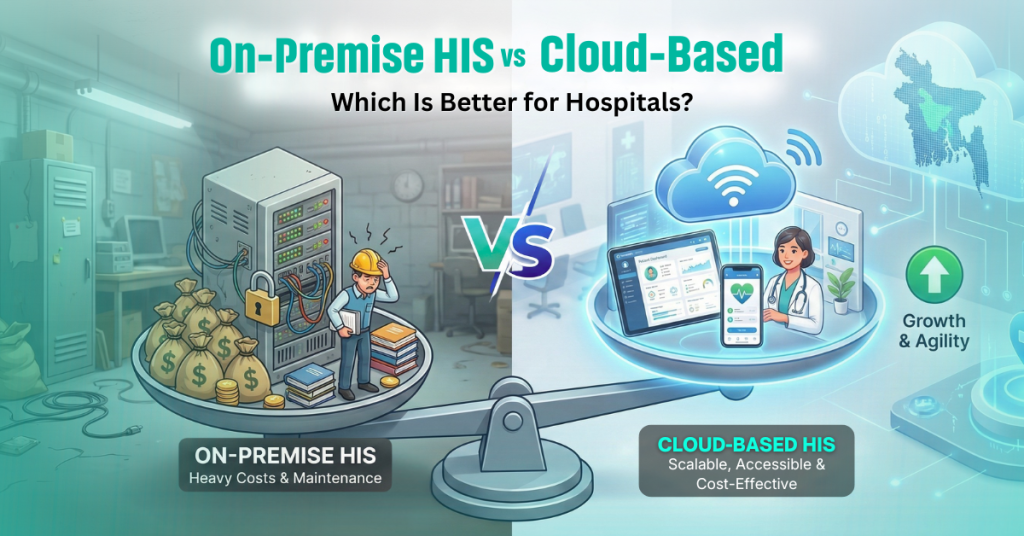
Over 68% of healthcare providers globally are expected to move their operations to the cloud? Yet, here in Bangladesh, many hospital owners are still stuck in a dilemma, staring at a server room full of blinking lights and wondering if there is a better way.
If you are reading this, you are likely standing at a crossroads. You might be a hospital administrator in Dhaka, a clinic owner in Chittagong, or a director of a diagnostic center in Sylhet. You know you need a Hospital Information System (HIS) to modernize your operations, but the big question remains: Cloud-Based vs On-Premise HIS: Which Is Better for Hospitals?
This isn’t just a technical decision; it is a financial and operational one that will define the future of your healthcare facility for the next decade. Choosing the wrong system could drain your budget with hidden maintenance costs or leave your patient data vulnerable. Choosing the right one could streamline your patient flow, cut costs by 30%, and help you sleep better at night.
In this comprehensive guide, we will break down everything you need to know— We will look at the pros, the cons, the costs, and specifically how this choice plays out in the unique landscape of the software industry in Bangladesh.
1. The Core Battle: What Are We Comparing?
Before we declare a winner in the battle of Cloud-Based vs On-Premise HIS: Which Is Better for Hospitals?, we need to understand exactly what the fighters look like.
What is On-Premise HIS?
Think of On-Premise software like buying a house. You own it completely. You buy the servers (the “land”), you install the software (the “house”), and you are responsible for everything. If the roof leaks (server crashes), you have to fix it. If you need more space (storage), you have to build an extension.
- Location: Physically inside your hospital building.
- Ownership: You buy the license once and own it forever.
- Responsibility: Your IT team manages security, backups, and updates.
What is Cloud-Based HIS?
Think of Cloud-Based software like renting a luxury apartment in a high-security building. You pay a monthly fee (rent). You don’t worry about the plumbing, the security guards, or the maintenance—the landlord (the service provider) handles all of that. You just move in and use the facilities.
- Location: Hosted on remote servers (like Amazon AWS, Google Cloud, or a secure data center managed by a top software company in Bangladesh).
- Ownership: Subscription-based (SaaS – Software as a Service).
- Responsibility: The vendor handles updates, security, and backups.
2. On-Premise HIS: The Traditional “Bunker” Approach
For decades, this was the only option. Many established hospitals in Bangladesh, especially large corporate ones, still rely on this model. But is it right for you today?
The Advantages (Why you might want it)
- Total Control: You have the “keys to the kingdom.” Your data is physically in your building. For some hospital owners, seeing the blinking lights of the server gives them peace of mind.
- No Internet? No Problem: This is the biggest selling point in areas of Bangladesh where internet connectivity is unstable. Since the server is connected via a local network (LAN) inside your hospital, your doctors can still type prescriptions and view reports even if the broadband line is cut.
- Data Sovereignty: You know exactly where your data is. It’s in room 302. You don’t have to worry about whether your data is stored in Singapore or the US (though modern cloud laws are changing this).
The Disadvantages (The headaches)
- Massive Upfront Cost (CapEx): You need deep pockets. You aren’t just buying software; you are buying expensive servers, cooling systems (ACs running 24/7), extensive cabling, and backup generators.
- The “IT Guy” Dependency: You cannot run an on-premise system without a dedicated IT team. In Dhaka, finding a software company in Bangladesh to support you is easy, but hiring and retaining skilled in-house IT staff who can manage complex servers is expensive and difficult.
- Slow Updates: Upgrading on-premise software is a project. It often involves downtime, manual installation, and additional fees. This means you might be stuck using old features for years.
- Security Risks: This sounds contradictory, right? You think it’s safer because it’s in your building. But if you don’t patch your server regularly (which many hospitals forget to do), you are a sitting duck for ransomware attacks. A professional cloud provider usually has better security than a local hospital’s IT room.
3. Cloud-Based HIS: The Modern Agile Solution
This is where the world is moving. From banking to shopping, everything is in the cloud. Healthcare is catching up fast.
The Advantages (Why everyone is switching)
- Low Entry Cost (OpEx): You don’t need to spend Lacs of Taka on servers. You just pay a setup fee and a monthly subscription. This frees up your capital to buy better medical equipment like MRI machines or CT scanners.
- Access Anywhere: This is a game-changer for doctors. A consultant can view a patient’s report on their phone while stuck in Dhaka traffic or from home. You can monitor your hospital’s revenue from your vacation spot.
- Automatic Updates: When the government changes a health regulation or the software vendor releases a new AI feature, you get it instantly. No installation required.
- Scalability: Did you open a new branch in Savar? With cloud software, you just add a new location in the system. With on-premise, you’d have to buy a whole new set of servers for the new branch.
The Disadvantages (The concerns)
- Internet Dependency: If your internet goes down, your access to the cloud goes down. However, with the arrival of 5G and widespread fiber optics in Bangladesh, this is becoming less of an issue. Plus, hybrid options exist (more on that later).
- Recurring Costs: While the startup cost is low, you have to pay every month. Over 10 years, this might add up, but you save on electricity, hardware replacements, and IT salaries.
4. The “Software in Bangladesh” Context: Why Geography Matters
When asking Cloud-Based vs On-Premise HIS: Which Is Better for Hospitals?, you cannot ignore the local reality. The situation in Bangladesh is unique.
The Rise of Local Tech
Ten years ago, you might have had to buy expensive foreign software. Today, there is likely a top IT company in Bangladesh or a best software company in Bangladesh building world-class HIS solutions.
- A software company in Dhaka understands local needs better—like how our billing works, how discharge papers are formatted, and how integration with government health IDs will work in the future.
- Local support is crucial. If your system crashes at 2 AM, you want someone who speaks Bangla and can pick up the phone, not a chatbot in a different time zone.
Infrastructure Reality
While Dhaka has excellent connectivity, rural areas face load shedding and internet drops.
- If you are in a major city (Dhaka, Chittagong): Cloud is almost certainly the better choice. The internet is stable enough, and the cost savings are massive.
- If you are in a remote Upazila: You might worry about the cloud. However, the best software company in Bangladesh will offer you an “Offline-First” or Hybrid cloud solution. This means the software works even when the internet is down and syncs up when the connection returns.
5. Detailed Feature Comparison: The Showdown
Let’s look at the numbers and facts side-by-side.
| Feature | On-Premise HIS | Cloud-Based HIS | Winner |
| Upfront Cost | High (Servers, Licenses, IT setup) | Low (Subscription based) | Cloud |
| Ongoing Cost | Maintenance, Electricity, IT Staff | Monthly/Yearly Subscription | Cloud |
| Implementation Speed | Slow (Weeks to Months) | Fast (Days to Weeks) | Cloud |
| Accessibility | Restricted to Hospital Premises (mostly) | Anywhere, Any Device (Mobile/Laptop) | Cloud |
| Data Security | Your Responsibility (High risk if neglected) | Vendor’s Responsibility (Bank-grade security) | Cloud |
| Internet Need | Low (Works on LAN) | High (Requires stable connection) | On-Premise |
| Disaster Recovery | Difficult (Need off-site backups) | Built-in (Data mirrored in multiple locations) | Cloud |
| Scalability | Hard (Buy more hardware) | Easy (Click to upgrade) | Cloud |
6. The Financial Showdown: BDT Cost Analysis
Let’s look at the numbers. Assume you are a medium-sized hospital (50 beds) in Bangladesh.
| Cost Category | On-Premise HIS (Estimated) | Cloud-Based HIS (Estimated) |
| Hardware (Server, AC, UPS) | 8,00,000 – 12,00,000 BDT | 0 BDT |
| Software License (One-time) | 10,00,000 – 20,00,000 BDT | 0 BDT |
| Implementation Fee | 2,00,000 BDT | 50,000 – 1,00,000 BDT |
| IT Staff (2 people/year) | 9,60,000 BDT (40k/mo each) | 0 BDT (Vendor manages it) |
| Annual Maintenance (AMC) | 2,00,000 BDT (usually 15-20%) | 0 BDT (Included) |
| Monthly Subscription | 0 BDT | 20,000 – 50,000 BDT |
| Electricity (24/7 Server) | 1,20,000 BDT/year | 0 BDT |
| Total Year 1 Cost | ~32,00,000 BDT | ~4,00,000 – 7,00,000 BDT |
The Verdict: Cloud-Based systems drastically reduce your risk and initial spending.
7. The Hidden Costs You Might Miss
When you talk to an IT company in Bangladesh about buying software, they might quote you the license fee. But that isn’t the whole picture.
The “Iceberg” of On-Premise Costs
For on-premise, the license fee is just the tip of the iceberg. Under the water, you have:
- Electricity: Servers need to run 24/7. Air conditioners need to run 24/7 to keep them cool. In Bangladesh, where electricity costs are rising, this bill alone can be thousands of Taka per month.
- Hardware Refresh: Servers don’t last forever. Every 3-5 years, you have to replace hard drives, upgrade RAM, or buy new machines entirely.
- IT Personnel: You need a salary for a system administrator. Even a junior admin in Dhaka costs significantly per year.
The Predictability of Cloud Costs
With cloud, your bill is predictable. You know exactly what you will pay next month. There are no surprise costs because a hard drive failed. This makes financial planning for your hospital much easier.
8. Security: Busting the Myth
“Is my patient data safe in the cloud?” This is the most common question we hear.
Many hospital owners think that if they can physically see the server, the data is safe. This is a dangerous myth.
- Physical Theft: Physical servers can be stolen or damaged by fire/water.
- Ransomware: Hospitals are the #1 target for hackers. If your local IT guy forgets to update the Windows firewall on your server, a hacker can lock all your patient files and demand money.
- Cloud Security: A reputable software company in Bangladesh providing cloud services uses top-tier data centers. These centers have armed guards, biometric locks, and fire suppression systems. More importantly, they have teams of cyber-security experts working 24/7 to patch vulnerabilities. Your data is likely safer in the cloud than in your own office.
9. Why “Buyer Intent” Matters for You
You aren’t just reading this for fun; you are looking for a solution. When searching for a partner, don’t just look for any vendor. Look for a top software company in Bangladesh that specializes in healthcare.
What to ask a potential vendor:
- “Do you offer a cloud solution with offline capabilities?”
- “Where is your data hosted? Is it secure?”
- “Can I see a demo of your mobile app for doctors?”
- “What is your support response time?”
If you are looking for the best software company in Bangladesh to handle your hospital’s digital transformation, you need a partner who understands both the technology and the medical workflow.
10. Decision Guide: Which One Should You Choose?
Here is a simple cheat sheet to help you decide.
Choose On-Premise HIS if:
- You are a massive 500+ bed hospital with a large budget.
- You already have a full server room and a dedicated IT department.
- You are located in an area with absolutely zero reliable internet access.
- You have extremely specific, custom security policies that prevent data from leaving your building.
Choose Cloud-Based HIS if:
- You are a clinic, diagnostic center, or small-to-medium hospital (20-300 beds).
- You want to minimize upfront investment.
- You want your doctors to have remote access to patient records.
- You want to avoid the headache of managing hardware and IT staff.
- You want to scale up quickly as your business grows.
11. The Future of HIS in Bangladesh
The government’s “Smart Bangladesh” vision relies heavily on interoperability—hospitals talking to each other. This is only possible with the cloud. In the future, a patient referring from a rural clinic to a Dhaka specialist will want their records to travel with them instantly. Only a cloud-connected ecosystem makes this seamless.
By choosing a cloud-based system today, you are future-proofing your hospital for the connected healthcare network of tomorrow.
FAQ Section (AI & Search Friendly)
Q1: Is Cloud-Based HIS safe for patient data in Bangladesh?
Yes, reputable cloud providers use encryption standards (like banking systems) that are often more secure than a local hospital server. Ensure your vendor complies with local data privacy laws.
Q2: What happens to my Cloud HIS if the internet goes down?
Most modern cloud HIS solutions offer an “offline mode.” This allows you to continue basic operations like billing and patient entry locally, and the data syncs to the cloud automatically once the internet is back.
Q3: Which is cheaper: Cloud or On-Premise?
Cloud is generally cheaper upfront and has lower operational costs for small to medium hospitals. On-premise may be cost-effective in the very long run (5-10 years) for massive institutions, but only if you exclude the hidden costs of IT staff and electricity.
Q4: Can I switch from On-Premise to Cloud later?
Yes, but data migration can be complex. It is better to start with the platform you intend to use long-term. Consult with a Top IT company in Bangladesh to plan your migration.
Q5: Are there local companies providing Cloud HIS in Bangladesh?
Absolutely. There are many excellent providers. Look for a software company in Dhaka that has a proven track record in the healthcare sector.
Making the Right Choice for Your Hospital
The debate of Cloud-Based vs On-Premise HIS: Which Is Better for Hospitals? is settling. For the vast majority of private hospitals and clinics in Bangladesh, the Cloud-Based model offers a superior blend of affordability, security, and agility.
It empowers you to modernize your practice without sinking millions of Taka into hardware that will be obsolete in three years. It allows your doctors to be mobile, your patients to be connected, and your data to be secure.
Are you ready to stop losing revenue and start streamlining your hospital operations?
Don’t let outdated technology slow down your patient care. If you are looking for a reliable partner, search for the best software company in Bangladesh that specializes in healthcare solutions. Upgrade your system, save costs, and step into the future of digital health today.
[Click Here to Schedule a Free Demo of the Best Cloud-Based HIS in Bangladesh] (Or contact our expert team today for a free consultation on your digital transformation strategy.)
Note: This article is designed for informational purposes. When choosing a software company in Bangladesh, always request a demo and review their specific security certifications.