





Introduction: The End of the Solo Freelancer and the Rise of the Hub
For more than ten years now, Bangladesh has been among the top providers of freelance services worldwide. Thousands of talented people have made their careers as freelancers, from their homes, providing services to clients from around the world. However, as we enter the year 2026, things are changing rapidly for Bangladesh’s freelance market.
As the demand for the generalist independent contractor decreases, the increase in number and quality of low-cost competitors (which is also due to the rapid growth of technology and artificial intelligence) are taking over from where generalist independent contractors once had their place. If you want to survive and thrive in this changing marketplace, you will need to adapt to the changes.
You need to move from being a single provider to building a profitable Freelance Services Hub in Bangladesh.
A Hub is a specialized team of professionals who work together under a single brand to handle a large amount of business and provide a higher level of service than a traditional freelancer. The Hub structure enables you to support larger projects in a way that no one person could do as a freelancer; therefore increasing your revenue potential. A Hub also gives your clients access to a greater number of skills collectively, reliability, and one point of responsibility—things your clients will pay a premium for.
As part of Bangladesh’s goal of being a “Smart Bangladesh” by 2041 and after being upgraded from least developed country status to developing country status recently, the Bangladesh government hopes to encourage Bangladesh to develop higher-value digital exporting. Improvements in infrastructure, increasing formalisation of payment corridors and recognition of Bangladesh as a provider not only as low-cost labour but as a source for managed and skilled digital solutions have assisted this shift.
This guide is your blueprint for making that transition. It’s a step-by-step guideline designed for the Bangladeshi context in 2026, covering the strategy, legal hurdles, operational systems, and acquisition tactics you need to build a scalable, profitable freelance services hub.
Phase 1: The Strategic Foundation – Defining Your Hub in 2026
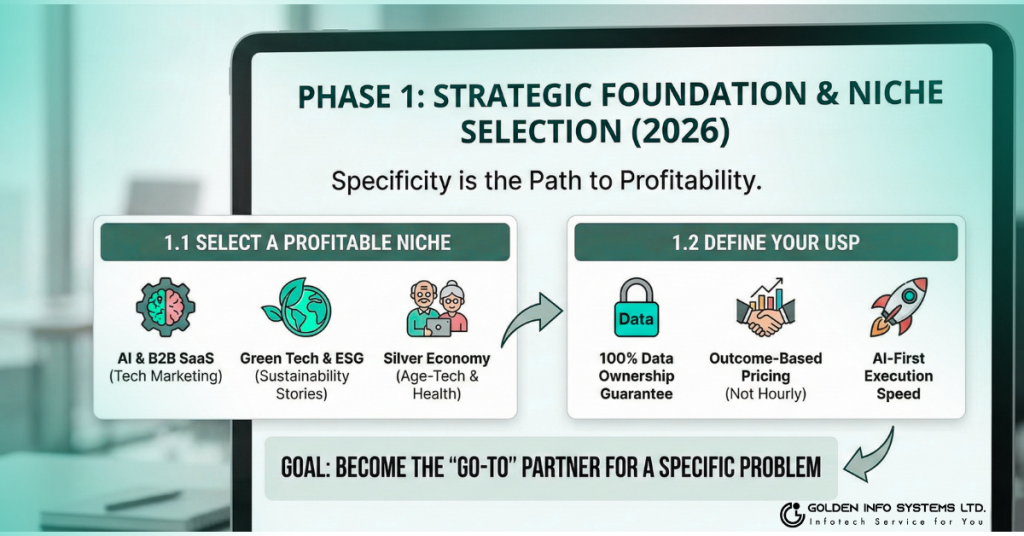
Before you hire a single person or build a website, you need a strategy. A hub without a clear focus is just a group of people waiting for work.
What is a “Freelance Services Hub”? (Vs. an Agency)
While the terms are often used interchangeably, there’s a subtle but important distinction for someone starting out:
- Traditional Agency: Typically has full-time employees, a physical office, high overhead, and sells its own in-house capabilities.
- Freelance Services Hub: A more agile model. You act as the central brain—the strategist, project manager, and client face. The execution is done by a curated network of high-quality freelancers (your “nodes”) who you partner with on a project basis.
Why the Hub model works for Bangladesh in 2026:
- Low Overhead: You don’t need a fancy office in Gulshan or Banani. You can run a world-class hub entirely remotely.
- Access to Talent: You have a massive pool of skilled local freelancers to draw from, allowing you to assemble “dream teams” for specific projects without the commitment of full-time salaries.
- Flexibility: You can scale up or down instantly based on project flow.
Your role shifts from “doer” to “manager and seller.” You own the client relationship, the quality control, and the final delivery.
Niche Selection: Moving Beyond Commoditized Skills
The biggest mistake new hubs make is trying to do everything. “We do SEO, graphics, web design, and data entry.” This is a recipe for disaster in 2026. Generalist skills are a race to the bottom on price.
You must build a Specialized Hub.
Profitable Niches for 2026 (Bangladesh Context):
- AI Implementation & Automation: Don’t just offer “writing.” Offer to build custom AI assistants for businesses, automate their customer support workflows using tools like ChatGPT APIs, or create AI-generated visual assets at scale. This is a massive growth area.
- E-commerce Growth for Specific Platforms: Instead of generic “digital marketing,” become the expert hub for “Scaling Shopify stores for US-based pet brands” or “Amazon FBA listing optimization and PPC management.”
- High-End B2B Content & Strategy: Move away from $5 blog posts. Build a hub of subject-matter experts (e.g., freelancers with finance or engineering backgrounds) who can create white papers, case studies, and technical documentation for global B2B companies.
- No-Code/Low-Code Development: Build a hub focused on creating MVPs (Minimum Viable Products), internal tools, and websites using platforms like Webflow, Bubble, or Airtable. This allows for faster, cheaper development that clients love.
The Rule: Choose a niche where you solve an expensive problem for a specific type of client.
The “Smart Bangladesh” Advantage in 2026
Leverage the national narrative. Bangladesh is rebranding itself as a hub for digital innovation. Use this in your marketing.
- Cost-Effective Quality: You can offer premium services at rates that are highly competitive globally, providing “global arbitrage” for your clients. A $5,000 project for a US client is a massive win for a Bangladeshi hub, but a budget-friendly option for them.
- A Hungry Workforce: The sheer volume of young, tech-savvy individuals entering the workforce means you will never have a shortage of talent to recruit into your hub.
- Government Incentives: Keep an eye on BASIS (Bangladesh Association of Software and Information Services) and government programs that offer tax holidays or cash incentives on digital exports. Position your hub to take advantage of these.
Phase 2: Legal & Financial Infrastructure (The Bangladeshi Context)
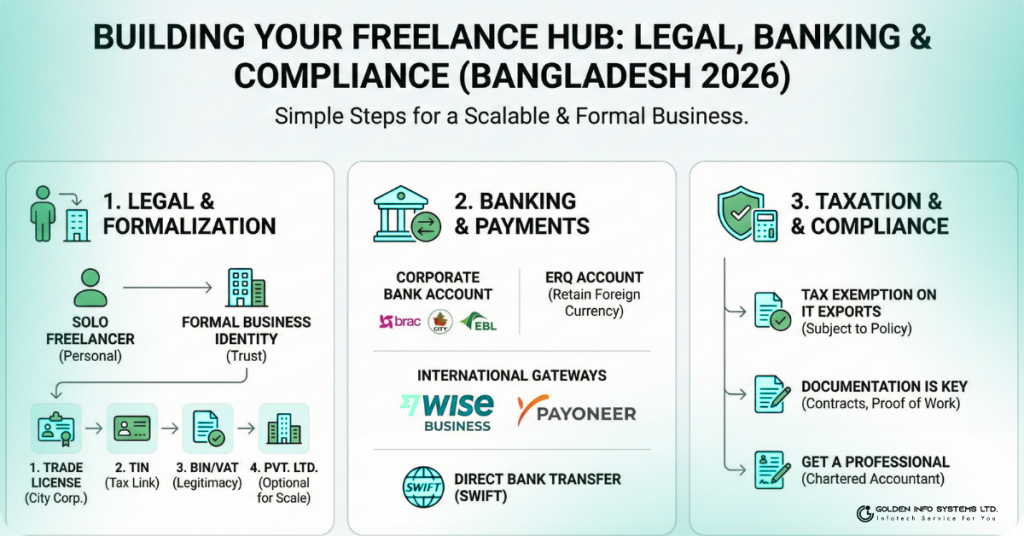
This is where many aspiring hub owners get stuck. Moving from a personal freelancer profile to a business entity requires navigating Bangladesh’s bureaucratic landscape. In 2026, formalization is more important than ever for scalability.
From Individual to Entity: Trade License & Registration
As a solo freelancer, you likely operate under your personal name. To build a hub, you need a formal business identity. This builds trust with international clients and is necessary for local banking.
- Step 1: Trade License: Get a Trade License from your local City Corporation or Municipality. The category should be relevant, like “IT Enabled Services” or “Software Development.” This is the foundational document for any business.
- Step 2: TIN (Tax Identification Number): You likely already have a personal TIN. You will need to ensure your business is properly linked for tax purposes.
- Step 3: BIN (Business Identification Number) / VAT Registration: While many digital export services are currently VAT-exempt, having a BIN is increasingly becoming a requirement for formal business operations and opening corporate bank accounts. It signals legitimacy.
- Step 4 (Optional but Recommended for Scale): Consider registering as a Private Limited Company with the RJSC (Registrar of Joint Stock Companies and Firms). This provides liability protection and makes it easier to bring on partners or investment later. It also carries more weight with large international enterprise clients.
Banking & International Payments: Solving the Biggest Pain Point
Getting paid smoothly from international clients and then distributing payments to your freelance team has historically been the biggest headache in Bangladesh. By 2026, the situation has improved, but you need the right setup.
- The Corporate Bank Account: Once you have your Trade License, open a dedicated business account. Do not mix personal and business finances. Banks like Brac Bank, City Bank, and EBL have specific desks and products for IT/freelance businesses.
- Exporter Retention Quota (ERQ) Account: This is crucial. An ERQ account allows you to retain a significant portion (usually up to 60-70%) of your foreign currency earnings in USD or EUR. You can use this balance to make international payments for software subscriptions (Zoom, project management tools), hosting, or even paying international contractors without needing Bangladesh Bank permission for every transaction.
- International Payment Gateways:
- Wise Business (formerly TransferWise): A must-have. It gives you local bank details in the US, UK, Europe, etc., making it incredibly easy for clients to pay you via local bank transfer. You then withdraw to your Bangladeshi business account at great exchange rates.
- Payoneer: Still a dominant player, especially for platforms like Upwork and Fiverr. Their “Global Payment Service” functions similarly to Wise.
- Direct Bank Transfer (SWIFT): For larger contracts with enterprise clients, direct wire transfers to your corporate account are standard. Ensure your bank is efficient at handling inward remittances and issuing the necessary encashment certificates.
Taxation and Compliance for Digital Exporters
- Tax Exemption on IT Exports: As of the current policy framework leading into 2026, income generated from exporting certain IT and IT-enabled services (ITES) enjoys a tax exemption. Crucial Note: This is subject to change and requires strict documentation. You must be able to prove the income is from foreign sources against service exports.
- Documentation is Key: For every payment you receive, maintain a clear paper trail: the contract/invoice with the foreign client, proof of work delivered, and the bank encashment certificate showing the inward remittance.
- Get a Professional: Do not try to handle corporate taxes yourself. Hire a chartered accountant firm that specializes in the IT sector to ensure you remain compliant and can avail of all tax benefits.
Phase 3: Building the Engine – Operations, Talent, and Tech
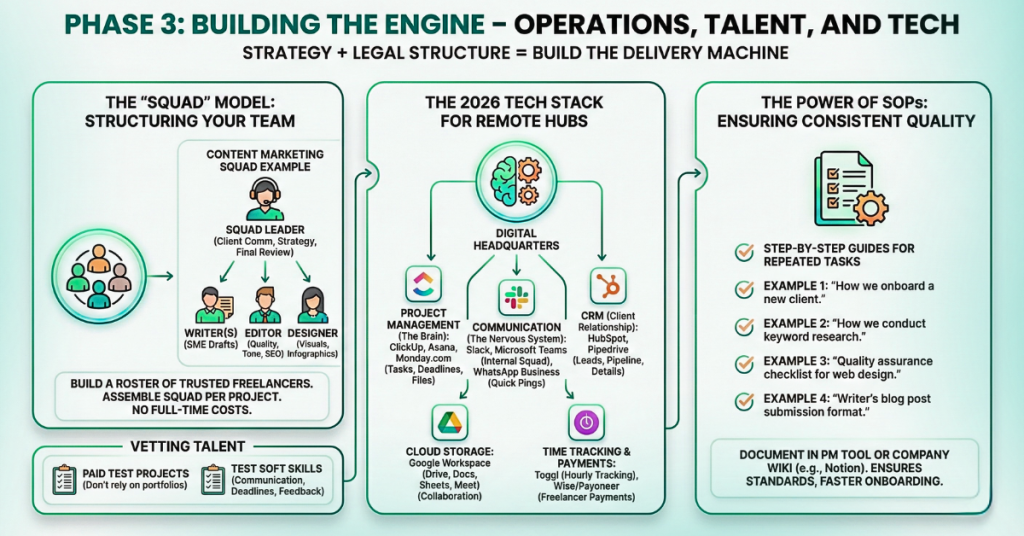
You have a strategy and a legal structure. Now you need to build the machine that delivers the work.
The “Squad” Model: Structuring Your Team
Don’t just hire a bunch of random freelancers. Structure them into functional units. A “Squad” is a small, cross-functional team designed to deliver a specific type of project.
- Example: A “Content Marketing Squad”
- Squad Leader (You or a Project Manager): Client communication, strategy, final review.
- Writer(s): Subject matter experts producing the drafts.
- Editor: Ensures quality, tone, and SEO optimization.
- Designer: Creates accompanying visuals or infographics.
You build a roster of trusted freelancers for each role. When a project comes in, you assemble the appropriate squad. This ensures you have the right skills for the job every time without carrying the cost of full-time staff.
Vetting Talent:
- Don’t rely just on portfolios. Give paid test projects.
- Test for soft skills: communication, adherence to deadlines, and ability to take feedback. These are often more critical than raw technical skill.
The 2026 Tech Stack for Remote Hubs
You need a digital headquarters to keep everything organized.
- Project Management (The Brain): ClickUp, Asana, or Monday.com. Everything must live here—tasks, deadlines, files, and communication related to specific projects. No more managing projects via email threads.
- Communication (The Nervous System): Slack or Microsoft Teams for internal squad communication. Set clear protocols (e.g., “no client talk in general channels”). Use WhatsApp Business only for quick client pings, but move substantial discussions to email or your PM tool.
- CRM (Client Relationship Management): HubSpot (free tier is great to start) or Pipedrive to track leads, manage your sales pipeline, and store client details.
- Cloud Storage: Google Workspace (Drive, Docs, Sheets, Meet) is the industry standard for collaboration.
- Time Tracking & Payments: Tools like Toggl for tracking time (if billing hourly) and Wise/Payoneer for paying your freelance team.
The Power of SOPs: Ensuring Consistent Quality
The biggest risk of a hub model is inconsistent quality. The solution is Standard Operating Procedures (SOPs).
An SOP is a step-by-step guide for a specific task. You need an SOP for everything you do repeatedly:
- “How we onboard a new client.”
- “How we conduct keyword research.”
- “Our quality assurance checklist for web design before delivery.”
- “How a writer should format a blog post for submission.”
Document these in your project management tool or a company wiki (like Notion). This ensures that no matter which freelancer does the work, the output meets your hub’s standards. It also makes onboarding new freelancers much faster.
Phase 4: Client Acquisition – Selling the Collective Value
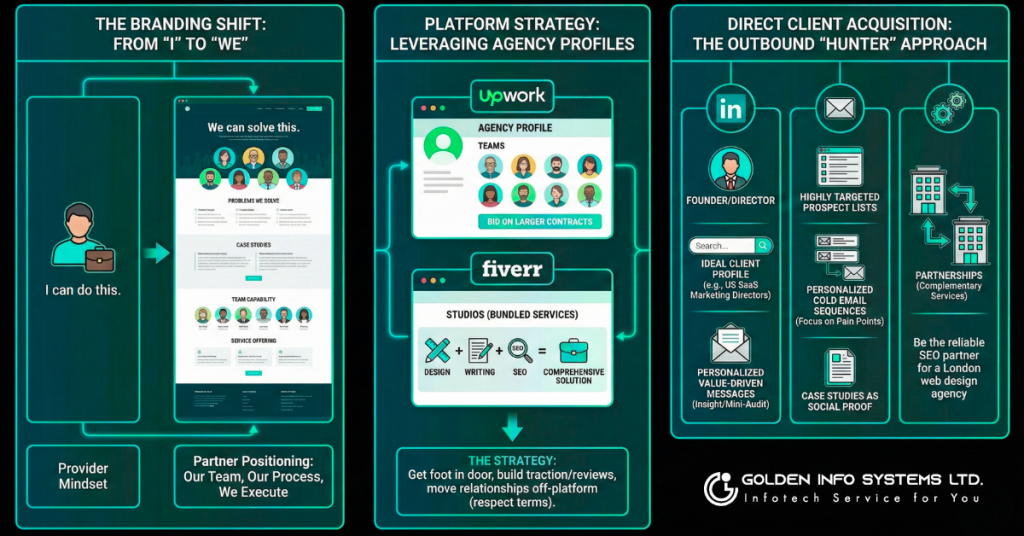
You are no longer selling “I can do this.” You are selling “We can solve this.”
The Branding Shift: From “I” to “We”
- Website: You need a professional agency website. It shouldn’t be about you; it should be about the problems you solve for your clients. Show case studies, testimonials that speak to the team’s capability, and a clear service offering.
- Positioning: Position yourself as a “Partner,” not just a “Provider.” You are here to help them grow their business, not just complete a task. Use language like “Our team,” “Our process,” and “We execute.”
Platform Strategy: Leveraging Agency Profiles (Upwork/Fiverr)
Don’t abandon the platforms that built Bangladesh’s freelancing reputation, but use them differently.
- Upwork Agency: Create an Agency profile on Upwork. Add your best freelancers to your agency roster. This allows you to bid on larger, agency-tier contracts that are hidden from individual freelancers. The client sees the collective strength of your team.
- Fiverr Studios (or equivalent): Utilize features that allow you to bundle services from multiple sellers into a single “Studio” gig, offering a more comprehensive solution.
- The Strategy: Use platforms to get your foot in the door, build initial traction and reviews for your hub, and then try to move successful relationships off-platform for long-term engagements (always respecting platform terms of service).
Direct Client Acquisition: The Outbound “Hunter” Approach
To build a truly scalable hub, you cannot rely solely on inbound platform leads. You must hunt.
- LinkedIn Lead Generation: This is your most powerful tool for B2B.
- Optimize your personal profile as the “Founder/Director” of your hub.
- Identify your ideal client profile (e.g., “Marketing Directors at US-based Series A SaaS startups”).
- Use Sales Navigator to build prospect lists.
- Send personalized connection requests and value-driven messages. Don’t just pitch; offer a relevant insight or a free mini-audit of their current setup.
- Cold Email: Build highly targeted lists of prospects in your niche. Craft personalized cold email sequences that focus on a specific pain point you’ve identified in their business. Use case studies as social proof.
- Partnerships: Partner with other agencies that offer complementary services. A web design agency in London might need a reliable SEO partner to refer clients to. Be that partner.
Phase 5: Scaling and Future-Proofing Your Hub
Once you have a steady stream of projects and a reliable team, it’s time to scale.
Integrating AI into Your Workflows
In 2026, if you aren’t using AI, you are already behind. You shouldn’t fear AI replacing you; you should use AI to replace inefficient parts of your process.
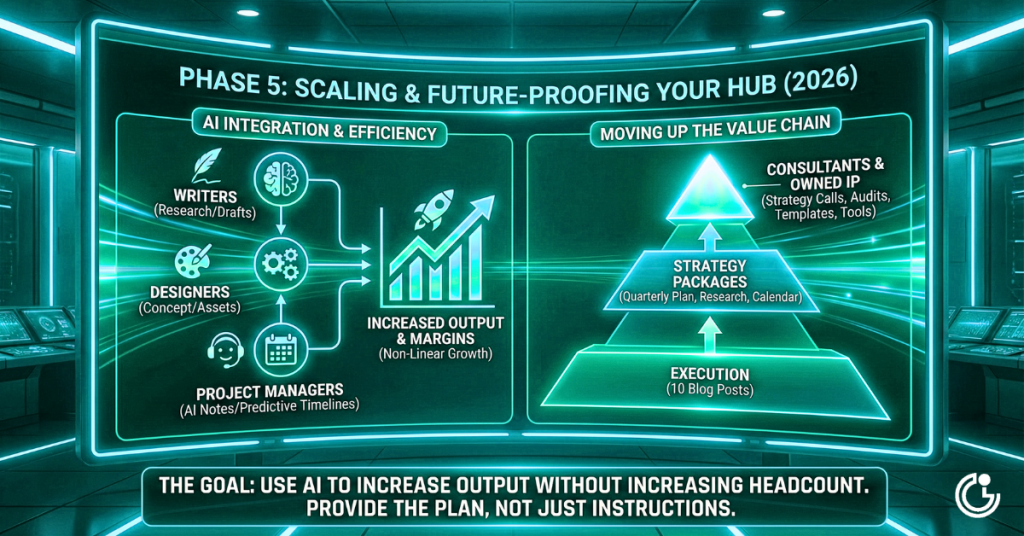
- For Writers: Use AI for research, outlining, and generating initial drafts to speed up production, allowing them to focus on creativity, tone, and final polish.
- For Designers: Use AI image generators for concept art, storyboarding, or creating background assets.
- For Project Managers: Use AI note-takers in meetings (like Otter.ai or Fireflies.ai) to automatically generate summaries and action items. Use AI within your PM tool to predict project timelines and identify bottlenecks.
- The Goal: Use AI to increase your hub’s output and margins without linearly increasing your headcount.
Moving Up the Value Chain: From Execution to Strategy
The highest paid hubs don’t just follow instructions; they provide the plan.
- Shift your Offering: Instead of just selling “10 blog posts a month,” sell a “Quarterly Content Strategy & Execution Package.” This involves keyword research, competitor analysis, content calendar planning, and the execution.
- Become Consultants: Charge for your brain. Offer paid strategy calls, audits, and consulting packages. This positions you as an authority and often leads to high-ticket execution contracts.
- Build Your Own IP: Create templates, frameworks, or even simple software tools that you use internally and can eventually sell as products. This detaches your revenue from purely service-based hours.
Conclusion: Your 90-Day Launch Roadmap
Building a hub is a marathon, not a sprint. Here is a practical 90-day plan to get started:
- Month 1: Foundation & Legal
- Define your niche and ideal client profile.
- Get your Trade License and open a corporate bank account.
- Set up your ERQ account for international payments.
- Build your basic agency website and branding.
- Month 2: Team & Tech
- Set up your project management and communication tools (ClickUp, Slack, etc.).
- Create your first 3-5 essential SOPs.
- Vet and onboard your first “core squad” of 3-5 reliable freelancers.
- Create your Upwork Agency profile.
- Month 3: Acquisition & Launch
- Launch your LinkedIn outbound campaign.
- Start bidding on agency-level contracts on Upwork.
- Land your first 1-3 “hub” clients.
- Deliver exceptional work, gather testimonials, and refine your processes based on real-world feedback.
The opportunity for Bangladesh in the global digital services market is immense. By shifting your mindset from a solo freelancer to a hub builder, professionalizing your operations, and strategically targeting high-value niches, you can build a sustainable, scalable business that is ready for the challenges and opportunities of 2026 and beyond. Start today.
Frequently Asked Questions (FAQs)
Q1: How much capital do I need to start a freelance hub? A: Your primary costs will be business registration (approx. BDT 5,000-10,000), website hosting, and subscriptions for your tech stack (PM tool, CRM, etc., which might run $50-$100/month initially). You don’t need to pay freelancer salaries until you have a paying client project.
Q2: Do I need a physical office? A: No. In 2026, a fully remote hub is perfectly acceptable and often preferred for its lower overhead. You can use co-working spaces if you occasionally need a physical meeting location.
Q3: How do I trust freelancers I’ve never met in person? A: Vetting is key. Use paid test projects. Start with small tasks before handing over large client projects. Use time-tracking software with screenshots if necessary for hourly work, but focus more on output and meeting deadlines. Build relationships over time; trust is earned.
Q4: How do I handle quality control when I’m not doing the work myself? A: This is where SOPs and the Squad Leader role come in. Never deliver work directly from a freelancer to a client. It must always pass through an internal review process (by you or a dedicated editor/QA person) against your defined quality checklist.
Q5: Can I still freelance as an individual while building my hub? A: Yes, and it’s often a good transition strategy. Keep your personal income flowing while you build the hub’s infrastructure and client base on the side. Once the hub’s revenue becomes sustainable, you can fully transition.